

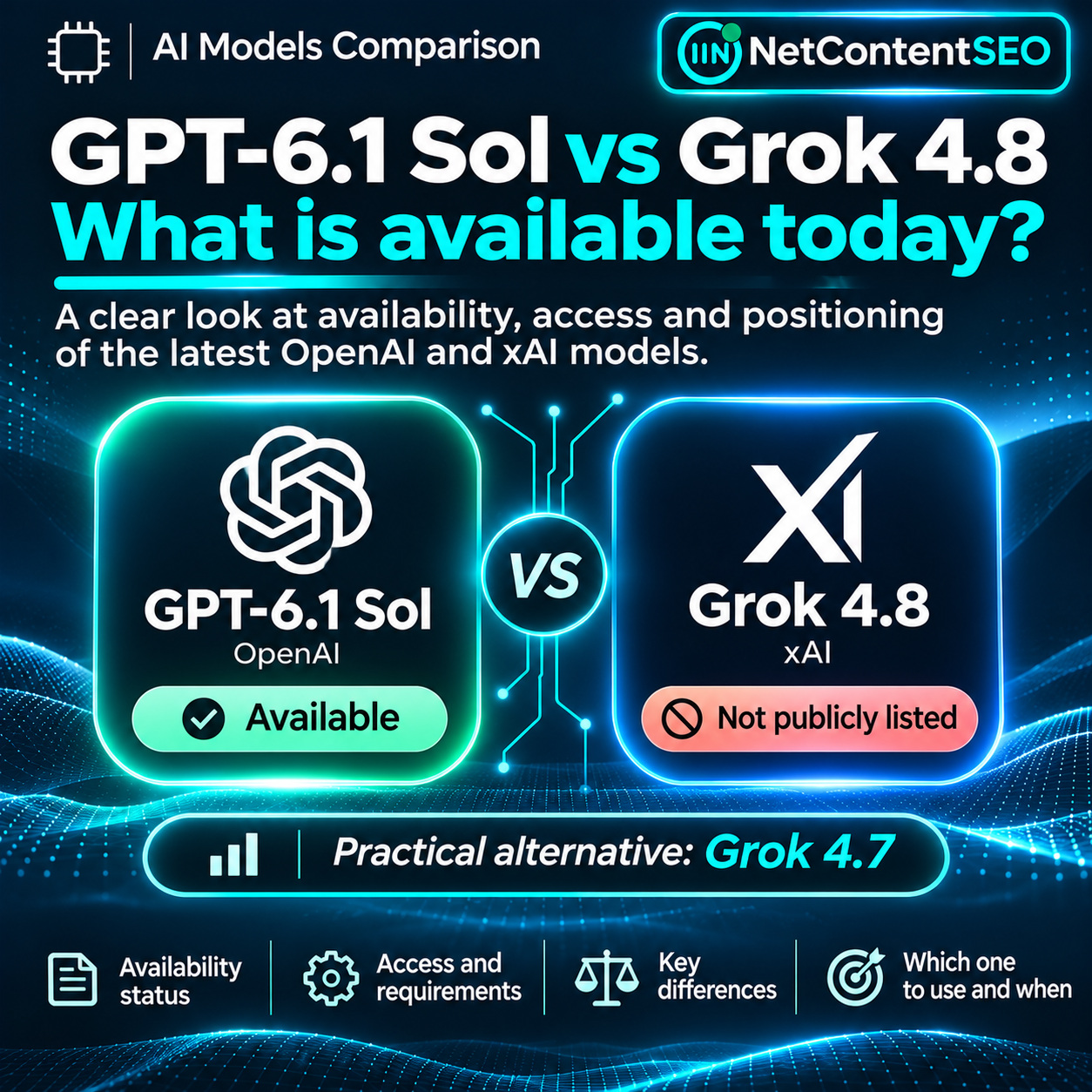

Updated November 5, 2026. A comparison between GPT-6.1 Sol and Grok 4.8 has a fundamental limitation: OpenAI publishes an official API model page for GPT-6.1 Sol, while the current public xAI model catalogue and release notes do not list a released Grok 4.8 model. There is therefore no verified Grok 4.8 API price, benchmark score, context window or release date to compare. The practical alternative available today is Grok 4.7.
An OrcaRouter analysis published November 4 frames this as a decision about shipping now versus waiting for an unannounced release. Its broader point is useful, but production teams should separate official specifications, third-party benchmark measurements and predictions. This guide explains what can be verified, what remains uncertain, and how to choose a model for an actual workload.
Quick answer: which model should you use?
If you need a publicly documented, callable model now, GPT-6.1 Sol and Grok 4.7 are real options; Grok 4.8 is not yet publicly documented as an available API model as of November 5. GPT-6.1 Sol is a strong candidate for complex reasoning and tool-based work. Grok 4.7 deserves testing when output throughput, lower listed output-token price or a specific coding workload matters. Neither should be declared universally superior without running your own evaluation.
If your project depends specifically on Grok 4.8, do not build around an assumed model ID or release date. Keep the model selection configurable, run tests against available alternatives, and reassess after xAI publishes an official model page and pricing.
What is confirmed and what is not?
| Question | GPT-6.1 Sol | Grok 4.7 | Grok 4.8 |
|---|---|---|---|
| Official public API model listing | Yes: gpt-6.1-sol | Yes: grok-4.7 | Not listed as of Nov. 5 |
| Documented input/output price per 1M tokens | $2 / $10 | $2 / $6 for prompts below 200K tokens | Not published |
| Cached input per 1M tokens | $0.10 | $0.50 below 200K prompt tokens | Not published |
| Published context window | 1,050,000 tokens | 500,000 tokens | Not published |
| Official release documentation | Available | Available | No public release note identified |
Sources: OpenAI model documentation, xAI models, and xAI release notes. Model availability and prices can change, so confirm them again before deployment.
What has actually been said about Grok 4.8?
OrcaRouter attributes preliminary claims about a future Grok 4.8 to Elon Musk, including a roughly 2.5-trillion-parameter figure, an expected training milestone and a later acknowledgement that development was taking longer than anticipated. The article also describes unverified model-picker strings reportedly seen by a tracker. These are not equivalent to an official API launch, published model card or independent benchmark.
A model-picker string can indicate experimentation or internal preparation, but it does not guarantee public access, a stable model identifier or an imminent launch. Parameter count is likewise not a reliable proxy for real-world quality, latency or cost per successful task. No responsible cost comparison can assign Grok 4.8 a price or performance score before credible data exists.
GPT-6.1 Sol vs Grok 4.7: specifications that matter
OpenAI documents GPT-6.1 Sol with a 1,050,000-token context window, up to 128,000 output tokens and support for reasoning effort levels low, medium, high, xhigh and max. It supports tools through the Responses API; teams migrating tool workflows from Chat Completions should check endpoint compatibility rather than assume the model identifier is the only change.
xAI documents Grok 4.7 with a 500K-token context window, configurable reasoning effort and text/image input. Its release notes describe no text output limit, which should not be interpreted as a guarantee that arbitrarily large responses will always complete: actual serving, token budget and application constraints still apply. The 450K maximum-output figure in OrcaRouter's comparison should therefore be treated as a router-specific or reported claim, not as an official universal limit.
Both vendors impose pricing conditions on long prompts. OpenAI says requests exceeding 272K input tokens are repriced at twice the input and cache rates and 1.5 times the output rate for the full request. xAI's Grok 4.7 release notes say rates double when prompts exceed 200K tokens. Teams processing long documents should model these thresholds explicitly.
What do independent benchmarks actually show?
OrcaRouter reports an Artificial Analysis Intelligence Index v5.0.1 comparison of 55 for GPT-6.1 Sol and 35 for Grok 4.7 at the maximum published effort, along with $1.27 versus $7.77 per completed index task. These are attributed figures for a particular evaluation configuration and version, not a universal quality or production-cost guarantee.
At the time of review, the public Artificial Analysis xhigh-to-xhigh comparison displays 52 for GPT-6.1 Sol and 35 for Grok 4.7, with costs of $0.76 and $7.77 per task respectively. The discrepancy between Sol's 55 and 52 is explained by differing effort configurations and/or reported evaluation views; these numbers must not be presented as the same test. The defensible conclusion is that the cited independent index favors Sol on aggregate reasoning capability, while results for individual tasks can differ.
The same public comparison shows Grok 4.7 generating output at about 72 tokens per second versus 57 for Sol at xhigh. But generation speed is only one component of latency. Time to first token, reasoning time, tool-call delays, network conditions and output length determine end-to-end completion time. A faster stream does not necessarily produce a faster successful workflow.
Why price per token can be misleading
At published standard API rates, Grok 4.7's output tokens cost $6 per million versus Sol's $10, a 40% lower unit rate. Yet an agent that reasons longer or retries more often may consume enough additional tokens to cost more overall. OrcaRouter's reported index cost-per-task gap illustrates that possibility, but it is a benchmark result, not a forecast for every application.
For a simple fixed-token scenario, suppose an application processes 50,000 requests monthly, each using 15,000 input tokens and 3,000 output tokens, with no caching, tools, retries or long-context surcharges. At the listed prices:
- GPT-6.1 Sol: 15,000 × $2/1M + 3,000 × $10/1M = $0.06 per request, or $3,000 for 50,000 requests.
- Grok 4.7: 15,000 × $2/1M + 3,000 × $6/1M = $0.048 per request, or $2,400 for 50,000 requests.
In that narrowly defined scenario, Grok 4.7 is $600 cheaper monthly. This calculation assumes identical token consumption and successful completion rates. If the models use different reasoning budgets, tool calls or retries, the actual ranking can reverse. A production estimate should use cost per accepted result, not only the published output-token rate.
How to calculate your own cost per successful task
Collect at least 100 representative prompts for each important workflow, including ordinary cases, ambiguous requests, long documents, difficult coding tasks and failure-prone inputs. Run the same test set against both available models with comparable instructions, tool access and quality criteria.
Record input tokens, cached input, output and reasoning tokens where exposed, tool charges, latency, retry count and whether the result passed review. Then calculate total spend ÷ number of accepted results. For example, if a model costs $30 to process 100 tasks but only 75 pass validation, its cost per accepted result is $0.40, not $0.30. A second model costing $35 with 95 accepted results costs about $0.37 per accepted result and is cheaper in practice.
Keep pricing tiers and prompt lengths in the evaluation. A model that wins on 10K-token prompts may be more expensive on 300K-token inputs after long-context surcharges. Include a separate benchmark for cached repeated instructions if your application uses substantial prompt caching.
Which model should you choose for common workloads?
Complex coding and multi-step agents: Start by testing GPT-6.1 Sol because the cited independent reasoning index and several task-specific evaluations favor it. Verify the advantage on your own repositories, tools and acceptance tests before migrating production traffic.
Latency-sensitive chat and short interactive outputs: Test Grok 4.7 as a candidate because of its reported higher output generation speed and lower standard output-token price. Measure complete response latency, not just tokens per second.
Long-document analysis: Sol's documented 1.05M-token context window offers more headroom than Grok 4.7's 500K. However, very large prompts can trigger higher rates and degrade practical performance. Use retrieval, chunking or summarization when these approaches improve cost and reliability.
Very large generated artifacts: Check the required output size against Sol's documented 128K-token maximum and the effective limits of the Grok deployment you plan to use. For large structured outputs, streaming and staged generation are often safer than assuming a single giant response will finish correctly.
Teams waiting for Grok 4.8: Ship a configurable integration with available models now unless a confirmed business requirement specifically depends on an unreleased capability. Re-evaluate Grok 4.8 only after its official documentation and independently measured performance become available.
Implementation checklist: test before switching
- Confirm both model IDs in the vendors' official API documentation and verify account access, rate limits and regional availability.
- Use the appropriate endpoint for tools; GPT-6.1 Sol tool calling requires the Responses API.
- Prepare a versioned evaluation dataset with pass/fail criteria and human-reviewed edge cases.
- Run tests at documented reasoning-effort settings, labeling the settings clearly in every result.
- Record p50 and p95 end-to-end latency, output quality, retries, token consumption and total cost.
- Test prompts on both sides of the 200K and 272K long-context pricing thresholds when relevant.
- Roll out a small percentage of traffic first, monitor failures and preserve an immediate rollback path.
Do not rely solely on one public benchmark or on a router's promotional comparison. Public leaderboards are useful for selecting candidates; internal evaluations decide whether a model is fit for your application.
Common questions
Is Grok 4.8 released?
As of November 5, 2026, it is not listed as an available model in the official public xAI model catalogue or release notes checked for this article. That does not prove no private testing exists. It means a public API release cannot be confirmed from those sources.
When will Grok 4.8 launch?
No verified public release date was available from the checked official documentation. Predictions and reported internal strings should not be used as delivery commitments.
Is GPT-6.1 Sol better than Grok 4.7?
In the cited Artificial Analysis reasoning index, Sol scores higher. Whether it is better for a particular application depends on coding accuracy, tools, latency, output requirements, reliability and cost per accepted task.
Which one is cheaper?
Grok 4.7 has a lower published standard output-token price. That does not guarantee a lower bill for tasks requiring more reasoning tokens or retries. Compare measured cost per successful result on your workload.
Can I compare Grok 4.8 benchmark scores today?
No reliable, independently verified Grok 4.8 benchmark score was identified in the checked sources. Avoid comparison charts assigning it precise scores or prices before publication.
What should I do next?
For an immediate deployment, shortlist GPT-6.1 Sol and Grok 4.7, run a representative evaluation, calculate cost per accepted result and deploy the winner behind a configurable model interface. Monitor the official xAI release notes for a future Grok 4.8 announcement rather than relying on an estimated launch window.
Bottom line
The most useful comparison is not a speculative head-to-head with an unpublished model. It is a transparent evaluation of two documented choices available today. GPT-6.1 Sol has stronger scores in the cited aggregate reasoning evaluations; Grok 4.7 offers a lower output-token rate and competitive streaming speed. The right choice is the one that completes your real tasks reliably at an acceptable total cost.
For AI engineering, the durable advantage is not predicting the next model launch. It is building an evaluation and routing process that makes switching models safe when the evidence changes.
Sources and verification
- OrcaRouter, “GPT-6.1 Sol vs Grok 4.8,” November 4, 2026 — secondary analysis and attributed benchmark figures.
- OpenAI API, GPT-6.1 Sol model documentation — official availability, context, output and pricing.
- xAI official models and release notes — Grok 4.7 specifications and public release status.
- Artificial Analysis, GPT-6.1 Sol (xhigh) vs Grok 4.7 (xhigh) — independent benchmark comparison; configuration-specific.