

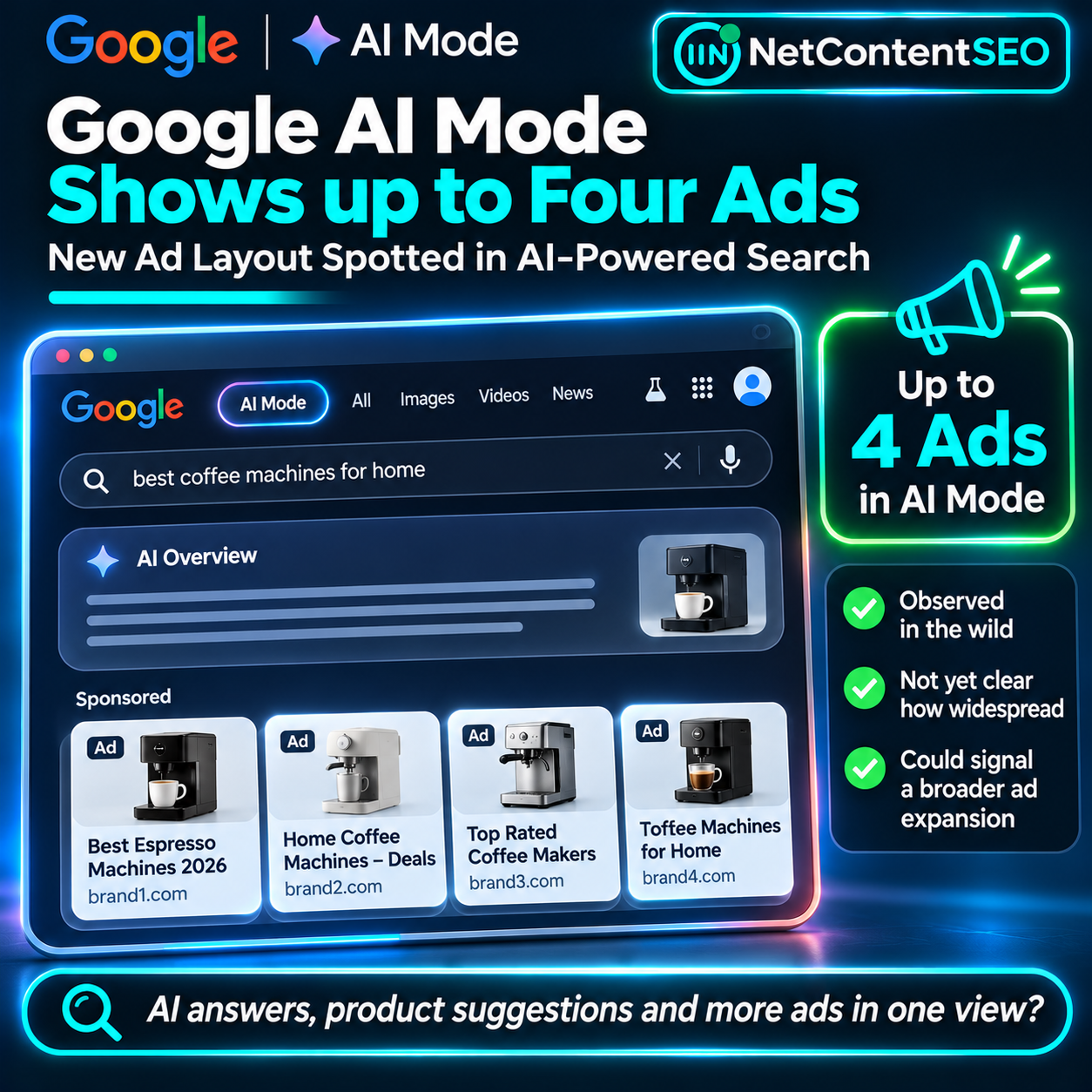

Google AI Mode has been spotted displaying four sponsored text ads beneath a single AI-generated answer. The example, reported by Barry Schwartz at Search Engine Roundtable on November 4, 2026 and originally highlighted by Sachin Patel of Search Engine Watch, suggests that Google's conversational search interface can accommodate a denser block of advertising than observers had typically seen. It does not establish that four ads are now the default, that the format is widely deployed, or that Google has officially raised an AI Mode ad limit.
The distinction is crucial for both SEO and PPC teams. A documented screenshot shows what can appear in one response; it cannot, by itself, establish how frequently that configuration appears across queries, users, countries or devices.
What was observed in Google AI Mode?
The documented AI Mode response concerned AI SEO and included a group of four sponsored placements beneath the generated answer. The advertisers visible in the reported example were eintelligenceweb, HubSpot, Yext and Siteimprove, all promoting services or tools related to AI search visibility. The ads appeared in a labeled sponsored section, while organic sources were shown separately in the AI Mode interface.
Schwartz noted that he had more commonly seen one or two ads, sometimes three. A separate observation of three-ad groupings had circulated in October. Those are anecdotal observations, not a statistically representative baseline. The reported four-ad example also does not identify a confirmed rollout percentage, the exact search query or all geographic and device conditions.
Google has not publicly confirmed whether this precise four-ad arrangement is a new test, a broader rollout, or an existing configuration observed more visibly. Schwartz himself cautioned that four search ads are not inherently new to Google: traditional search has supported four top text ads for commercial queries since 2016.
Four ads in AI Mode: why the context matters
AI Mode differs from a classic results page because it combines a generated answer, source links, follow-up questions and potentially paid placements in a conversational interface. Four ads beneath one answer may affect the visual balance of that experience, especially when users are deciding whether to follow a cited source or a sponsored recommendation.
However, an increased number of visible ads does not automatically prove that organic links receive fewer clicks. That would require controlled click data or comparable measurements across layouts. The position of ads, screen size, query intent and answer length all affect what users see and do.
The example is notable because the advertisers themselves were selling AI visibility services. It illustrates how commercial demand for GEO, AEO and AI SEO products can appear directly beside AI-generated answers discussing that market.
Google is expanding advertising across AI search
The observation comes amid a broader, documented expansion of Google advertising in AI-powered search. Google announced additional AI Mode ad markets and multiturn advertising in the United States in late October 2026. Multiturn ads can appear in responses to follow-up questions, extending paid visibility beyond a user's first query.
Google's official Ads Help documentation says that ads may appear within or alongside AI Overviews and AI Mode responses when the interaction has commercial relevance. Placements are labeled Sponsored, and Google says paid advertising does not influence the independently generated organic AI response.
These official statements support the conclusion that AI Mode is an expanding advertising surface. They do not establish a universal four-ad cap or disclose the frequency of four-ad groups.
Why monetization is part of the story
During Alphabet's late-October earnings discussion, Google's chief business officer Philipp Schindler acknowledged that AI Mode queries currently monetize at a lower rate than traditional Search queries. The company also discussed expanding AI ads to more users and queries.
That creates an understandable commercial incentive to test additional inventory and ad layouts. Yet there is an important distinction between ad reach, the proportion of users or queries eligible to see ads, and ad density, the number of ads shown in a particular response. The four-ad observation concerns density; Google's expansion announcements concern reach as well as new contexts such as follow-up turns.
It would be speculative to claim that the four-ad grouping was introduced specifically to compensate for lower monetization. Google has not publicly linked this exact layout to its financial results.
How Google matches ads to AI Mode responses
According to Google, ads in AI Overviews and AI Mode can be matched in two main ways. Direct query matching applies when a user's search clearly expresses commercial intent. Contextual matching can consider both the query and the AI-generated response, allowing relevant ads to appear when a longer exploratory question leads naturally toward a product or service.
Eligible existing Search, Shopping and Performance Max campaigns can participate through the normal Google Ads auction without advertisers creating a separate AI Mode campaign. Google says advertisers cannot exclusively target AI Mode or opt out of it separately from Search. Negative keywords and other existing campaign controls remain relevant.
Google also describes AI-generated explainers that may introduce sponsored options or provide context. These explainers are generated by Google's systems rather than written by advertisers. The four-ad screenshot reportedly includes introductory text in the sponsored section, but the available reporting does not conclusively establish whether that specific line was one of Google's formally defined AI explainers.
What this means for PPC advertisers
More potential ad slots may create additional opportunities to appear near commercially relevant AI responses. That is a plausible benefit, not a measured outcome. Without placement-level impression, click, conversion and cost data, it is impossible to know whether the fourth ad attracts incremental attention or simply redistributes clicks among advertisers.
Advertisers should monitor campaign-level trends while acknowledging that standard Google Ads reporting may not isolate every AI Mode placement. They should avoid treating changes in CPC, CTR or conversions as proof of a specific four-ad test unless more granular evidence is available.
Practical preparation still centers on high-quality landing pages, accurate product and service information, conversion measurement and campaign assets that match user intent. Google recommends AI-powered targeting approaches for contextual eligibility, but their suitability depends on campaign goals and measurement quality.
What this means for SEO and GEO
For organic search teams, the key issue is not simply the count of ads. It is how AI Mode allocates attention between generated answers, cited sources, sponsored options and the next conversational turn. A website may be cited as an information source without receiving a visit, while a sponsored placement may offer a more direct commercial path.
Organic citations and paid ads must be measured separately. Paying for an AI Mode ad does not buy inclusion in Google's organic AI-generated answer, according to Google's documentation. Conversely, being cited in an AI response does not guarantee ad auction eligibility or a click.
A sound AI visibility framework should distinguish at least four signals: presence in generated answers, citations or linked sources, paid visibility and attributable referral traffic. Mixing these into one number would make it difficult to determine whether a brand is earning authority, purchasing exposure or receiving actual visits.
How to evaluate ad density responsibly
Researchers studying this layout should collect a representative sample of AI Mode responses across clearly defined query categories, devices, locations and time periods. Each observation should record whether ads appeared, how many, where they were placed, whether the response included organic citations, and whether the query was informational or commercial.
Repeated tests are essential because AI Mode responses and ad auctions can vary. A single screenshot cannot support a claim that four ads are typical. Nor can it establish that the layout is new if historical examples were not systematically collected.
For publishers, any analysis of referral impact should use actual traffic evidence where possible and should avoid attributing a change to ad density alone. Seasonality, ranking changes, answer quality and query mix may also influence clicks.
What remains unconfirmed?
Google has not announced the share of AI Mode responses showing four ads, whether this exact layout is experimental or permanent, the markets where it appears, or whether four represents a formal maximum for the format. The observed example is a block of text ads, and it is not clear how other formats, such as Shopping placements, relate to any per-group limit.
These unanswered questions matter more than the temptation to turn one screenshot into a sweeping product announcement. The evidence supports a narrower and more useful conclusion: Google AI Mode has been observed showing four sponsored ads beneath a single answer.
The bigger picture
Google is evolving AI Mode into a search interface that can answer questions, guide follow-up exploration and surface commercial offers within the same journey. The four-ad observation is one visible sign of that evolution, not proof of a universal policy change.
For SEO and PPC professionals, the practical priority is to track paid exposure, organic citations and actual traffic as different outcomes. As advertising expands inside conversational search, the most important question will not be how many ads a single screenshot contains, but how these layouts affect user attention, publisher referrals and advertiser performance at scale.