

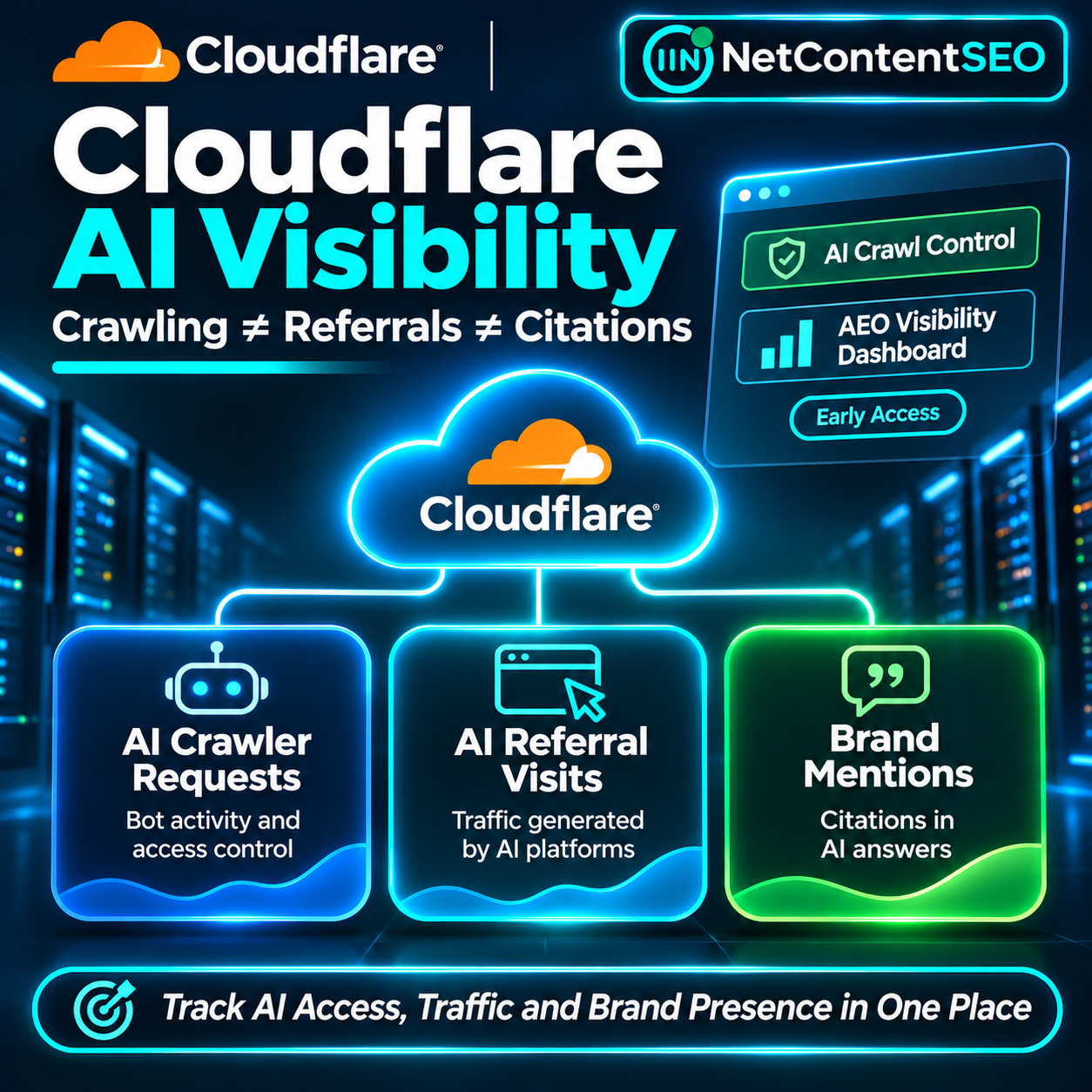

Cloudflare is bringing together several signals that have often been conflated in AI search reporting: whether AI crawlers can access a website, whether AI platforms send visitors back, and whether a brand appears in AI-generated answers. The distinction is fundamental. A crawler request is not a referral, and a brand mention is not necessarily a clickable citation.
In an October 26, 2026 Search Engine Land report, David Bell described a preview of Cloudflare's expanding tools at Cloudflare Connect. The company had already announced its AEO Visibility Dashboard on August 6, initially as an early-access product. Together with AI Crawl Control and Agent Readiness, the tools point toward a more layered approach to measuring AI discovery.
Three metrics, three different questions
AI crawling measures requests made to a website by identifiable automated agents. It can reveal which operators request content, which paths they access, the volume of bandwidth consumed and whether requests succeed or are blocked. It cannot establish that the fetched page was used to produce a particular AI answer.
AI referrals measure visits that arrive at a website from AI-related services, usually identified through referrer information or analytics attribution. They help quantify traffic returned to publishers, but they miss some visits when referrers are absent or stripped, including traffic from certain native apps. Referral counts are therefore not a complete census of AI-driven discovery.
AI citations and mentions concern the answers themselves. A citation links or attributes information to a source; a mention may simply name a brand without linking to its website. A model can mention a company without citing it, cite a page without generating a click, or retrieve content without naming either the publisher or its brand.
These signals answer different questions and should not be combined into one unqualified AI visibility number.
What AI Crawl Control can show
Cloudflare's AI Crawl Control documentation describes dashboards for request volume, allowed and unsuccessful requests, status codes, crawler operators, hostnames and frequently accessed paths. Paid-plan features include AI referral views, and the GraphQL Analytics API supports programmatic analysis. The tools can help distinguish crawling for training, search or agent purposes where classification data is available.
These network-layer observations are valuable because they capture activity at the edge rather than relying entirely on third-party estimates. However, a network log still cannot reveal every downstream use of retrieved content inside a model. The presence of GPTBot or another crawler in logs does not prove that a brand was recommended in a ChatGPT response.
What the AEO Visibility Dashboard adds
Cloudflare describes four answer-oriented measures in its AEO Visibility Dashboard: Citation Rate, Mention Rate, Prominence and Share of Voice. Citation Rate addresses whether AI assistants cite a website as a source. Mention Rate captures whether a brand is named even without a citation. Prominence considers where and how strongly a brand appears in an answer, while Share of Voice compares visibility against competitors for selected questions.
These metrics move beyond server access and referral counts into sampled or otherwise observed AI-answer behavior. They also introduce methodological questions: which prompts are tested, which assistants are included, how often are answers repeated, and how are citations and brand mentions classified? A useful dashboard must make those choices transparent because AI answers can vary by prompt wording, geography, account state and time.
The August announcement described early access, not unrestricted general availability. Bell's October preview demonstrated capabilities and future direction, but should not be interpreted as proof that every Cloudflare customer can already use every AEO reporting feature.
The crawl-to-refer ratio is useful, but incomplete
Cloudflare has popularized the crawl-to-refer ratio: crawler requests divided by referral visits from the corresponding AI ecosystem. For example, 10,000 crawler requests and 100 referrals yield a 100:1 ratio. This is a diagnostic comparison, not a conversion rate: the numerator is requests, not users or AI answers, and the denominator may omit unattributed visits.
Cloudflare's 2025 analysis explicitly cautioned that referrals from native applications may lack a Referer header, which can inflate apparent crawl-to-referral ratios. Operators also use different bots for different purposes, making simple cross-platform comparisons potentially misleading.
For publishers, the ratio can highlight heavy content access with limited measurable return. It cannot by itself establish that a crawler is harmful, that content was incorporated into training, or that an AI answer used a particular page.
Why this matters for SEO and GEO
Traditional SEO reports often focus on rankings, impressions, clicks and conversions. AI discovery adds additional stages: accessibility to crawlers, retrieval eligibility, answer inclusion, source citation, brand recommendation and referral behavior. A failure at one stage calls for a different diagnosis than a failure at another.
If a site receives no AI crawler requests, technical accessibility, bot rules and crawl controls may warrant review. If it is crawled but never cited in a representative answer sample, the question shifts toward relevance, source selection and content quality—although no single cause can be inferred automatically. If a brand is frequently mentioned but receives little referral traffic, the issue may concern answer format, link placement or user behavior rather than discoverability alone.
For organizations monitoring GEO performance, the most reliable approach is to maintain separate metrics for access, citations, mentions, referrals and business outcomes. A combined executive score can be useful for communication, but it should never conceal the underlying definitions and uncertainty.
How to build a defensible AI visibility dashboard
Start with crawler logs or Cloudflare AI Crawl Control to measure verified bot activity by operator, purpose, page type and status code. Record changes to access policies, robots.txt and firewall settings so apparent crawling trends can be interpreted correctly.
Next, compare AI referrals using Cloudflare's available referrer data, GA4 and server-side evidence where possible. Document attribution gaps, particularly for native applications and direct visits. Then run repeatable answer-level tests across relevant prompts and platforms, preserving the exact prompt, date, location, model or product, brand mentions and linked citations. Compare against competitors only within consistent samples.
Finally, connect the visibility layers to actual business outcomes: engaged sessions, leads, subscriptions or sales. High citation frequency may be strategically valuable, but it is not synonymous with incremental revenue. A source can be cited without a click, and a recommendation can influence a later direct visit that attribution tools do not connect to the original answer.
Cloudflare's advantage—and its limits
Cloudflare's network position gives it first-party visibility into requests and traffic for sites using its infrastructure, which can improve the reliability of crawling and referral measurements. Its AEO tools seek to pair that evidence with answer-level observations. This is a meaningful step toward better measurement, but no network provider has direct, complete visibility into every AI assistant's internal reasoning, private answer generation or all user interactions.
The central challenge for the industry remains data provenance: which metrics are directly observed, which are sampled, and which are inferred. Clear labeling matters more than presenting a single precise-looking score.
The takeaway
Cloudflare's evolving AI visibility suite illustrates a shift from generic GEO dashboards toward multi-layer measurement. Crawling shows access. Referrals show measurable traffic returned. Citations and mentions show presence in AI answers. None proves the others, and all require careful interpretation. For SEO teams and publishers, separating these signals is the first step toward making AI visibility reporting credible.
Sources
- David Bell, Search Engine Land, “Cloudflare will upend the AI visibility space,” October 26, 2026
- Cloudflare, AEO Visibility Dashboard announcement, August 6, 2026
- Cloudflare Developer Docs, Analyze AI traffic
- Cloudflare, Crawl-to-refer ratio research, July 2025
- Cloudflare, Attribution Business Insights, July 2026