

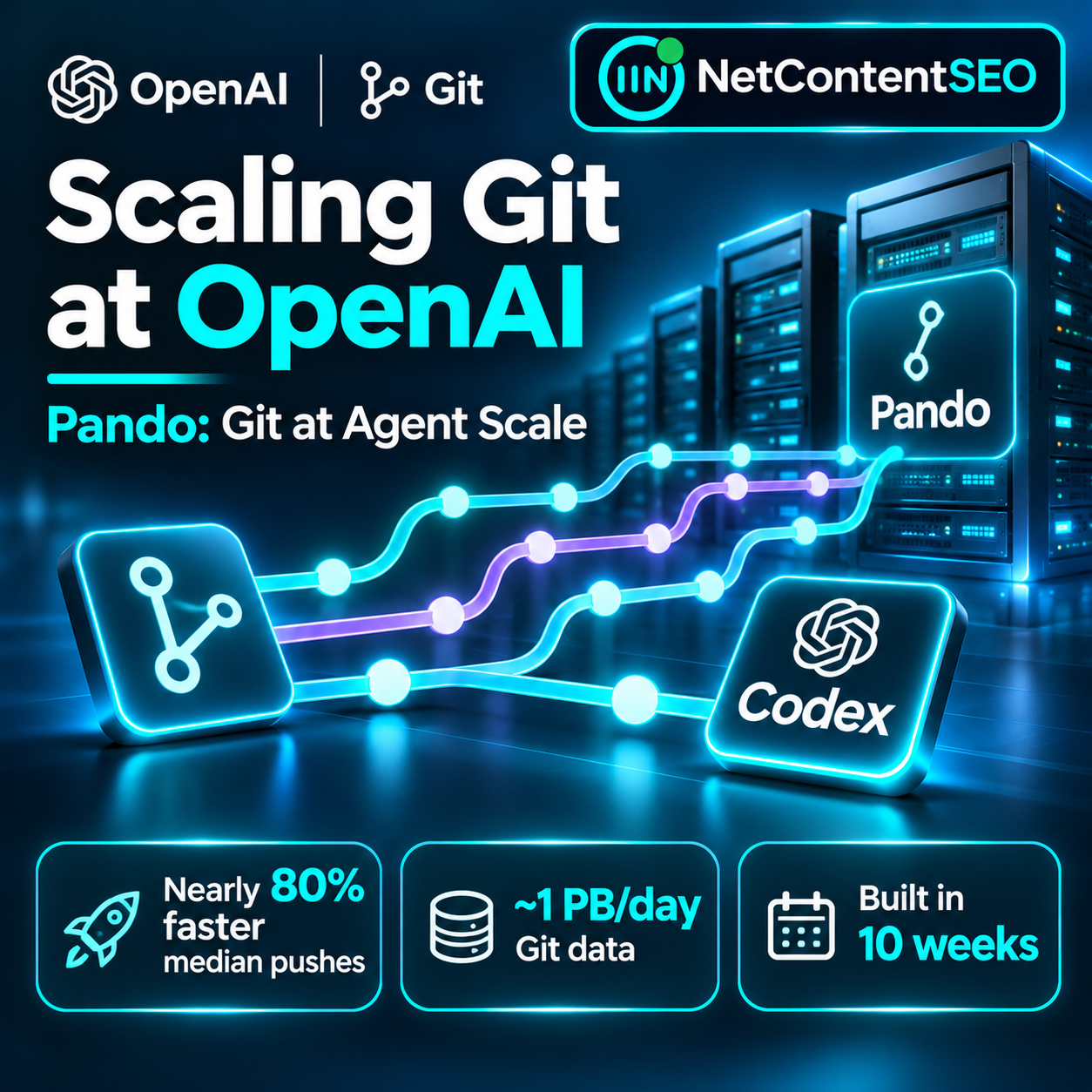

OpenAI has built Pando, a Git-compatible source-control backend intended to handle the volume and concurrency of software development with Codex. In a technical article published November 2, 2026, engineers Aaron Friel, Taylor Blau and Ted Nyman describe why OpenAI redesigned the way it serves its monorepo without replacing the Git workflows used by people and agents.
The reported production results are substantial: median push latency fell by nearly 80%, Pando now serves nearly a petabyte of Git data daily, and it has handled more than 57 terabytes of Git packs in a single hour. These are OpenAI-reported engineering measurements for its own workloads, not a universal benchmark for every repository.
Why Codex changed the scale of source control
AI-assisted coding allows engineers to develop more changes in parallel. Every additional branch, push, merge, CI job and fresh development environment can multiply the amount of repository traffic. OpenAI says its previous monorepo infrastructure experienced slow fetches and pushes, failed merges and reliability that at times fell below 90%. The bottleneck was not simply that Git could no longer represent the code. It was how the repository was coordinated and served to large numbers of simultaneous clients.
Pando preserves compatibility with the Git protocol and client while redesigning the server architecture around two goals: independent, horizontally scalable writes to different branches and very high-throughput reads that can saturate client network connections.
Parallel branch updates without one global bottleneck
Traditional distributed Git services often coordinate changes across full repository replicas or serialize updates through a shared write-ahead log. Both approaches can force unrelated branch updates to compete for a common coordination resource. Pando instead records versions of individual references in a horizontally scalable metadata store and stores incoming Git packfiles as immutable blobs.
Each branch update can be committed independently, with conflicts concentrated on concurrent changes to the same reference. The trade-off is a relaxed, causally consistent view of the repository: a client fetching several branches may observe versions from different moments rather than one repository-wide snapshot. OpenAI argues this is acceptable for its development workflows because the critical guarantee is the ordering of updates to each branch.
Reusing packfiles to accelerate fetches
Conventional Git servers often calculate a custom packfile for each fetch by comparing the objects the client has with the objects it wants. That work can be expensive at scale and hard to cache. Pando takes advantage of packfiles already uploaded during pushes. It tracks their dependencies, selects the packs needed by a reader and serves them through the Git protocol's packfile-URI mechanism.
OpenAI's Express delivery service caches packs regionally. The company reports cache hit rates above 99%, and says clone and fetch traffic can saturate 10 Gbps links using standard cloud virtual machines. This is not the same as claiming every individual developer always downloads at 10 Gbps: network limits and workload conditions still matter.
Compaction keeps repository history practical
Reusing incoming packs creates another challenge: a fast-changing monorepo can accumulate tens of thousands of small packs per day. Pando uses background compaction, grouping packfiles into increasingly large covers similar to levels in a log-structured merge tree. These covers reduce the number of files needed for a fetch, improve compression and accelerate planning for clients that are far behind the latest commit.
Unlike traditional Git garbage collection, Pando can retain packs at multiple levels to support different reading patterns. The server selects an efficient combination based on the client's history and requested commits.
Codex helped build Pando itself
OpenAI reports that Pando went from kickoff to production in 10 weeks, with the core designed by one engineer, implemented with teams of coding agents and deployed by a small engineering group. The project was written in Rust, supported by Git conformance tests and deterministic simulation harnesses. Agents also used formal methods, including Lean and TLA+, to explore system properties and find bugs.
The system began serving production traffic in April 2026. Deployment started as a read-and-write-through proxy for the existing source-control backend, allowing gradual migration without disrupting engineering work. OpenAI also migrated integrations, development tools and workflows that depended on legacy APIs and repository downloads.
What the performance numbers mean
The nearly 80% reduction in median push latency is an operational outcome, not a claim that all development tasks became 80% faster. The daily petabyte-scale delivery reflects total Git data served, much of it from cached packs, rather than a petabyte of newly authored source code every day. Likewise, the 10-week build timeline describes OpenAI's project, staffing and agent-assisted implementation, not a general estimate for other organizations.
The architecture shows how storage, caching and consistency decisions can become critical when AI agents create many parallel changes. More coding output increases demand not just on code generation but on version control, testing, code review and continuous integration.
Why this matters for AI engineering and technical SEO
Pando is not a Google Search update and has no demonstrated direct effect on SEO rankings or AI Search citations. Its relevance to SEO organizations is indirect but practical. Teams increasingly use coding agents to maintain large websites, deploy structured data, generate tests, manage templates and ship technical fixes. Those workflows depend on reliable source control and CI, especially when multiple agents or engineers modify separate branches at once.
Faster infrastructure can reduce friction in shipping changes, but it does not guarantee better site quality. Automated deployments still need review gates, regression tests, content validation and production monitoring. In AI-assisted development, the constraint can shift from writing code to safely integrating, verifying and deploying it.
Git compatibility and the wider ecosystem
OpenAI says it has contributed improvements related to packfile-URI handling, concurrent downloads, interrupted transfers and tracing back to Git, with additional changes available in its public Git distribution. The company is exploring how to share more of Pando's technology, but has not announced that the entire Pando backend is generally available as an open-source product.
The larger lesson is architectural. When agentic development multiplies concurrent work, source-control infrastructure must scale with it. Pando illustrates one approach: preserve the familiar Git interface, relax unnecessary global coordination, reuse data aggressively and validate correctness with rigorous tests.
Primary source: OpenAI Engineering, “Scaling Git at OpenAI,” November 2, 2026.