

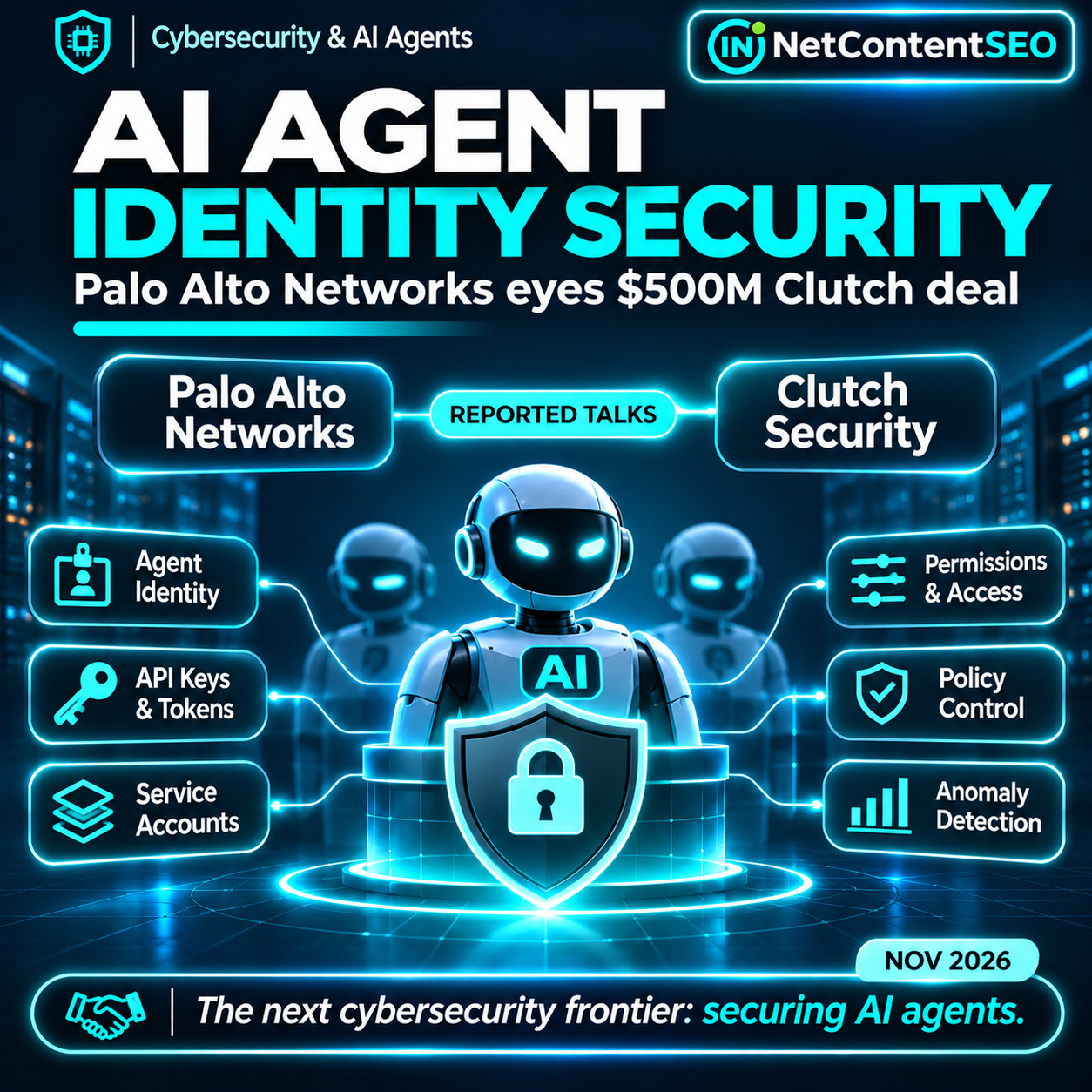

November 6, 2026. Palo Alto Networks is reportedly in talks to acquire Israeli cybersecurity startup Clutch Security for approximately $500 million. The negotiations, first reported by The Information and subsequently covered by TechCrunch and Israeli business publications, have not been announced as a completed transaction. That distinction is essential: a proposed price is not a signed deal, and discussions could end without an acquisition.
Beyond the potential transaction, the strategic issue is much larger. Enterprises are deploying AI agents that can read documents, call APIs, query databases and perform actions without a human clicking every button. Those agents need credentials and permissions. The result is a rapidly expanding class of non-human identities that security teams must discover, govern and monitor.
What is known about the reported $500 million Clutch deal?
The Information reported on November 4 that Palo Alto Networks was discussing a purchase of Clutch Security for around $500 million, citing people familiar with the matter. CTech reported the talks on November 5, identifying Clutch's specialization in credentials used by software systems and AI agents.
The reported deal remains unconfirmed by a definitive acquisition announcement. Palo Alto Networks told The Information it does not comment on rumors or speculation. Public reporting does not establish a final price, closing date or agreed integration roadmap. An article describing the transaction as completed would therefore be premature.
Clutch was founded in late 2023 by Ofir Har-Chen, Sagi Haas and Tal Kimhi. CTech reports approximately $28.5 million raised across a seed round and Series A financing. A $500 million purchase price, if agreed, would be a striking figure, but funding raised is not the same as current valuation, revenue or enterprise value.
What does Clutch Security actually protect?
According to Clutch's own product documentation, its platform discovers and manages non-human identities, AI agents and secrets across cloud, SaaS, code and on-premises environments. These include API keys, OAuth tokens, service accounts, machine credentials and passwords used by automated applications.
Clutch markets an Identity Lineage graph intended to connect an identity with its origin, owner, storage location, consumers and reachable resources. The platform also describes posture management, secret governance, credential lifecycle controls, behavioral baselines and threat detection. These are vendor-described capabilities, not an independent guarantee that every deployment discovers every credential or blocks every attack.
The operational problem is straightforward: a company may know which employees have privileged access but have a much less complete picture of which bots, scripts, integrations and AI agents possess similar permissions.
Why AI agents create a new identity-security problem
Traditional identity management often begins with a person: an employee signs in, authenticates and receives a defined set of permissions. Software identities have existed for decades, but agentic systems add a more dynamic layer. An AI agent may choose among tools, chain operations and initiate actions based on natural-language instructions or retrieved content.
Consider a marketing agent connected to an analytics dashboard, a content management system and an email platform. It might need read access to campaign metrics, permission to create draft articles and access to a limited test audience. If the same identity can delete production data, change user permissions or export the entire customer database, the risk is not simply an inaccurate answer. It is an overprivileged system capable of acting.
The important security question becomes: which agent is acting, on whose behalf, using which credential, with what permission and under which approval?
How this fits Palo Alto Networks' CyberArk and Koi strategy
Palo Alto Networks completed its CyberArk acquisition on February 11, 2026, describing identity security for human, machine and agentic identities as a core strategic priority. CyberArk's established capabilities in privileged access and identity governance provide a broad foundation for managing who and what can reach sensitive systems.
Palo Alto also completed its acquisition of Koi in February 2026 to expand security visibility for agentic software operating on endpoints. Koi addresses a different part of the risk: understanding and protecting the AI tools and applications running within enterprise environments.
Clutch, if acquired and integrated, could complement those investments with deeper discovery and contextual governance of non-human credentials and agent identities. That is a plausible strategic interpretation, not a confirmed product integration plan. Overlap between the three offerings is also possible; the final architecture cannot be inferred from acquisition reports alone.
Six concrete risks behind AI agent identity security
1. Long-lived API keys
An agent may be configured with a static API key that remains valid for months. If exposed in a repository, log or prompt transcript, it can enable unauthorized access until revoked. Prefer scoped, short-lived credentials where the connected service supports them.
2. Excessive permissions
An agent tasked with reading analytics does not need administrator access to the database. Broad permissions increase the consequences of mistakes, prompt injection and compromised integrations. Enforce least privilege at the API, database and tool layers rather than relying only on the agent's instructions.
3. Unclear ownership
A service account may remain active after the employee or project that created it disappears. Every machine or agent identity should have an accountable owner, documented purpose and review schedule.
4. Prompt injection and tool misuse
Untrusted content can try to redirect an agent into executing unintended actions. Tool descriptions and retrieved documents are not substitutes for authorization. Sensitive operations require server-side checks and, where appropriate, human approval.
5. Secret leakage through logs
Debug output, request traces and error reports can accidentally expose tokens. Redact secrets, restrict log access and design incident procedures to rotate credentials quickly.
6. Poor auditability
When multiple agents share one credential, investigators may be unable to determine which one initiated an action. Assign distinguishable identities where practical and record authenticated actions with sufficient context for investigation.
MCP does not automatically solve agent authorization
The Model Context Protocol (MCP) makes it easier to connect AI applications to tools and data sources. But protocol compatibility is not the same as secure authorization. A tool server must still authenticate callers, validate scopes, enforce permissions and reject actions that exceed the user's or agent's authority.
For example, an MCP server exposing a Laravel application might offer separate capabilities for reading SEO reports, drafting articles and publishing content. A research-only agent should not inherit publishing or user-management privileges simply because those functions exist on the same server.
Security boundaries must be enforced by the application, not merely described in a system prompt. The safest architecture treats the agent as a potentially fallible caller and independently checks every sensitive request.
Practical checklist: securing agents connected to Laravel, APIs and databases
- Inventory identities. Record each agent, service account, API key, OAuth client and MCP integration, including its owner, purpose and accessible resources.
- Separate environments. Use distinct credentials and endpoints for development, staging and production. Never let a test agent inherit production administrator access.
- Apply least privilege. Use read-only database roles for analysis, narrow API scopes and explicit allowlists for write operations.
- Protect secrets. Store credentials in a managed secret store or appropriately secured environment, not in source code, prompts or shared documentation. Rotate exposed credentials immediately.
- Prefer short-lived access. Where possible, issue temporary tokens and revoke them when sessions or tasks end.
- Gate destructive actions. Require additional authorization or human approval for deleting records, changing permissions, transferring data or publishing high-impact content.
- Validate tool inputs. Apply server-side authorization, schema validation, rate limits and safeguards against injection. Do not trust model-generated arguments.
- Log meaningful activity. Record the agent identity, tool called, resource accessed, timestamp, outcome and approval context without storing plaintext secrets.
- Monitor anomalies. Alert on unusual volumes, unexpected geographic access, privilege changes and calls outside an agent's normal workflow.
- Test revocation. Verify that disabling an agent or rotating its credentials actually prevents further actions across all connected systems.
These controls are applicable whether an organization uses a commercial identity-security platform or builds a narrower internal system. A paid product can improve visibility and automation, but it does not eliminate the need to design permissions correctly.
How to evaluate a non-human identity security product
Before purchasing, request a demonstration using your own representative environment. Ask the vendor to identify service accounts, agent credentials and unused secrets, then show the evidence connecting each identity to an owner and resource. Test whether it detects excessive privileges and how it handles a revoked or rotated credential.
Assess the integration model: does the product require privileged access to cloud accounts or vaults, and what information leaves your environment? Ask how findings are prioritized, how false positives are reviewed and what happens if the security platform becomes unavailable. Verify claims about credential storage and data isolation against contractual and technical documentation.
For an AI-heavy organization, also test whether the product distinguishes a human-initiated agent action from an autonomous background task and whether it can enforce approval requirements. Vendor claims about complete visibility should be tested, not assumed.
Why this matters for SEO and agentic marketing
Agentic marketing tools increasingly connect search analytics, content management, customer data and publication workflows. An SEO assistant that only summarizes crawl findings has a limited risk profile. One that can edit canonical tags, publish pages, change redirects or manage advertising integrations has much broader operational power.
That difference is especially important when AI is introduced into production CMS and analytics systems. Technical SEO teams should map tool permissions as carefully as they map crawl paths. A mistaken automated change to robots directives, canonical templates or redirects can affect thousands of URLs before anyone notices.
This reported acquisition does not announce a new Google ranking factor or AI Search citation rule. Its relevance to SEO is the governance of automated systems that increasingly create, modify and distribute digital content.
What the $500 million figure does—and does not—tell us
The reported amount signals that large cybersecurity vendors see strategic value in agent identity and non-human credential management. It does not prove that Clutch has achieved a particular annual revenue level, that the transaction will close or that a $500 million valuation is justified by audited operating results.
Different outlets have reported additional transaction details based on unnamed sources. Unless independently confirmed, figures about final cash terms, earn-outs or revenue should be labeled as unverified reporting rather than settled facts.
The broader competitive pattern is nevertheless visible: security vendors are expanding beyond employee authentication toward software identities, autonomous agents and the credentials those systems use. The question is no longer whether enterprises have non-human identities; it is whether they can govern them consistently.
Frequently asked questions
Has Palo Alto Networks acquired Clutch Security?
Not as of the reporting reviewed on November 6, 2026. Multiple outlets report negotiations for approximately $500 million, but no completed acquisition has been confirmed.
What is a non-human identity?
It is an identity used by software rather than an individual person, such as a service account, workload identity, API client or automated agent. These identities can authenticate and receive permissions to access systems.
Why are AI agents different from ordinary automation?
Some AI agents dynamically select tools and actions in response to changing context. That flexibility can make their behavior less predictable than a fixed script, increasing the importance of narrow permissions and monitoring.
Does MCP provide identity security by itself?
No. MCP helps connect AI applications to tools, but authentication, authorization, secrets management, approval workflows and logging must still be implemented and configured securely.
What is the difference between CyberArk and Clutch?
CyberArk provides a broad identity-security and privileged-access platform covering human and machine identities. Clutch specializes in visibility and governance of non-human identities, agent credentials and secrets. Their exact future integration remains speculative.
What is the first security step for a small AI-agent project?
List every credential the agent can use, remove unnecessary permissions and test that the agent cannot perform an action outside its approved scope. Add logging and a reliable way to revoke access before deploying it to production.
Does this deal affect AI Search rankings?
No ranking change has been announced. The implications concern the security of AI-driven marketing and content operations, not search ranking algorithms.
The bigger picture
For years, identity security focused primarily on people and the applications they used. The growth of autonomous agents shifts attention to software that can act continuously, cross system boundaries and use credentials at machine speed.
Palo Alto Networks' reported interest in Clutch Security is one sign of that shift. Whether or not the deal closes, the engineering lesson is already clear: the next cybersecurity challenge is not only protecting users. It is controlling what AI agents are allowed to do—and proving that those limits work.
Sources
- The Information, November 4, 2026 — original reporting on acquisition discussions.
- TechCrunch, November 5, 2026 — report supplied for editorial review.
- CTech, November 5, 2026 — founders, financing and product background.
- Clutch Security — official description of its non-human identity and secrets platform.
- Palo Alto Networks, February 11, 2026 — CyberArk acquisition completion.
- Palo Alto Networks, February 17, 2026 — Koi acquisition and agentic endpoint strategy.