

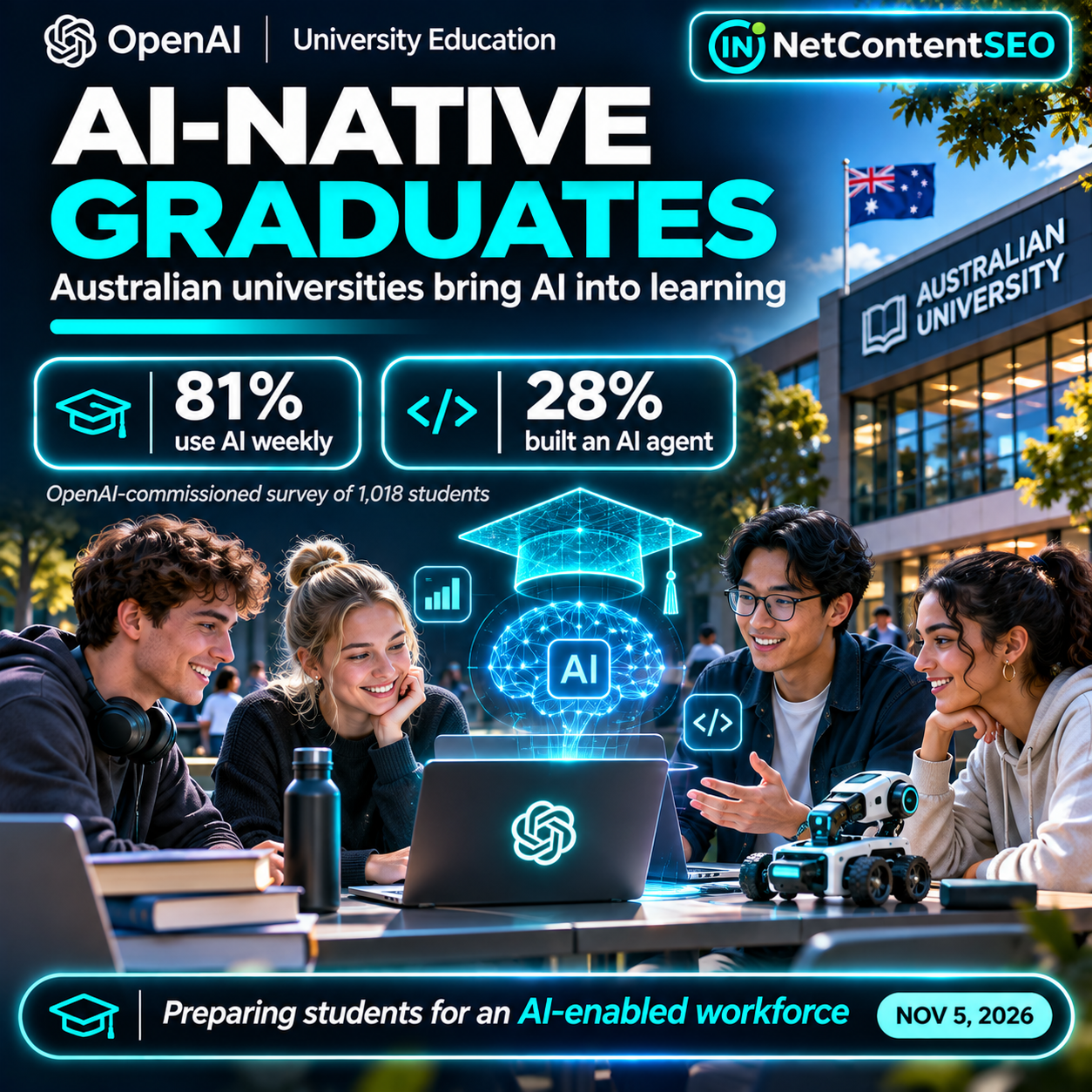

November 6, 2026. Australian universities are moving beyond the debate over whether students should use generative AI. Institutions including UNSW Sydney, the University of Sydney, La Trobe University and Adelaide University are expanding access to advanced AI tools while redesigning teaching, assessment and practical work experience. OpenAI describes the ambition as preparing AI-native graduates: people who can use AI to investigate, build and solve problems while retaining the expertise and judgment to check the results.
The shift is substantial, but it is not a declaration that AI replaces learning. In fact, the most revealing detail is how universities are distinguishing situations where students can use AI, cannot use it and must demonstrate their ability to work with it. That is the beginning of a more useful model of AI literacy.
What OpenAI announced on November 5
In its official November 5 announcement, OpenAI highlighted collaborations with four Australian universities and published results of a commissioned student survey. The partnerships span institution-wide ChatGPT Edu access, curriculum development, real-world industry projects, research and secure AI use.
The institutions are not all at the same deployment stage. Some staff already have access, some students are participating in trials, and several broader student rollouts are scheduled for 2027. Reporting the initiatives as if every student already has full access would misrepresent the announcement.
What Australian students say about AI: the survey figures
OpenAI commissioned Pureprofile to survey 1,018 Australian university students aged 18 or older who studied on campus or remotely, between August 3 and August 7, 2026. The published findings include:
| Survey response | Share |
|---|---|
| Use AI several times a week | 81% |
| Use AI multiple times a day | 33% |
| Have built an AI agent or assistant for studies, work or personal life | 28% |
| Want more opportunities to use advanced AI on real-world projects | 79% |
| Believe AI skills are essential to success in their chosen career | 61% |
| Believe AI literacy will become as fundamental as other basic skills | 69% |
| Believe AI skills give Australian graduates a global advantage | 65% |
These are self-reported survey responses, not direct measures of proficiency or employment outcomes. The 28% figure does not establish that more than a quarter of students have deployed secure, production-ready autonomous agents: the survey groups together agents and assistants built for a wide range of purposes. Because the research was commissioned by OpenAI, independent replication would be valuable before treating its findings as a definitive national benchmark.
Four universities, four different implementation models
UNSW Sydney: broad access and a Can, Can't, Must assessment framework
UNSW is expanding ChatGPT Edu toward access for more than 80,000 students and staff. Its September partnership announcement describes staged access and plans to reach the wider student community before the 2027 academic year.
The university's most transferable contribution may be its Can, Can't, Must assessment framework. Educators can explicitly permit AI for a task, prohibit it when students need to demonstrate independent knowledge, or require its use when the learning objective is AI capability. This makes expectations visible instead of leaving students to guess what counts as acceptable assistance.
UNSW also intends to introduce generative AI foundations, Codex, hackathons and industry-linked projects. The institution's own reporting describes a 10-month ChatGPT Edu trial involving about 800 students and staff; 98% of participating staff wanted to retain access. This is encouraging feedback from a pilot, not proof of improved graduate employment or learning outcomes.
University of Sydney: a phased rollout with governance and sustainability research
The University of Sydney is introducing ChatGPT Edu in stages, with university-wide student access scheduled for Semester 1, 2027 after a pilot. Its official student guidance explains that ChatGPT Edu is intended to supplement existing university-approved AI tools rather than replace them all.
The university has also committed A$1 million in seed funding to an AI Sustainability Research and Innovation Fund to investigate AI's environmental effects and ways to reduce them. That is a research commitment, not a claim that the institution's AI use is already carbon-neutral.
Its rollout illustrates a cautious approach to agentic features. External connectors and autonomous or write-capable agents are disabled until separately assessed and approved. Access to a managed AI workspace is therefore not the same as blanket permission to connect it to sensitive research systems.
La Trobe University: AI embedded across disciplines
La Trobe reports that 3,500 staff already have ChatGPT Edu access and plans universal availability for approximately 45,000 students and staff in the first quarter of 2027. It is also introducing AI-related degree programs, including a Bachelor of AI Engineering (Honours) and an AI MBA.
More revealing are its discipline-specific applications. Paramedicine students practice interpreting ECGs, assessing suspected heart attacks and triaging simulated emergencies. Teacher trainees can practice difficult parent conversations with an OpenAI-powered social robot named Fletch. In both examples, AI helps create realistic practice scenarios; students must still interpret evidence, explain decisions and demonstrate professional judgment.
La Trobe is also integrating AI literacy into 50 priority first-year subjects for Semester 1, 2027. Its AI Business Studio aims to provide more than 1,000 students with practical experience helping small and medium businesses adopt AI by 2028. These are plans and targets, not completed outcomes.
Adelaide University: governed AI and defensive cybersecurity
Adelaide University is incorporating AI into a newly established institution formed through a merger. OpenAI reports that the university is using its API and is among the first higher education institutions to work with OpenAI Daybreak Blue for authorized defensive security activities, including vulnerability discovery, secure code review, malware analysis, incident response and patch validation.
Authorized defensive work is an important qualifier. This does not imply that students are given unrestricted access to offensive tools or production systems. Security research requires scoped permissions, institutional oversight and controlled environments.
What does AI-native actually mean?
AI-native should not mean simply knowing how to write prompts. A graduate prepared for AI-enabled work needs to define a problem, select an appropriate tool, evaluate evidence, recognize errors, protect data and explain decisions. In some disciplines, they must also understand when AI should not be used.
For example, a software engineering student might use an AI coding assistant to prototype an application, then write tests, inspect dependencies and verify security. A health student might use a simulation to rehearse triage while remaining accountable for clinical reasoning. A business student might use AI to analyze customer data but must still understand sampling, bias, consent and the limits of attribution.
The distinction matters for employers. Frequent AI use is not evidence of competence, just as frequent spreadsheet use does not automatically demonstrate statistical literacy.
How universities can assess students without banning AI
A practical assessment model begins with the learning outcome. If the objective is foundational reasoning, a supervised or independent task may be appropriate. If the objective is professional tool use, AI can be permitted or required, but students should document how they used it and what they verified.
Educators can ask students to submit a short AI-use disclosure, explain why they accepted or rejected generated suggestions, and defend important conclusions orally or through reproducible work. This tests both subject expertise and the ability to supervise an AI system.
The UNSW Can, Can't, Must model is particularly useful because it reduces ambiguity at the assignment level. It is not a universal law: students must follow their own institution's current course rules, which may vary by subject and assessment.
Privacy, intellectual property and responsible access
Institution-managed ChatGPT Edu environments provide organizational controls that differ from individually managed consumer accounts. The University of Sydney states that data submitted through its ChatGPT Edu environment is not used to train foundation models and that access is controlled through university authentication, with encryption, audit logging and configurable retention settings.
Those protections do not mean every file can be uploaded without review. Universities may restrict confidential research, personal records, sensitive information and particular integrations. UNSW explicitly warns users not to enter restricted or classified information unless authorized and has additional controls for defense-related participants.
Students and researchers should check their institution's approved tools, data classification rules and assessment policies before using AI. A university partnership does not automatically grant permission to process third-party copyrighted works, confidential datasets or patient information.
What does this mean for jobs and workforce readiness?
The partnerships are designed to connect learning with professional practice, including internships, hackathons, projects and startup networks. That can help students move beyond passive AI consumption toward building and evaluating systems.
But the November announcement does not provide independent longitudinal evidence that graduates from these programs earn more, secure jobs faster or perform better at work. The reported student beliefs about AI's career value are perceptions. Employment outcomes will require follow-up studies and comparison groups.
Employers can still draw a useful lesson: when hiring for AI-enabled roles, ask candidates to demonstrate how they validate AI output, manage access and recover from mistakes. A portfolio containing a working prototype, tests and a clear explanation of trade-offs is more informative than a claim of general AI fluency.
Implications for SEO, AI Search and digital marketing education
For SEO professionals, the story illustrates a broader shift from using AI as a writing shortcut to using it as part of a verifiable workflow. Future marketing graduates may be expected to combine research, analytics, coding, structured data and automated systems while understanding where generated answers can fail.
In an AI Search context, students should learn to distinguish ranking from citations, visibility from referral traffic and generated summaries from independently verified sources. They should be able to audit an AI answer, inspect the evidence and explain whether a proposed content or technical change serves a real user need.
Agentic workflows add a second skill set: managing permissions, APIs and automation safely. An AI agent that drafts a campaign has a different risk profile from one authorized to publish content, change a website or access customer records. Responsible AI literacy includes understanding those boundaries.
None of the university partnerships announces a change to Google's ranking systems or a guaranteed way to appear in AI-generated answers. Their relevance to SEO is educational and operational: the next generation of practitioners will need both AI proficiency and domain expertise.
A practical AI-native curriculum checklist
- Define learning outcomes: specify the subject knowledge students must demonstrate independently and the AI skills they must develop.
- Publish clear use rules: state whether AI is allowed, prohibited or required for each assessment, with examples of acceptable disclosure.
- Provide equitable access: ensure students are not assessed on paid tools they cannot reasonably obtain; supply institution-approved alternatives where possible.
- Teach verification: require students to check sources, calculations, code, generated citations and factual claims.
- Use real projects: connect assignments to authentic problems while keeping sensitive data and production systems appropriately protected.
- Assess judgment: ask students to explain why they used AI, what it got wrong and how they corrected it.
- Protect data: provide approved workspaces, access controls, training and clear rules for confidential material.
- Measure outcomes: compare learning, completion, critical-thinking performance and graduate readiness—not just login counts or prompt volume.
What remains uncertain?
The student survey measures reported behavior and attitudes, not independently assessed capability. University rollout dates are announced targets and can change. The partnerships also do not establish that all students have identical features, model access or permission to use agents and connectors.
There are legitimate open questions about academic integrity, unequal access, dependence on commercial vendors, model errors and environmental costs. The University of Sydney's sustainability fund and staged governance approach are responses to some of those concerns, but not evidence that they have been fully resolved.
Frequently asked questions
What is an AI-native graduate?
In this context, a graduate who has practical experience using AI to research, create, analyze and solve problems, while retaining the subject knowledge and judgment needed to evaluate its output.
Are Australian universities giving ChatGPT to every student now?
No. Rollouts differ by institution. UNSW is expanding access, while the University of Sydney and La Trobe have broader student access planned for 2027.
What percentage of Australian students use AI?
In an OpenAI-commissioned August 2026 survey of 1,018 adult university students, 81% reported using AI several times a week. This is a survey finding, not a count of every student in Australia.
Have 28% of students really built AI agents?
Twenty-eight percent of surveyed students said they had built an AI agent or assistant for studies, work or personal life. The question does not establish production deployment, autonomy or technical sophistication.
Can students use AI in exams and assignments?
That depends on the course and assessment. UNSW's Can, Can't, Must framework explicitly distinguishes permitted, prohibited and required use.
Does ChatGPT Edu use student conversations to train public models?
The University of Sydney and UNSW state that data in their managed ChatGPT Edu environments is not used to train OpenAI's foundation models. Students must still follow local privacy and data-handling policies.
Does AI literacy guarantee better employment?
No. Students expect AI skills to matter, and universities are building practical pathways, but the announcement does not demonstrate a causal improvement in employment outcomes.
How does this relate to AI Search and SEO?
It signals growing demand for practitioners who can combine AI tools with source verification, analytics, content quality, technical skills and responsible automation. It does not introduce a new search ranking factor.
The bigger picture
Australian universities are treating AI as a capability students should learn to use critically, not merely a technology to permit or prohibit. The most promising element is the combination of institutional access, practical projects, explicit assessment rules and professional judgment.
The test will come later: whether these programs produce graduates who can solve meaningful problems, identify AI mistakes and use automated systems responsibly. AI-native education should be measured by what students understand and can verify—not by how often they open a chatbot.
Sources
- OpenAI, November 5, 2026: Australian universities are creating AI-native graduates — partnerships, survey, programs and case studies.
- UNSW Sydney, September 8, 2026: partnership announcement — rollout and Can, Can't, Must framework.
- Inside UNSW, September 11, 2026 — pilot and rollout context.
- University of Sydney: ChatGPT Edu guidance — eligibility, rollout, privacy, governance and sustainability fund.