

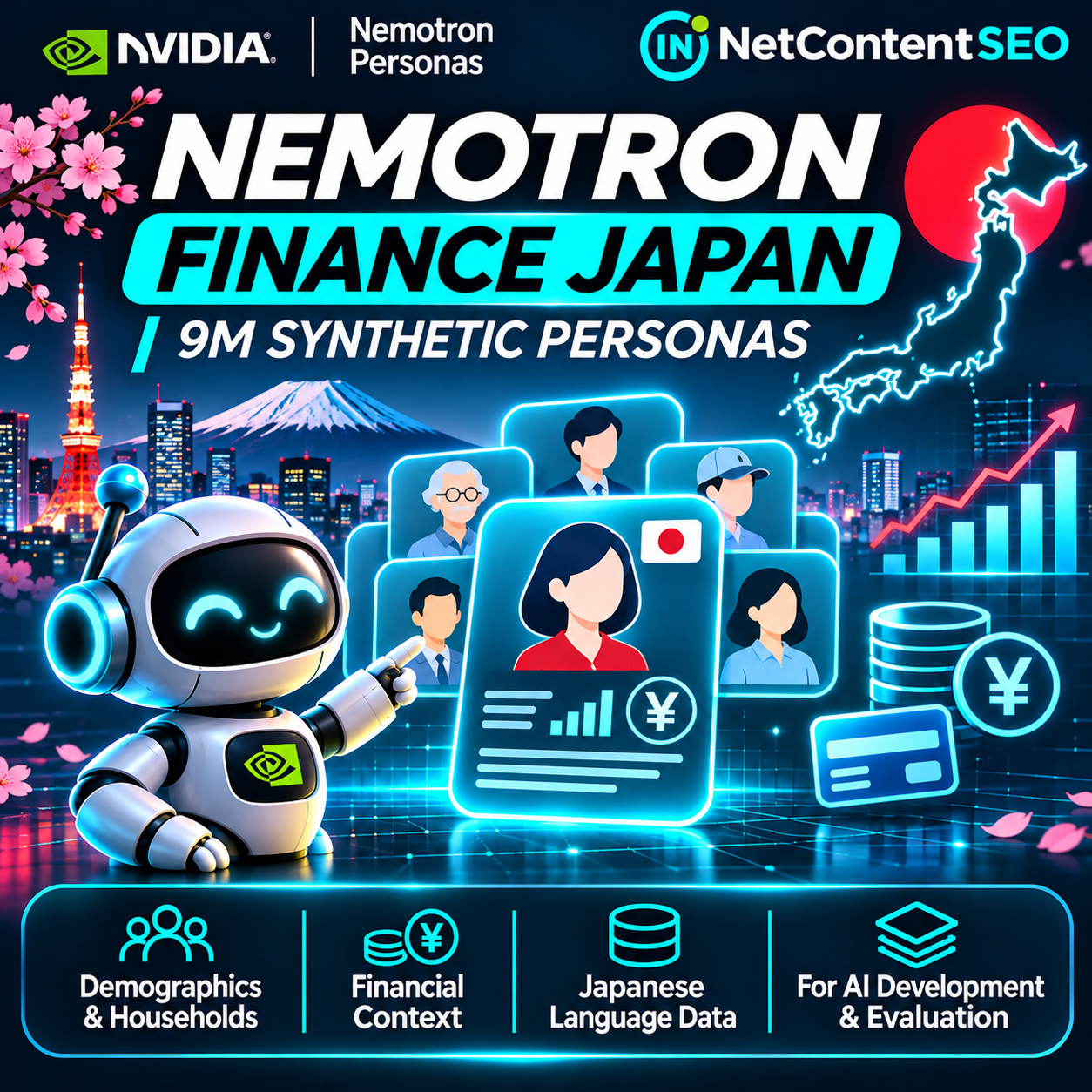
November 9, 2026. NVIDIA and Japanese AI company Elith have introduced Nemotron-Personas-Finance-Japan, an openly available synthetic dataset designed to help developers build and evaluate financial AI systems that reflect Japan's demographic, household and financial circumstances. The release extends NVIDIA's earlier Nemotron-Personas-Japan dataset with financial information and additional persona types, creating a resource for conversational agents, customer simulations and fairness testing.
According to the primary NVIDIA and Elith announcement on Hugging Face, the dataset contains one million records and nine persona narratives per record, or nine million personas in total. The data is synthetic, written in Japanese and released under Creative Commons Attribution 4.0 (CC BY 4.0), which permits commercial use subject to the license terms.
For AI Search and GEO, the relevance is indirect but important. AI discovery systems that understand local financial contexts may eventually deliver more appropriate responses to questions about banking, insurance and financial services. This announcement does not establish a new search engine, a change to Google rankings or an improvement in AI citations for Japanese brands.
What NVIDIA released
The new resource is a dataset, not a standalone chatbot or a new Nemotron model. It is intended to supply synthetic customer contexts that developers can use when creating, training and testing AI systems. NVIDIA says the release incorporates insights and feedback from organizations including Sompo Japan, Tokio Marine Holdings, Bank of Fukuoka, Mizuho Financial Group, Meiji Yasuda Life Insurance and the Financial Data Utilization Association.
Those organizations are identified as sources of domain insights and feedback. The announcement does not say they all deployed the dataset in production or that they provided actual customer records.
Nemotron-Personas-Finance-Japan by the numbers
| Characteristic | NVIDIA-reported figure |
|---|---|
| Dataset records | 1 million |
| Persona narratives per record | 9 |
| Total persona narratives | 9 million |
| Fields per record | 50 |
| Field breakdown | 9 persona fields, 11 persona attributes, 30 contextual fields |
| Approximate total tokens | 1.5 billion |
| Approximate persona tokens | 750 million |
| Unique names | About 950,000 |
| Occupation categories | More than 1,600 |
| Language | Japanese |
| License | CC BY 4.0 |
These figures come from NVIDIA's release. Nine million personas does not mean nine million unique real people or nine million independently collected survey responses. The personas are synthetic narratives derived from one million structured records.
How the finance dataset differs from the original Japan release
The earlier Nemotron-Personas-Japan, published in September 2025, contained one million records, six persona narratives per record and 22 fields. Its focus was broad demographic and cultural diversity. The finance extension increases the number of persona narratives from six million to nine million and expands the schema from 22 to 50 fields.
The added financial context includes household finances, assets, attitudes toward money and financial planning, together with digital and financial literacy. These details matter because two people with similar ages or occupations may have very different financial needs, access to digital services and comfort with complex products.
NVIDIA describes the dataset as statistically grounded in official Japanese demographic and labor information, while extending those distributions with modeled financial characteristics. This is a design objective, not proof that every generated joint distribution perfectly matches Japan's population.
How the synthetic data was created
The primary announcement identifies two components in the generation pipeline. NeMo SDG-PGMs, a probabilistic graphical-model framework, supports statistically grounded synthetic data generation. NeMo Data Designer coordinates generation workflows using templates, structured output validation, retries and multiple model backends. NVIDIA also identifies gemma-4-31B-it as the model used for Japanese text generation.
The pipeline combines statistical structure with natural-language generation. The intended result is not simply a collection of invented biographies, but personas that can be filtered or sampled according to demographic and financial conditions. Developers can use those conditions to build test conversations and assess how an assistant responds to different circumstances.
Why Japan's financial context matters for AI agents
A generic financial assistant may answer the same question differently depending on a user's circumstances. A retired customer evaluating an insurance policy, a student managing a limited budget and a household considering a mortgage may need different explanations, levels of detail and follow-up questions.
The dataset is designed to make it easier to simulate such variation in Japanese. NVIDIA points to use cases including multi-turn dialogue generation, domain-specific assistants, customer simulations, marketing evaluation and bias testing. A team might use synthetic personas to test whether an agent explains a product consistently to people with different levels of financial literacy, or whether a digital onboarding workflow becomes harder for certain age groups.
Those are potential applications, not independently validated outcomes. The announcement does not provide a public benchmark demonstrating that agents trained on this dataset outperform all alternatives in financial advice accuracy, suitability or customer satisfaction.
Privacy benefits and the limits of synthetic data
NVIDIA states that every persona is synthetic and that no real individual is represented. The underlying demographic and household-finance patterns come from public statistics and survey distributions rather than real customer records. This can reduce the need to expose sensitive customer data when prototyping or testing AI systems.
But synthetic does not automatically mean risk-free. A statistically grounded generator can still reproduce biases or unrealistic assumptions. Models trained or tested on synthetic profiles can underperform for groups whose circumstances are poorly represented. Financial firms also remain responsible for checking legal requirements, data provenance, fairness, suitability and security before using an AI system with real customers.
CC BY 4.0 allows commercial reuse with attribution and other license conditions. It does not constitute regulatory approval for financial advice or guarantee that every generated output is appropriate for a particular customer.
What this means for Japanese AI Search and digital discovery
The strongest connection to AI Search is better local context for agent development and evaluation. A Japanese-language financial assistant may need to understand household structures, financial literacy, life stages and regional differences when interpreting a query or guiding a user through a decision. Synthetic personas provide a way to test those scenarios before exposing a system to real customers.
For example, a bank could evaluate whether an assistant can explain a savings product to users with different levels of financial literacy. An insurer could test how consistently an agent asks clarifying questions before discussing coverage. A comparison service could check whether an AI-generated explanation omits important qualifications for a simulated customer group.
These are proposed evaluation workflows, not confirmed deployments. The dataset does not itself contain a web index, determine which banks appear in search results or measure referral traffic.
The GEO question: will better local AI produce different recommendations?
Potentially, but the mechanism should be described carefully. If developers use representative Japanese personas to test retrieval and recommendation systems, they may discover gaps in how those systems handle regional or financial context. They could then improve prompts, retrieval sources, product documentation or evaluation criteria.
That may influence how a particular deployed assistant presents financial services. It does not follow that publishing this dataset changes citations in ChatGPT, Google AI Mode, Naver or other public assistants. No such causal result is reported by NVIDIA.
For brands and publishers, the practical implication is to maintain accurate, understandable Japanese-language information about products, eligibility, costs, risks and customer support. A capable assistant still needs trustworthy source material. Synthetic personas can help evaluate how that material is interpreted, but they do not replace it.
How developers can access the dataset
NVIDIA provides a Hugging Face dataset identifier and an example using the Python datasets library:
from datasets import load_dataset
ds = load_dataset("nvidia/Nemotron-Personas-Finance-Japan")
The dataset is described as available under CC BY 4.0. Teams should verify the current dataset card, download availability, storage requirements and licensing details before integrating it. A dataset of approximately 1.5 billion tokens is substantial, so developers should plan for storage and processing resources rather than assuming it can be handled like a small CSV.
Before production use, sample records and inspect the schema; confirm the relationship between the nine persona fields and contextual attributes; test for implausible combinations; and document which statistical distributions and generated narratives are used in each experiment.
Practical evaluation plan for a financial AI team
- Define the use case. Separate customer support, product explanation, marketing research and regulated financial advice. Each requires different safeguards.
- Select representative scenarios. Sample across region, age, occupation, household composition, asset context and financial literacy, while checking whether those fields are appropriate for the task.
- Build realistic dialogues. Use personas as starting conditions for multi-turn conversations, rather than treating a persona biography as a complete customer history.
- Test factual correctness. Compare every product statement, eligibility condition and fee against current official product documents.
- Measure fairness. Look for differences in explanation quality, refusals, omissions and inappropriate assumptions across groups.
- Evaluate tool use. For agents that retrieve rates, policies or account information, verify source selection and tool outputs separately from conversational fluency.
- Review with domain experts. Include Japanese-language reviewers, financial compliance teams and relevant product specialists.
- Validate with real-world evidence where permitted. Synthetic tests can reveal problems, but they are not a substitute for appropriately governed real-user evaluation.
A related NVIDIA release: Nemotron-PII-Japan
NVIDIA says Nemotron-PII-Japan was launched on the same day, containing 100,000 synthetic Japanese business documents with labeled personal information for training and testing detection and redaction systems. NVIDIA presents the two resources as complementary: finance personas for customer simulation and PII-labeled documents for privacy-pipeline testing.
That pairing reflects a broader enterprise AI challenge. Developers need both realistic task scenarios and safeguards for information handling. The existence of a synthetic PII dataset does not prove that any particular redaction model is compliant or error-free.
What the release does not prove
The announcement does not establish a new Japanese search engine, an AI assistant ranking benchmark, a measurable improvement in brand citations, or evidence that synthetic financial personas improve investment decisions. It also does not demonstrate that every subgroup in Japan is perfectly represented.
NVIDIA describes the dataset as a foundation for development and evaluation. Independent tests are still needed to determine whether a specific agent trained or evaluated with these records performs better than a comparable system without them.
Frequently asked questions
What is Nemotron-Personas-Finance-Japan?
It is an openly available synthetic dataset from NVIDIA and Elith for developing and evaluating Japanese-language AI systems with demographic, household and financial context. It is not a standalone AI model.
How many personas does it contain?
NVIDIA reports nine million persona narratives derived from one million records, with nine persona fields per record.
Does the dataset contain real bank customers?
NVIDIA says no. The personas are synthetic and generated from public statistical distributions rather than actual customer records.
What financial information is represented?
The release describes household finances, financial and real assets, financial behavior, money attitudes and financial literacy, alongside demographic and labor context.
Can businesses use it commercially?
Yes, NVIDIA identifies CC BY 4.0 as the license, permitting commercial reuse subject to attribution and other license requirements. Organizations must still assess regulatory and operational suitability.
How does it differ from Nemotron-Personas-Japan?
The original 2025 release included six million personas and 22 fields. The finance extension includes nine million personas and 50 fields, with more detailed financial context.
Is this a new Japanese financial chatbot?
No. It is a dataset for building and testing AI applications. NVIDIA lists conversational agents and customer simulations as possible uses.
Does it improve Google or ChatGPT citations?
There is no evidence of a direct effect on public AI search citations or rankings. Its relevance to GEO is indirect, through potential improvements in local-context evaluation and agent design.
How can developers download it?
NVIDIA documents the Hugging Face identifier nvidia/Nemotron-Personas-Finance-Japan for use with the datasets Python library. Check the current repository for access and technical requirements.
The bigger picture: regional AI needs regional evaluation data
Nemotron-Personas-Finance-Japan is part of a wider movement toward AI systems designed around local languages, institutions and social conditions rather than relying exclusively on generalized, English-heavy datasets. The meaningful innovation is not simply the number of synthetic personas. It is the attempt to combine statistical grounding, cultural context and finance-specific scenarios in an openly reusable resource.
For AI Search and GEO, the lesson is to distinguish model and agent readiness from public search visibility. More representative synthetic data could help developers build and test better Japanese-language financial assistants. Whether those assistants change how consumers discover businesses—and whether brands gain or lose citations—remains a separate empirical question.
Sources
- NVIDIA and Elith — Nemotron-Personas-Finance-Japan: A Synthetic Dataset Capturing Japan's Demographics and Financial Context (November 9, 2026).
- NVIDIA — Nemotron-Personas-Japan: Synthesized Data for Sovereign AI (September 23, 2025).
- NVIDIA — Nemotron-Personas-Japan dataset card and methodology.
- NVIDIA — Nemotron-Personas dataset collection.