

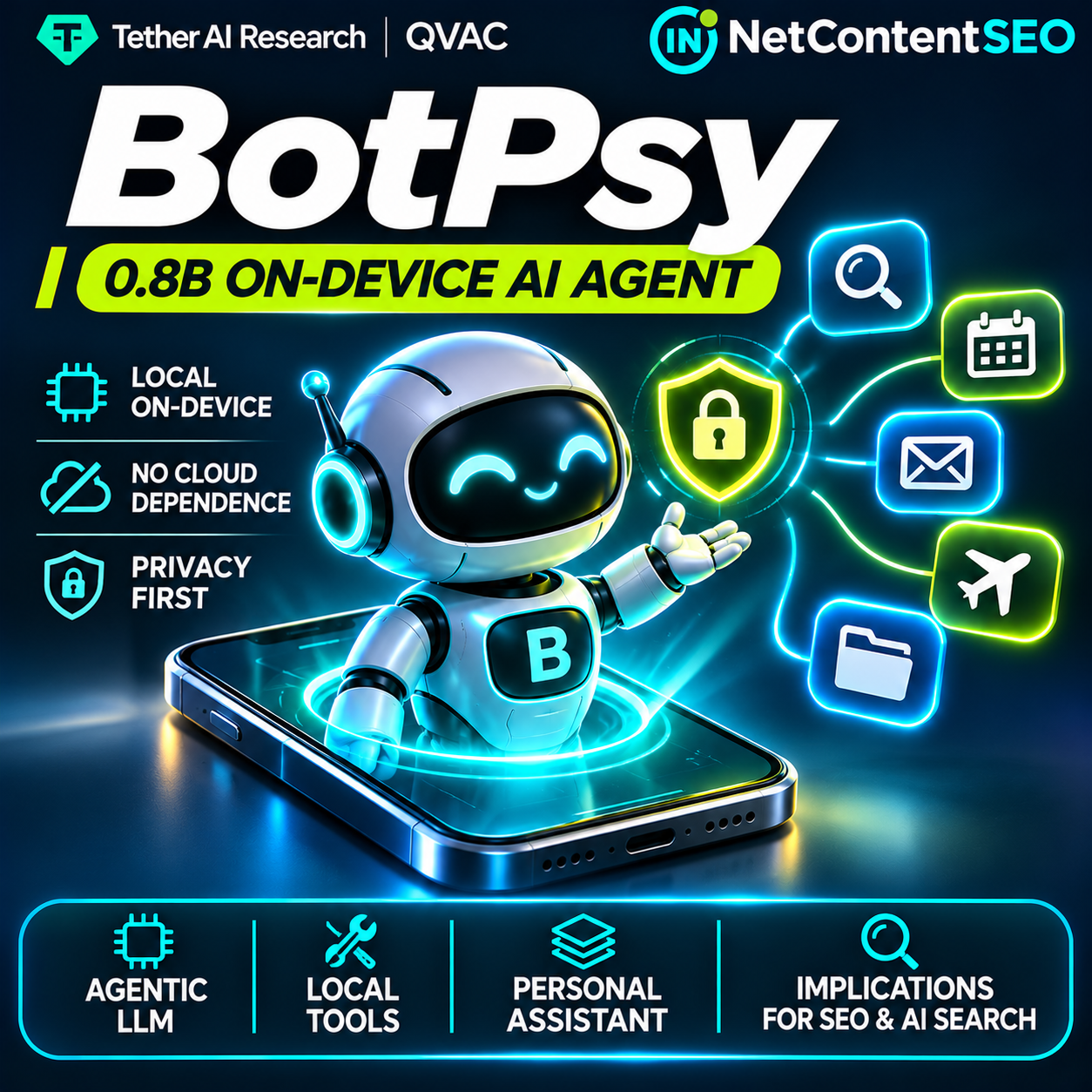
On-device AI agents are becoming more capable without requiring billion-dollar cloud infrastructure. On November 11, 2026, Tether AI Research introduced BotPsy, a 0.8-billion-parameter language model designed for local function calling, tool selection and personal-assistant workflows. Built on Qwen3.5-0.8B, the model targets routine tasks involving calendars, messaging, documents, web research, travel, commerce and device controls. Its significance for AI Search is not that it launches another search engine. It is that small, locally executed agents could become an additional layer between users and the websites, services and APIs they rely on.
The announcement appears in the team's Hugging Face technical article and connects to the broader QVAC local-AI ecosystem. The developers report strong results against similarly sized models, but the numbers are developer-reported evaluations, not independently reproduced findings. BotPsy also has significant limitations: its creators explicitly warn that the small model still makes mistakes and should not be trusted for high-stakes decisions.
What is BotPsy?
BotPsy is a specialized 800-million-parameter agentic language model intended to interpret requests, choose tools and generate structured calls that allow software to perform actions. It is based on Qwen3.5-0.8B and post-trained for instruction following and multi-step tool use. The developers position it for low- to medium-complexity tasks rather than open-ended frontier-level reasoning.
Its target applications include looking up information, handling personal productivity workflows, interacting with calendars and email, managing files, helping with travel research and performing simple commerce-related operations. These are potential use cases and model capabilities; they should not be confused with proof that every complete consumer integration is already shipping or production-ready.
Local inference is central to the project. Running a model on a phone, computer or other owned device can reduce dependency on external inference APIs and keep sensitive input local when the application is properly designed. However, a tool-using agent may still access external websites, cloud calendars or messaging services. On-device inference does not mean every workflow is offline or that no information ever leaves the device.
What do the benchmarks show?
Tether AI Research says BotPsy outperformed every tested model with up to 1.2 billion parameters on six agentic and tool-use evaluations. It also beat the larger Qwen3.5-2B-Think model on five of those six benchmarks. The reported comparison is meaningful because it focuses on selecting and using tools, not simply producing fluent answers.
| Benchmark | BotPsy-0.8B | Qwen3.5-0.8B-Think base | Qwen3.5-2B-Think |
|---|---|---|---|
| BFCL v4 | 44.0 | 23.4 | 37.7 |
| ACEBench | 58.7 | 30.1 | 55.4 |
| τ-bench | 51.5 | 23.2 | 46.5 |
| ToolSandbox | 64.6 | 30.5 | 41.2 |
| Claw-Eval | 46.5 | 39.3 | 48.9 |
| BrowseComp-Plus | 4.5 | 1.9 | 2.8 |
Source: Tether AI Research's published benchmark table. Scores are developer-reported; evaluation conditions and datasets matter, and these figures have not been independently verified for this article.
The team also reports an improvement in IFEval instruction-following scores from 59.7 to 90.8 and in IFBench from 22.0 to 55.9. Its unweighted average across the six agentic benchmarks is reported as 45.0, versus 24.7 for the base model. These gains suggest that specialized training can materially change what a small model can do, but they do not establish reliability in every real-world environment.
One particularly important counterexample is BrowseComp-Plus: BotPsy's reported score is only 4.5. Even though that exceeds the tested comparators, the absolute result illustrates the gap between improving relative performance and solving complex browsing tasks reliably. For search-intensive agents, that distinction is essential.
How did the team train such a small agent?
The developers describe a four-stage post-training process: supervised fine-tuning, multi-teacher on-policy distillation and two rounds of reinforcement learning. The approach combines example tool-use trajectories, guidance from larger teacher models and verifiable rewards for correct tool-calling behavior.
The broader lesson is that model size is not the only determinant of agent usefulness. A smaller model optimized for a constrained set of tools may outperform a larger general-purpose model on a narrow evaluation. That does not imply that BotPsy surpasses frontier cloud models in general reasoning, multilingual knowledge or open-ended research.
Tether also reports reduced reasoning overhead on questions answered correctly by the compared models. Fewer generated reasoning tokens could help with latency and battery use on constrained hardware. Actual device speed, power consumption, memory use and sustained performance still need hardware-specific tests before making deployment claims.
What does on-device deployment actually require?
The project describes open-weight distribution under Apache 2.0, with model formats including Hugging Face safetensors and GGUF variants at bf16, Q8 and Q4 precision for the QVAC SDK and llama.cpp. The announcement uses future-tense language for parts of this release, so developers should verify the actual availability of the weights and files before presenting a particular download as ready.
For a practical pilot, a developer should check the model repository, license, quantization format, supported inference runtime, device memory and tool-call output format. A model that fits on a device is not automatically an agent: it still needs a secure application layer that defines permitted tools, validates arguments, manages credentials and handles failures.
The QVAC platform describes a broader local-first toolkit with text generation, embeddings, retrieval-augmented generation, transcription, translation and other capabilities. Those ecosystem capabilities should not all be attributed to the BotPsy model itself. BotPsy is one component in a larger software stack.
Privacy benefits—and the security limits
Local inference can be attractive because private prompts and files need not be transmitted to a remote model provider. But agentic systems introduce a different risk: a tool may read untrusted web pages, emails or documents containing instructions designed to manipulate the assistant.
Tether's own automated red-team evaluation reports unsafe responses in 21% of tested cases, compared with 36% for the base model. Under prompt-injection attacks, the reported unsafe rate is 31%, down from 46%. Those figures show improvement in the developers' tests, but they are not evidence of comprehensive safety. An unsafe-response rate of nearly one-third under prompt injection is a material limitation for an agent that can perform real actions.
Practical safeguards include explicit tool permissions, confirmation before sending messages or making purchases, strict separation between untrusted retrieved content and system instructions, minimal credential access, logging of consequential actions and a reliable way to stop or reverse operations. The model's developers advise against high-stakes applications, including sensitive financial or health decisions.
Language support is another constraint
BotPsy was primarily trained and evaluated in English, which the developers recommend for use. Their multilingual evaluation includes Chinese, French, Hindi, Italian, Portuguese, Russian and Spanish, with notably weaker results reported for Hindi and Russian.
For international businesses, that means English-language tool-call success should not be extrapolated to every local market. Teams should test the language, writing system, entity names, addresses, currencies and service vocabulary their users actually employ.
Why BotPsy matters for AI Search
Search has traditionally involved a user submitting a query, receiving links and visiting a destination. A tool-using personal assistant can mediate more of that journey. It may search the web, read multiple results, compare options and call a service API without requiring the user to open every source.
BotPsy is relevant to that direction because it explores whether some of these decisions can be made locally by a small model. The project also describes future work around decentralized search and peer-to-peer query handling. Those are roadmap ambitions, not proof of a mature independent search index or a measurable traffic channel today.
The distinction is important for GEO. A model capable of deciding which tool to call is not necessarily a search engine, a citation system or a recommendation platform. A tool-use benchmark does not measure whether publishers receive traffic, whether sources are attributed or how brands are selected.
What could change for publishers and brands?
If personal agents become a meaningful discovery interface, some user journeys may shift from browsing pages to asking an assistant to find, compare and act. A restaurant, tour operator or software provider might be encountered through an agent's retrieval process or API integration rather than a conventional search-results page.
That creates several potential requirements for digital visibility: consistent business identities, accurate product and service details, accessible pages, trustworthy documentation, machine-readable data where appropriate and dependable booking or commerce endpoints. These are sensible readiness measures, not confirmed BotPsy ranking factors.
Small local agents may also work differently from cloud assistants. Their limited context, tool availability, local memory and retrieval design could strongly influence what information they can access. Some might rely on web search APIs, others on cached documents or direct integrations. Without a deployed application and a defined retrieval stack, no universal optimization recipe exists.
SEO implications: accessibility before optimization myths
For technical SEO teams, the immediate lesson is to maintain reliable content access and entity clarity. Pages that load consistently, describe products precisely and expose stable URLs are easier for many types of retrieval systems to process. Structured data can clarify facts where supported, but there is no evidence that a specific Schema.org type increases BotPsy recommendations.
For businesses with APIs, accurate documentation, authentication rules, error responses and structured outputs can be as important as website copy in an agent-mediated workflow. An assistant can only complete a booking or retrieve availability if the relevant tool exists and the application grants permission to use it.
There is no confirmed BotPsy crawler, publisher dashboard, citation index or SEO reporting interface in the announcement. Any claim that BotPsy already sends measurable referral traffic would require independent analytics evidence.
A practical evaluation framework for local agents
Teams interested in testing BotPsy or comparable small models should build an evaluation set based on actual user tasks rather than relying on headline benchmark scores:
- Define the task. For example, find three accessible attractions in a destination, check official opening hours and prepare a comparison without making a booking.
- Specify the allowed tools. Separate web retrieval, local files, calendar access and transaction APIs.
- Measure completion. Track whether the assistant finished the user's intended task correctly, not merely whether it emitted valid JSON or called a tool.
- Verify sources. Check factual accuracy, freshness, source attribution and whether unsupported claims were introduced.
- Test failures. Include stale pages, conflicting prices, missing API data, prompt-injection attempts and unavailable networks.
- Record local costs. Measure latency, memory, battery consumption, retries and human correction effort on actual target hardware.
- Require approval. Keep purchases, messages, account changes and other consequential actions behind explicit user confirmation.
- Compare baselines. Evaluate against the original Qwen model, another small local model and a suitable cloud alternative under equivalent conditions.
The most meaningful KPI for an agent is cost per successfully completed and verified task, including failure handling and user intervention. A cheap model that repeatedly makes the wrong decision may be more expensive in practice than a larger model with a higher per-token price.
How this fits the broader local-AI movement
BotPsy belongs to a growing category of compact, task-specialized models intended to run close to the user. The appeal is not simply lower parameter count. Local execution can offer resilience against API changes, more control over data handling and predictable marginal inference costs after deployment.
However, model distribution, maintenance, security updates, device compatibility and integration engineering still have costs. “No cloud inference bill” is not equivalent to “zero total cost.” Hybrid architectures may remain preferable for tasks that require stronger reasoning, fresh information or expensive computation.
Tether's longer-term vision includes local fine-tuning, device-to-device delegation and decentralized search. Each of these would need separate evidence of real-world availability and performance before it could be treated as an established discovery ecosystem.
Frequently asked questions
What is BotPsy?
BotPsy is an 800-million-parameter agentic language model from Tether AI Research, built on Qwen3.5-0.8B and optimized for tool use and on-device personal-assistant tasks.
When was BotPsy announced?
The Hugging Face technical article was published on November 11, 2026.
Can BotPsy run without a cloud API?
Its design targets local inference. However, individual tools such as web search, cloud calendars and messaging may still require network access.
Is BotPsy open source?
The developers describe an open-weight release under Apache 2.0, with safetensors and GGUF formats. Check the current repository for actual download availability and applicable terms.
Does BotPsy outperform larger AI models?
In the developers' reported tests it outperforms Qwen3.5-2B-Think on five of six selected agentic benchmarks. That does not establish superiority over larger models generally, and independent reproduction remains important.
Is BotPsy safe for autonomous payments or medical decisions?
The developers explicitly warn against high-stakes use. Automated safety tests still show significant failure rates, particularly under prompt-injection attacks.
Does BotPsy support Italian?
Italian is among the languages included in the team's multilingual evaluation, but English is the recommended language. Real-world Italian workflows should be tested independently.
Is BotPsy a new search engine?
No. It is a tool-using model. Search capabilities depend on the surrounding application and integrations.
Will BotPsy affect Google rankings?
No direct Google ranking change is associated with the announcement.
How should publishers prepare for on-device AI agents?
Prioritize accessible, accurate content, clear entity information, trustworthy source references and reliable APIs where relevant. Avoid claiming guaranteed citations or recommendations.
The bottom line
BotPsy is an interesting engineering result: Tether AI Research reports substantial improvements in agentic tool use from a model with fewer than one billion parameters. The more consequential possibility is that useful personal assistants may increasingly operate on devices people already own, using local reasoning to decide when and how to access information or services.
For SEO and AI Search, this is a potential future discovery architecture, not an immediate ranking update or a proven new referral channel. The next evidence to watch is independent benchmark reproduction, real hardware performance, secure tool execution and deployment at meaningful scale.