

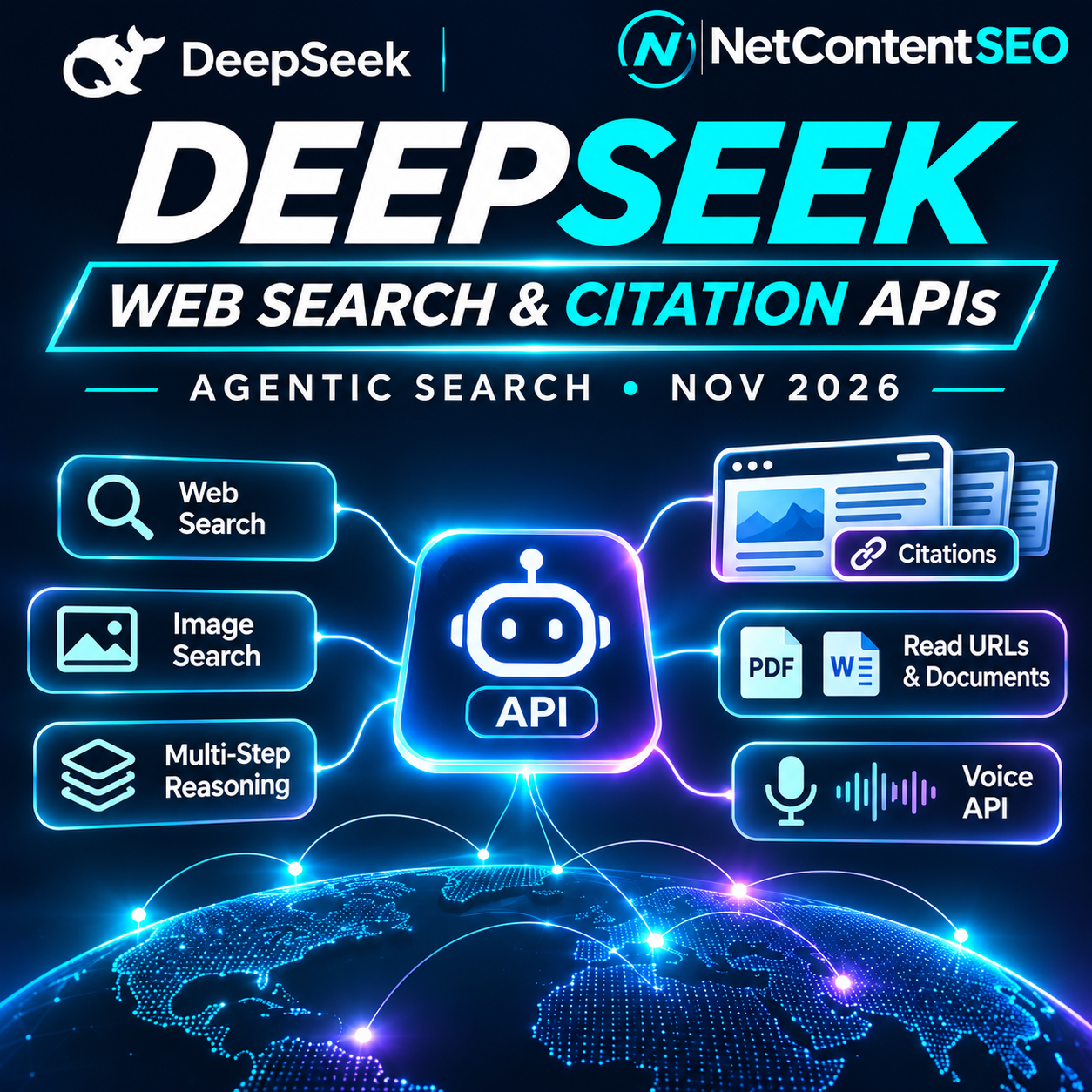

DeepSeek has opened the search, citation and document-processing capabilities of its consumer application to API developers. Announced on November 13, 2026, the release lets developers add web search, multi-step online research, URL reading, file parsing and safety checks to conversations built on deepseek-flash. DeepSeek also offers separate Search, Fetch, OCR, automatic speech recognition (ASR) and text-to-speech (TTS) APIs for developers who want to assemble their own workflows.
For AI Search and GEO, the significant development is not a new model benchmark. It is a new way for third-party applications to use DeepSeek's search infrastructure and return source-linked answers. That potentially expands the number of agents and products in which publisher content can be retrieved, summarized and cited. It does not yet demonstrate an increase in website traffic, AI citations or publisher revenue.
What DeepSeek announced on November 13
In its official announcement, The full DeepSeek App experience, now via API, DeepSeek said it was making the features behind its app available to developers. The API changelog confirms that deepseek-flash supports built-in web search, deep-thinking search, file input and URL reading across three interfaces: Messages, Responses and Chat Completions.
Importantly, the service handles tool calls and assembles retrieved context on the server. Developers do not need to run a separate browser crawler for the built-in features, although they remain responsible for the surrounding product, safety settings, user experience and how source information is displayed.
The release includes several distinct capabilities
| Capability | What it does | Important limitation |
|---|---|---|
| Web search | Searches web pages or images and returns answers with citations | Requires the deepseek_web_search tool; behavior depends on thinking mode |
| Deep-thinking search | Searches, opens pages and finds information across multiple reasoning steps | Must enable thinking and the search tool |
| URL reading | Fetches links supplied in user messages and adds page content to the answer context | Requires deepseek_read_url |
| File input | Parses PDFs, Office files and images into conversation context | File parsing is not equivalent to unrestricted access to private documents |
| Search API | Returns structured web search results to developer code | Separate from model-managed search; direct Search API image search is not yet supported |
| Fetch API | Retrieves a specified web page as Markdown | Does not automatically verify the retrieved page's claims |
| OCR | Extracts text from images and documents | Accuracy depends on input quality and layout |
| ASR and TTS | Support speech-to-text and text-to-speech workflows | Voice APIs are separate from web retrieval |
| Safety checks | Screen inputs and outputs and provide refusal indicators | Public-facing applications must enable them under DeepSeek's documented requirements |
These distinctions matter. An application using the raw Search API receives results to process itself; an application using built-in web tools can let the model decide when to search and incorporate results into a response. Neither approach guarantees accurate attribution or a referral to a source website.
The October 17 milestone: DeepSeek already had a search API
It would be inaccurate to describe November 13 as the first time DeepSeek made any web search API available. Its official changelog records the opening of its in-house Search API on October 17, 2026. DeepSeek describes that system as a general-purpose, multilingual search engine indexing hundreds of billions of web pages and processing hundreds of millions of requests daily. Those scale figures are vendor claims, not independently audited statistics.
The November release builds on that earlier infrastructure by integrating search, URL reading and file handling into the existing conversational APIs. For developers, the change reduces the work required to reproduce a search-enabled AI assistant.
How web search works with deepseek-flash
DeepSeek documents two main search patterns. With thinking disabled and deepseek_web_search enabled, the model decides when a question requires web or image search and can return citations. With thinking enabled, the same tool supports multi-step research: the model may search, read pages and find text in documents as its reasoning progresses.
The Web Tools documentation also explains that citations appear as structured metadata, rather than simply as text appended to an answer. In streaming responses, citation updates can arrive as citations_delta events. A client application should preserve and render this metadata rather than discarding it.
Developers should not assume that the model searches every time. DeepSeek says the model decides when to use the tool, and the API does not permit forcing the built-in search tool by naming it through tool_choice. Disabling tools also disables URL reading.
Developer example: enable search and URL reading
DeepSeek's official guide provides a Chat Completions pattern using the deepseek-flash model and server-side tools:
curl https://api.deepseek.com/chat/completions \
  -H "Content-Type: application/json" \
  -H "Authorization: Bearer $DEEPSEEK_API_KEY" \
  -d '{
    "model": "deepseek-flash",
    "thinking": {"type": "enabled"},
    "tools": [
      {"type": "deepseek_web_search"},
      {"type": "deepseek_read_url"}
    ],
    "messages": [
      {"role": "user", "content": "Summarize the latest changes to DeepSeek API search with sources."}
    ],
    "stream": true
  }'
This is an illustrative request adapted from the official Web Tools guide, not evidence of a live successful API call in our environment. Developers should review current request limits and response formats before using it in production. API keys should remain server-side and never be embedded in public client code.
Standalone Search and Fetch APIs
For teams that want deterministic control over retrieval, DeepSeek offers raw JSON endpoints at POST https://api.deepseek.com/v1/tools/search and POST https://api.deepseek.com/v1/tools/fetch. The Search endpoint returns structured results; Fetch retrieves a single page and converts it to Markdown. Both use DeepSeek API bearer authentication.
According to the Search & Fetch guide, direct image search is not yet supported through the standalone Search API. Image search is available through the model-managed web tool instead. That is a meaningful integration detail for applications that need to search visual content.
Developers building their own RAG pipeline can use Search to identify candidate pages, Fetch to retrieve them and a separate model call to evaluate relevance, extract facts or produce an answer. They should retain source URLs, timestamps and provenance throughout the process.
Pricing: tool usage is billed separately
DeepSeek's November announcement explicitly notes that extended capabilities incur tool usage fees in addition to standard model token charges. That means cost estimates based only on input and output tokens will understate the expense of search-heavy agents. An application that makes repeated searches, fetches several pages and parses uploaded files can have a different cost profile from a simple chatbot.
Before deploying, consult the official Models & Pricing page and the relevant tool pricing breakdown. Track the number of search and fetch calls, tokens, latency, failures and cost per successfully completed task. Do not assume that a single API price covers every feature.
Why this is significant for AI Search and GEO
DeepSeek is moving from an AI product that performs its own web research to a provider of retrieval infrastructure that other products can embed. A travel assistant, product comparison service, research agent or enterprise knowledge tool could use DeepSeek to discover current webpages, read documents and assemble an answer. If those applications expose citations, publishers may gain a new form of source visibility beyond conventional search engines.
However, three separate stages must be measured: retrieval (a page was found), citation (the answer attributed a claim to that page) and referral (a user clicked through). A site can appear in retrieval without being cited, or be cited without receiving traffic. The November API announcement establishes developer access to tools, not any measured improvement in those downstream outcomes.
DeepSeek's claims about SEO spam and GEO manipulation
DeepSeek's October 17 changelog says its search engine filters SEO spam, GEO manipulation and low-quality AI-generated content through detection mechanisms. This is an official description of the company's system, not an independently documented ranking-factor list or a validated explanation of how particular domains are evaluated.
For publishers, the defensible approach remains producing original, accurate and attributable content. There is no verified DeepSeek-specific schema trick or keyword pattern that guarantees inclusion in its search results or citations. Claims about penalties or rewards for particular GEO techniques should be supported by controlled tests, not extrapolated from the marketing description.
How publishers can test DeepSeek citation visibility
- Define a query set: collect 20–30 prompts covering brand facts, product comparisons, current news and practical questions in relevant languages.
- Record the environment: note the date, model, API interface, thinking setting and enabled tools for every test.
- Separate retrieval from attribution: store URLs returned by Search or Fetch and compare them with citations in the final response.
- Inspect citation metadata: capture structured citation fields, including URLs and titles, rather than relying only on the rendered answer text.
- Test source accuracy: verify that cited pages actually support the claims attributed to them.
- Compare languages and query types: assess whether the same entity receives consistent coverage in Chinese, English and other target languages.
- Monitor traffic separately: use server logs and analytics to investigate referrals where identifiable, without assuming every citation generates a click.
- Test resilience: use harmless prompt-injection samples in retrieved pages to check that untrusted instructions do not override application rules.
- Measure economics: calculate cost per correctly answered question or completed agent task, including search and fetch fees.
These tests can establish behavior for a particular application configuration. They do not establish a universal ranking rule for all DeepSeek-powered products.
What this means for developers building AI agents
For developers, server-managed retrieval can simplify implementation: the model chooses when to search, reads URLs and receives parsed documents without requiring the application to coordinate every retrieval step. Standalone endpoints remain useful when precise control, auditing or custom ranking is essential.
The trade-off is observability. An agent that makes autonomous multi-step searches needs careful logging and evaluation to identify which sources influenced the answer, whether a source was misread and how often retrieval failed. Applications should provide visible citations, preserve source metadata and implement human review for consequential decisions.
Public-facing applications also need to enable DeepSeek's documented safety checks and remain responsible for moderation, applicable model registration and AI-generated-content labeling. These are operational requirements, not optional SEO enhancements.
What has not been established
| Claim | Status |
|---|---|
| DeepSeek released app-style search and document APIs on November 13 | Confirmed by official announcement |
| deepseek-flash supports web search with citations | Confirmed by official documentation |
| Thinking mode supports multi-step online research | Confirmed by official documentation |
| Standalone Search and Fetch endpoints exist | Confirmed; Search opened earlier in October |
| Direct Search API supports image search | Not yet; image search is available through web tools |
| Every DeepSeek-powered app will display citations | Not established; depends on implementation |
| DeepSeek has changed its public search rankings | No such ranking update demonstrated |
| Publisher clicks or revenue increased after release | No supporting data available |
Frequently asked questions
What did DeepSeek launch on November 13, 2026?
It opened app-style capabilities including web search, deep-thinking search, file parsing, URL reading and safety checks to API developers, alongside standalone OCR and speech-related services.
Which model supports the new integrated web tools?
DeepSeek documents deepseek-flash across Messages, Responses and Chat Completions APIs.
Can DeepSeek return citations through its API?
Yes. The web search tool can return answers with structured citation metadata, which developers should preserve and display appropriately.
Does the model search automatically?
When the relevant tool is enabled, the model decides whether to search based on the question. Search is not guaranteed for every prompt.
What is the difference between web search and deep-thinking search?
Non-thinking mode supports web or image search with cited answers. Thinking mode can search and read pages over multiple reasoning steps.
Can DeepSeek read PDFs and Office documents?
Yes. The documented file-input capability parses PDFs, Office files and other supported formats into the conversation context.
Can developers call Search without asking a model to search?
Yes. Standalone Search and Fetch endpoints provide raw JSON results and page content for custom workflows.
Is image search available through the standalone Search API?
Not yet, according to DeepSeek's Search & Fetch documentation. It is available through model-managed web tools.
Are search tools free?
No. DeepSeek states that tool usage fees apply in addition to normal token charges.
Will this increase my site's traffic?
There is no evidence of a general traffic increase. Developers can now build more search-enabled agents, but retrieval, citation and referral behavior must be measured independently.
The bottom line
DeepSeek's November 13 release turns capabilities previously associated with its consumer app into reusable infrastructure for developers. Built-in search, citations, multi-step research, document reading and standalone retrieval endpoints make it easier to build AI agents grounded in current web content. For SEO and GEO, this is a credible new distribution opportunity for source material, but not yet a verified new traffic channel. The next step is to test which pages agents retrieve, which they cite and whether those citations lead to measurable user visits.
Sources
- DeepSeek — The full DeepSeek App experience, now via API, November 13, 2026 (official announcement).
- DeepSeek API Changelog, October 17 and November 13, 2026 (official release history).
- DeepSeek — Web Tools (official citation, thinking-mode and streaming documentation).
- DeepSeek — Search & Fetch (official standalone API documentation).
- DeepSeek — Build a Chatbot (official integration guide).