

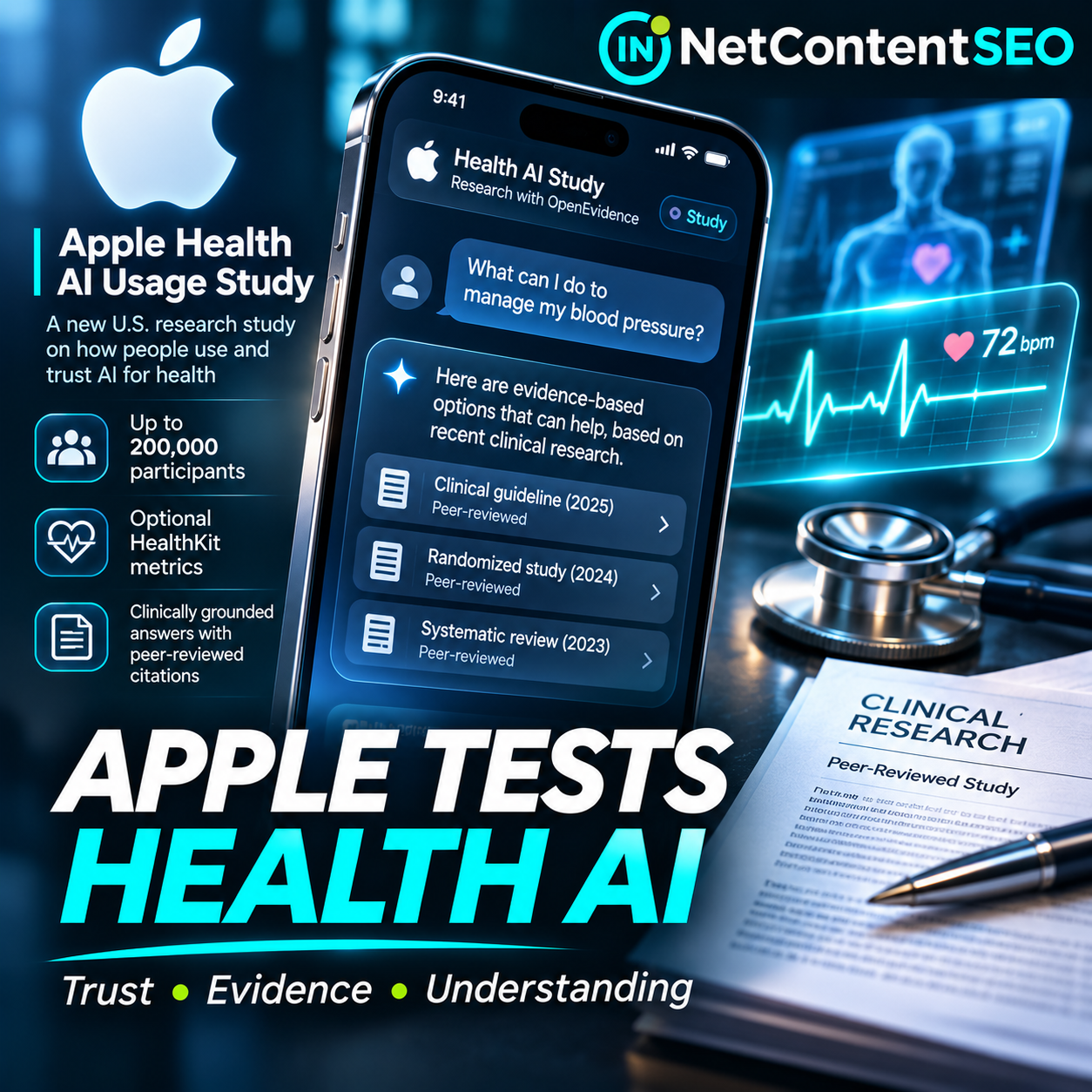

Apple has launched a dedicated iPhone research app to investigate how people understand, trust and act on AI-generated health information. Announced on November 15, 2026, the Apple Health AI Usage Study is being conducted with clinical AI company OpenEvidence and could enroll up to 200,000 US participants. It is a research project—not a public launch of a medical chatbot inside Siri or Apple Health, and not a tool intended to diagnose or treat disease.
That distinction is central to the story. Many AI systems can produce plausible medical explanations. Apple is asking a more difficult question: do people understand those explanations, recognize their limitations, and use them appropriately when making real-world decisions or preparing to speak with clinicians?
What Apple announced
In its official announcement, Apple said the study will evaluate trust, comprehension, response quality and everyday health actions. Participants use a separate Apple Health AI Study App to ask questions about symptoms, health information, fitness or personal metrics. The underlying clinical AI technology comes from OpenEvidence, which draws on medical literature and clinical guidelines, including sources such as The New England Journal of Medicine, JAMA and Nature.
Responses include linked, peer-reviewed citations so participants can inspect the evidence behind explanations. Participants can rate the quality and usefulness of answers, and the study includes follow-up surveys. The central goal is to evaluate not merely whether the system can produce an answer, but whether the person receiving it can make sense of it.
Who can participate?
| Requirement | Confirmed details |
|---|---|
| Location | United States |
| Age | 21 or older |
| Enrollment | Up to 200,000 eligible participants |
| Device | Apple Intelligence-enabled iPhone 15 Pro or later |
| Operating system | iOS 26 or later |
| Participation | Voluntary enrollment through the dedicated study app |
Some reporting loosely refers to “iPhone 15 or later,” but Apple's own eligibility wording specifies an Apple Intelligence-enabled iPhone (iPhone 15 Pro or later). An ordinary iPhone 15 does not meet that description. The study is not announced as available in Europe or other markets.
How the AI health experience works
A participant might ask what a resting-heart-rate trend means, how to understand a laboratory result or which questions to raise during a medical appointment. The app is designed to explain complex information in approachable language and cite clinical evidence. Apple says the experience can also help people prepare for visits with their own doctors.
Participants may optionally share selected HealthKit information—including activity, sleep, resting heart rate and laboratory results—to explore whether personalized context makes answers more relevant or understandable. Sharing is a choice, not a requirement to provide every health record. The app's App Store listing also describes uses such as understanding symptoms and preparing exercise or meal plans, while emphasizing that the study does not provide medical advice, diagnosis or treatment.
The clinical grounding is significant but should not be overstated. A citation to a peer-reviewed paper is not a guarantee that a particular answer correctly applies that evidence to an individual's circumstances. Nor does a consumer-facing AI explanation replace examination, diagnosis or treatment by a qualified professional.
Privacy: what Apple promises, and what remains to be evaluated
Apple says study data will not be used to train AI models, that participants control optional HealthKit sharing and survey responses, and that safeguards are designed to protect confidentiality. Reporting from Fierce Healthcare describes a processing flow in which identifying information is removed from queries on the device, then further separated and screened in a secure study environment before reaching OpenEvidence. TechCrunch reports Apple's statement that OpenEvidence deletes query-and-response data after 24 hours.
These are company-reported safeguards, not an independent security audit. “Not used to train models” does not mean “no data is processed,” and the 24-hour deletion claim about OpenEvidence should not be generalized to every category of study record retained by Apple or its research partners. Anyone considering participation should read the current consent and privacy materials in the app before sharing sensitive data.
Why Apple is studying comprehension rather than just answer accuracy
There is a critical gap between an AI system producing a medically plausible response and a patient safely using it. An answer may be technically correct but too dense, omit an important caveat, or create unjustified reassurance. The study therefore investigates whether people understand responses and whether they help prepare for appropriate clinical conversations.
Apple says the app includes safeguards intended to identify some concerning questions and suggest consulting a healthcare provider or other resources. That is a safety feature, not a guarantee that all emergencies or dangerous symptoms will be recognized. Participants should not rely on the app for urgent assessment or medical monitoring.
What OpenEvidence contributes
OpenEvidence is a clinical AI platform used by healthcare professionals. For this study, it supplies the medical-answering technology while Apple designs the consumer research experience. The collaboration connects peer-reviewed medical evidence with questions expressed in everyday language.
This distinction matters because clinical reference systems and consumer chatbots serve different audiences. Doctors may be comfortable reading specialist terminology and weighing conflicting studies; a patient may need an explanation of uncertainty, practical questions to ask and a clear indication of when professional evaluation is appropriate. The study aims to investigate that translation rather than assuming it is already solved.
What this means for AI Search and healthcare SEO
For NetContentSEO, the development signals a potential evolution in how health information is discovered and consumed. Instead of typing a question into a search engine, opening several medical websites and interpreting them independently, some users may increasingly ask an assistant to synthesize evidence and contextualize it using voluntarily shared personal information.
But the study does not announce a new Apple search engine, a healthcare ranking algorithm, a guaranteed source-citation mechanism for publishers, or a rollout inside Siri. It provides no measured change in search referrals. Any claim that Apple's research app has already reduced health publishers' traffic would be unsupported.
The defensible editorial implication is that evidence quality, clear authorship, medical review, dates of revision, transparent citations and understandable explanations remain essential for trustworthy health content. These are sound publishing practices, not newly announced Apple ranking factors. For high-stakes health queries, discoverability without accuracy is not a success.
A new challenge for publishers: citations versus actual comprehension
The study raises an important question for the wider AI Search industry. If a system can cite an authoritative journal but the user misinterprets its summary, has the information experience succeeded? Conversely, if a useful explanation appears entirely within an app, how should the researchers and publishers responsible for the original evidence be recognized and supported?
Apple has not published study outcomes yet. The research could eventually inform design principles for citation presentation, uncertainty communication, source transparency and patient handoffs, but those are possibilities, not announced features or findings.
What researchers should watch
Meaningful outcomes would include whether users understand cited evidence, recognize when to consult a clinician, distinguish general information from personalized medical advice, and arrive better prepared for appointments. Researchers should also examine whether optional personal data improves usefulness without introducing confusion or misplaced confidence. The number of enrolled participants alone will not demonstrate that the app improves health outcomes.
Future reporting should distinguish usability and trust survey results from clinical efficacy. A high satisfaction score is not proof of diagnostic accuracy; a helpful appointment-preparation tool is not automatically safe for triage.
Frequently asked questions
Is Apple launching an AI doctor?
No. Apple has launched a research app for studying interactions with health AI. The app is not intended to diagnose, treat or replace medical professionals.
Is the app available outside the United States?
Apple's November 15 announcement limits study enrollment to eligible US participants. No international expansion has been confirmed.
Can an iPhone 15 user join?
Apple specifies an Apple Intelligence-enabled iPhone 15 Pro or later with iOS 26 or later. The standard iPhone 15 is not covered by that eligibility wording.
Does Apple use participants' health data to train AI models?
Apple says study data will not be used for AI model training. Participants can choose whether to share selected HealthKit data and survey responses.
Does the app show medical sources?
Yes. Apple says answers include links to peer-reviewed clinical citations. Citations support transparency but do not eliminate the need to verify medical information with professionals.
Will this feature come to Siri or the Health app?
Apple has not confirmed a consumer rollout of this research experience into Siri or the main Health app.
The bigger picture
Apple's study represents a shift in emphasis from building an AI that can answer health questions to testing whether those answers are genuinely understood and responsibly used. For the AI Search ecosystem, that is a consequential distinction. In medicine, the quality of an answer is inseparable from the quality of its evidence, the clarity of its communication and the user's ability to act safely on it.
Sources and methodology (reviewed November 16, 2026): Apple Newsroom, November 15, 2026; Official App Store listing; TechCrunch, November 15, 2026; Fierce Healthcare, November 15, 2026. Company statements about privacy and safety are attributed rather than independently audited. No study results or publisher traffic impacts have yet been established. Barry Schwartz coverage: not checked.