
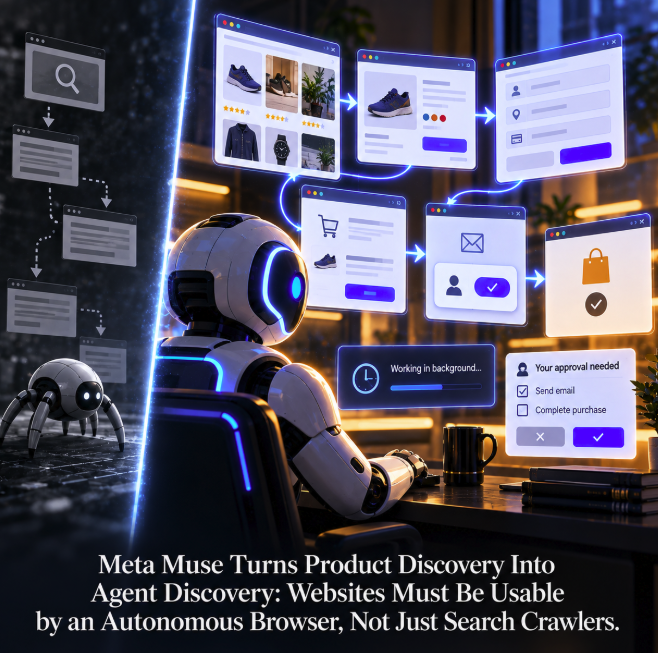
Search engines taught websites to be discoverable by machines. Personal AI agents are beginning to impose a harder requirement: the machine may need to use the website after it finds it. Meta's new Muse agent can open its own browser, navigate services, fill out forms, negotiate on a user's behalf and continue working after the user closes the app. When a sensitive action arrives—such as sending an email or completing a purchase—it stops and asks for approval.
Meta introduced Muse on September 8 as a personal AI agent built around a dedicated cloud computer called Muse Secure VM. According to the official Meta announcement, users can give the agent tasks ranging from booking travel to selling a car or lowering a bill, and Muse can advance longer projects autonomously in the background. The product is rolling out in the United States on iOS, Android and the web, with Meta saying it will also come to AI glasses.
For ecommerce teams and publishers, the most consequential part is not another conversational interface. It is the browser. Muse is designed to operate the same web that people do, turning a website from something an AI system merely reads into an environment an AI system may need to navigate and transact with.
The agent has a computer, not just an answer box
Muse runs inside a dedicated virtual machine containing its browser and the user's connected data. Meta says the agent can open websites, complete forms and negotiate while working toward a goal. Long-running tasks can continue after the person leaves the app, with Muse returning when circumstances change or when it reaches an action that requires the user's permission.
This architecture changes the interaction model. A conventional search crawler fetches pages primarily to understand and index content. A browser-operating agent can move through a multi-step process: search for an option, inspect a product page, compare alternatives, enter information, reach checkout and prepare an action for confirmation. The website is no longer only an information source. It becomes part of the agent's execution environment.
Meta is already connecting that execution layer to payments. The company says Muse can check out using Stripe's Link, including a one-time-use card that keeps the user's actual card details hidden from the merchant flow. Shop Pay support is planned, along with 1Password integration that would let Muse use credentials a person has already stored.
Product discovery becomes an agent-usability problem
The immediate SEO analogy is tempting: if search crawlers needed crawlable pages, autonomous agents need agent-friendly pages. But the second requirement is broader. A crawler can succeed after extracting a product name, price and description. A browser agent may need to identify the correct variant, understand availability, manipulate controls, complete address fields, interpret delivery choices and recover when the site changes state.
That means product visibility and product operability begin to converge. A merchant could theoretically be easy for an AI system to discover but difficult for an agent to buy from. Conversely, a technically straightforward store with clear product states and predictable checkout interactions may be easier for an autonomous browser to complete successfully even without a special agent integration.
Meta has not published a universal optimization specification telling websites how to rank or perform inside Muse, and its launch announcement does not establish a new SEO ranking factor. The practical implication is more fundamental: if consumers delegate more research and purchasing tasks to agents that operate browsers, web usability increasingly has a machine customer as well as a human one.
JavaScript, forms and state now matter beyond human UX
Many websites already contain friction that humans tolerate because they can improvise. A person can close a newsletter modal, infer that an unlabeled icon opens a size selector, retry a form after a vague validation error or understand that a visually styled card is actually a button. An autonomous browser must correctly perceive those states and determine the next valid action.
For web teams, this strengthens the case for semantic HTML, properly labeled controls, stable forms, explicit validation messages and clear state changes. Those practices have long been important for accessibility and robust frontend engineering. Agentic browsing adds another reason to avoid interfaces whose meaning exists only in visual convention or brittle client-side behavior.
Checkout is an especially demanding test. Prices, taxes, shipping costs, inventory and delivery dates can change during a session. Optional add-ons can look like required steps. Authentication challenges can interrupt a flow. A useful agent must distinguish informational content from actionable controls and recognize when a change is consequential enough to require the user to decide.
Meta puts a human checkpoint before sensitive actions
Muse is not designed to execute every action without supervision. Meta says it checks with the user before sensitive actions such as sending an email or making a purchase. The system also provides an audit trail showing what Muse has done and what it plans to do.
A separate Sentinel agent runs on the same secure machine but is isolated from Muse at the system level. Meta says nothing Muse does reaches the internet unless Sentinel approves it, with the user asked for permission when necessary. Credentials and payment methods are stored so that Muse can use them without seeing the underlying secret values.
Those controls are important because browser agents encounter untrusted content by design. A system navigating arbitrary websites can be exposed to malicious instructions, deceptive interfaces and content designed to influence agent behavior. Meta presents Secure VM and Sentinel as part of its answer to that problem, although the launch announcement is a vendor description of its own security architecture rather than independent evidence that browser-agent risks have been eliminated.
The commercial funnel may increasingly happen before the human visits
Muse also suggests a change in what “traffic” means. In a conventional search journey, a person searches, clicks a result, browses a merchant's site and makes a decision. An agentic journey can move much of the research upstream. The user may tell Muse what they need, allow it to compare options in the background and become directly involved only when the agent asks for approval to purchase.
That can compress the visible human funnel. The merchant still needs to supply accurate product information and a functioning transaction path, but the person may never manually browse the category page, read every comparison or interact with the site's merchandising in the traditional sequence. Some of that work is delegated to software.
This makes machine-readable accuracy more economically important. Product names, variants, prices, stock status, shipping rules, return conditions and other commercial facts need to remain consistent across the page and the transaction flow. An agent that discovers one price and encounters another at checkout has to decide whether the change is expected, an error or a reason to return control to the user.
Agents can negotiate, not merely compare
Meta's announcement goes further than product search by saying Muse can negotiate on a user's behalf. The company gives examples such as selling a car for more or lowering a bill. This pushes browser automation beyond retrieval and form filling into interactions where the website or service may itself need to respond dynamically to an agent representing a customer.
If that model becomes common, businesses will face a new design question: which customer interactions should an autonomous agent be allowed to complete, and where should a human be required? Some organizations may welcome machine-mediated workflows because they reduce service costs and standardize transactions. Others may need stronger verification when discounts, contractual commitments, account changes or regulated actions are involved.
The answer will vary by industry, but the underlying shift is the same. Websites have historically been designed around humans operating browsers and bots fetching documents. Muse introduces a third actor at consumer scale: a bot operating a browser on behalf of a human, with enough autonomy to move through a workflow but explicit checkpoints around consequential actions.
Agent discovery will require more than crawler access
None of this makes conventional SEO obsolete. Agents still need to discover products, businesses and information, and search engines, structured data, feeds, brand authority and crawlable content remain ways information enters machine-mediated journeys. What changes is the endpoint. Discovery is increasingly valuable only if the agent can do something useful with what it finds.
For technical teams, a sensible preparation strategy is therefore broader than making pages indexable. Important information should be available in accessible page content; interactive controls should have clear semantics; forms should behave predictably; error and success states should be explicit; prices and inventory should stay synchronized; and critical flows should not depend on ambiguous visual interactions that only a human can interpret reliably.
Businesses should also test real workflows rather than only individual pages. A product page can look perfectly machine-readable while the cart, authentication or checkout sequence breaks automation. As autonomous browsers become more common, end-to-end task completion may become as important a technical quality signal for commerce operations as crawlability has been for search.
The web is gaining a new kind of visitor
Meta describes Muse as a consumer product rather than a new web standard, and there is no evidence that sites must implement a Muse-specific protocol to participate. That is precisely what makes the launch notable. The agent is designed to use the existing web through a browser, meaning today's websites may already be encountering the interface assumptions that tomorrow's autonomous customers will have to navigate.
The transition from search crawler to browser agent changes the optimization question. Search asked whether a machine could find and understand a page. Agentic commerce asks whether a machine can find the page, understand the offer, operate the interface, complete the workflow and know when to ask the human for permission.
Muse is one implementation, and its real adoption and commercial impact remain to be measured. But its architecture makes the direction unusually concrete. Product discovery is becoming agent discovery, and for websites the emerging challenge is not simply to be visible to AI. It is to be usable by AI when the software arrives with a browser, a task and a customer's permission to act.