

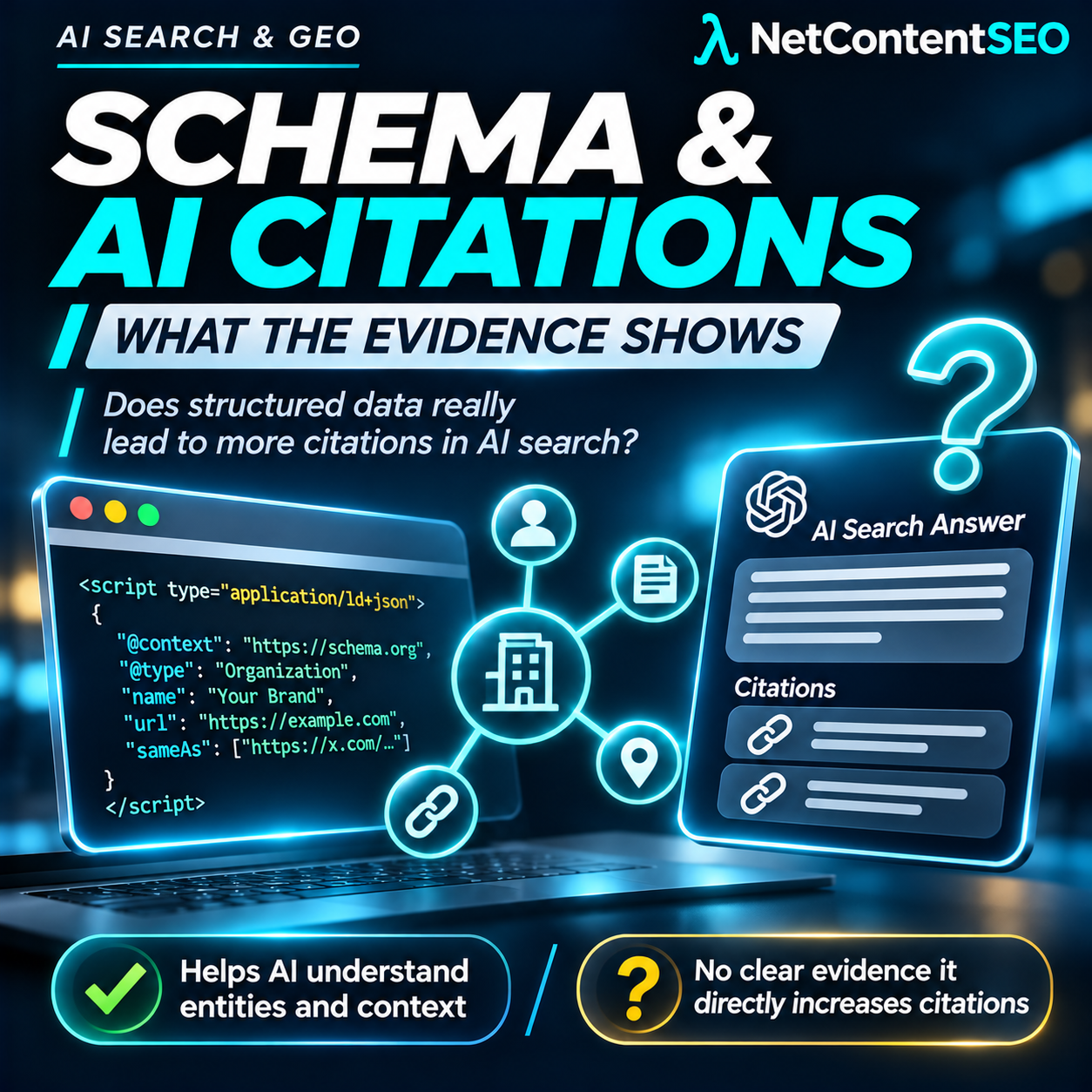

November 2026 — Technical SEO analysis. Does adding Schema.org markup make a page more likely to be cited in ChatGPT, Google AI Mode or AI Overviews? The strongest available answer is not demonstrably. Structured data is useful for identifying entities, describing content and enabling supported Google Search features. But the evidence that simply adding JSON-LD causes more AI citations is weak, and several controlled or quasi-controlled studies have failed to find a meaningful lift.
This is not an argument against structured data. It is an argument for separating three questions that often get bundled together: Can a search system understand the markup? Does it use the markup at a particular stage of retrieval or answer generation? Does that use cause a measurable increase in citations? A yes to the first question does not establish the third.
What Search Engine Land's analysis actually says
In How schema markup fits into AI search — without the hype, published March 25, 2026, Aimee Jurenka reviewed the gap between plausible technical benefits and citation claims. The article distinguished confirmed use of structured data for understanding content in major search ecosystems from the absence of convincing causal evidence that schema alone produces AI visibility gains. It also noted that an LLM's ability to process structured information does not prove that a live AI search product reads or privileges a page's JSON-LD when selecting sources.
The practical distinction is essential. Schema can identify a company, connect an author to an article, specify a product's price or clarify that two references point to the same entity. But a model can understand a company correctly and still choose not to cite its website. Source selection also depends on query relevance, accessible evidence, the retrieval system and how the answer is assembled.
The strongest test: 1,885 pages that added JSON-LD
A May 2026 report on Ahrefs' experiment describes 1,885 pages that added JSON-LD, compared with matched pages that did not. Researchers examined citation changes before and after implementation across Google AI Overviews, Google AI Mode and ChatGPT. Their central result was no meaningful increase in citations attributable to adding schema.
| AI surface | Estimated citation change versus controls | Interpretation |
|---|---|---|
| Google AI Overviews | −4.6% | A small statistically notable negative difference, but the researchers could not establish schema as the cause |
| Google AI Mode | +2.4% | Too small to distinguish confidently from random variation |
| ChatGPT | +2.2% | Too small to distinguish confidently from random variation |
These are not universal conversion or ranking figures. They are study-specific citation estimates. The analysis also observed that pages cited by AI were substantially more likely to contain JSON-LD, but that correlation did not survive as a clear positive effect when the researchers examined pages that actually added markup.
There are important limitations. The test focused on pages already receiving substantial AI citations, pooled different schema types and used a 30-day observation window. It does not answer whether good markup could help a previously unknown page become eligible for discovery or whether a specific schema type matters in a narrower workflow. It does, however, undermine the common sales claim that adding JSON-LD to an already visible page reliably produces more citations.
Why correlation is not causation
Well-maintained sites often have structured data because their teams also invest in technical SEO, editorial quality, internal linking, product information and brand consistency. Those same sites may be more likely to earn links, rank well and be retrieved by AI search. If schema-rich sites receive more citations, it is tempting to credit the markup. But the underlying cause may be the broader quality and visibility of the site.
A separate 2026 preprint examining 730 AI citations across commercial queries offers a useful methodological warning. An initial statistical model appeared to find a negative association between schema and citations, but the effect disappeared after the researchers accounted for how the control sample was constructed. The corrected analysis did not find a statistically significant schema effect. The paper is a preprint and should not be treated as definitive, but it illustrates how easily a poorly controlled comparison can manufacture a misleading conclusion.
What Google officially says about schema and AI search
Google's official guidance for generative AI features is unusually direct: structured data is not required for appearing in AI Overviews or AI Mode, and there is no special Schema.org markup that website owners need to add for those features. Google still recommends using appropriate structured data as part of conventional SEO, particularly for supported rich-result eligibility.
Its structured-data documentation explains that markup provides explicit clues about page meaning and can help Google understand entities and display certain rich results. That is a real, documented use case. It is not a guarantee of inclusion in AI-generated answers.
Google also stresses ordinary search fundamentals: pages must be crawlable, indexed and eligible to appear with a snippet; useful original content and clear technical structure remain important. A technically perfect JSON-LD block cannot compensate for an inaccessible page, an unsupported claim or thin content.
Does ChatGPT actually read JSON-LD?
That question needs to be split by processing stage. A real-time page-fetching component might extract visible HTML without retaining JSON-LD. An indexing system may process structured data differently. Training data, retrieval, grounding and final answer generation are separate processes. Observing one of them does not prove how the others work.
As summarized by Search Engine Land's later review of the evidence, a searchVIU experiment found that five AI systems ignored JSON-LD, hidden Microdata and RDFa when directly fetching pages during the tested interactions. This is evidence about the observed real-time retrieval behavior, not proof that those platforms never use structured data elsewhere in their infrastructure.
For ChatGPT and Perplexity in particular, publishers should avoid asserting undocumented schema-based citation boosts. A model being capable of parsing JSON-LD does not mean its search pipeline exposes that markup to the model or uses it as a selection signal.
Entity clarity is valuable even without a citation boost
Schema is most defensible when it makes facts explicit and consistent. An Organization node can state a business's canonical name and website. A Person node can identify an author. An Article node can link the publication to its author and publisher. A Product node can describe a specific item. Stable @id values can connect these nodes across pages without treating every occurrence as an unrelated entity.
Consider an editorial publisher with a brand page, author biography and news articles. A coherent graph can identify the publisher as one organization, the author as one person and each article as a separate work. This helps avoid ambiguous markup and supports downstream consumers that do process structured data. It does not prove that ChatGPT will cite the publisher more often.
Example: a small, coherent JSON-LD entity graph
The following illustrative example links a publisher, an author and an article. Replace every example URL, name, date and title with accurate values before deployment. The sameAs property should reference genuine authoritative profiles for the same entity, not loosely related websites.
<script type="application/ld+json">
{
  "@context": "https://schema.org",
  "@graph": [
    {
      "@type": "Organization",
      "@id": "https://example.com/#organization",
      "name": "Example Publisher",
      "url": "https://example.com/"
    },
    {
      "@type": "Person",
      "@id": "https://example.com/authors/jane/#person",
      "name": "Jane Example",
      "url": "https://example.com/authors/jane/"
    },
    {
      "@type": "Article",
      "@id": "https://example.com/articles/schema-ai/#article",
      "headline": "Schema and AI Citations",
      "mainEntityOfPage": "https://example.com/articles/schema-ai/",
      "author": {
        "@id": "https://example.com/authors/jane/#person"
      },
      "publisher": {
        "@id": "https://example.com/#organization"
      }
    }
  ]
}
</script>
The graph does not invent a new AI-specific vocabulary. It uses ordinary Schema.org types and stable identifiers to express relationships. In production, include all required and recommended properties for any Google Search rich-result feature you intend to support, and make sure the data matches the visible page. The example is a minimal entity illustration, not a guarantee of rich-result eligibility.
Which schema types are worth maintaining?
Organization and Person: Useful for explicit brand and author identity, provided the details are accurate and connected consistently. Article or BlogPosting: Useful for identifying a published work and its attribution. Product: Important for eligible commerce experiences when the page genuinely describes a product and meets Google's requirements. BreadcrumbList: Can support navigation interpretation and eligible breadcrumb presentation. VideoObject: Relevant for pages with qualifying videos. FAQPage: Should be used only where the page genuinely contains the marked-up questions and answers; Google has restricted FAQ rich-result eligibility, so adding FAQ markup is not a general-purpose traffic or citation tactic.
The best priority is not “add every possible schema type.” It is to implement the types that accurately describe real content and have a documented use case, then maintain them as the site changes.
How to test whether schema affects AI citations on your own site
- Define the outcome. Decide whether you are measuring source citations, unlinked brand mentions, retrieved URLs or referral clicks. Do not combine them.
- Choose comparable pages. Group pages by topic, current visibility, search demand and content type. Avoid comparing a strong brand homepage with a new niche article.
- Record a baseline. Capture several weeks of repeated prompts and citations, including platform, locale, date and collection conditions.
- Implement a controlled change. Add accurate markup to a defined treatment group while leaving comparable pages unchanged where feasible. Avoid simultaneous content rewrites, internal-link changes or major technical migrations.
- Validate the deployment. Inspect the rendered HTML and test the markup with Google's Rich Results Test and Schema.org validator as appropriate.
- Monitor recrawling and eligibility. Confirm that the markup is accessible and that the affected pages remain indexed. A page that was not reprocessed cannot provide a clean post-change observation.
- Measure treated and control groups. Compare changes over time, accounting for platform-wide citation volatility and query mix.
- Report uncertainty. Use sample sizes and confidence intervals where possible; do not interpret a handful of AI answers as a stable ranking system.
- Track other outcomes. Check rich-result eligibility, extraction accuracy, data consistency and organic Search performance separately from AI citations.
- Document limitations. AI answers can vary across sessions, languages and users, and platform behavior may change during the experiment.
Even a careful site-level test may not isolate causation perfectly. If the effect is small, the cost of proving it may exceed the benefit of chasing it. This is a reason to prioritize documented technical value over unsupported citation promises.
What should GEO teams prioritize before schema experiments?
First make sure important pages are accessible, indexable and useful. Publish original facts, clear explanations, relevant evidence and identifiable authorship. Keep company and product information consistent across owned and credible third-party sources. Maintain accurate internal links and page titles. Use structured data to clarify that content—not to substitute for it.
AI citation selection involves more than discovering a URL. A reported AirOps analysis of ChatGPT retrieval found that many pages encountered during research never appeared as citations in the final answer. This reinforces the difference between being retrievable and being selected as a source. It does not establish which specific ranking or citation factors are causal.
Common claims, checked against the evidence
| Claim | Evidence-based assessment |
|---|---|
| “Schema helps Google understand page content.” | Supported by Google documentation. |
| “Schema can enable eligible rich results.” | Supported, subject to feature-specific requirements and eligibility. |
| “Schema is required for AI Overviews or AI Mode.” | False according to Google. |
| “Adding JSON-LD reliably boosts ChatGPT citations.” | Not demonstrated; controlled comparisons found no meaningful lift. |
| “AI crawlers always ignore schema.” | Too broad; some direct-fetch tests ignored it, but platform pipelines differ. |
| “An entity graph guarantees AI understanding.” | Unsupported. It can express relationships explicitly but does not guarantee how every system uses them. |
| “Sites with schema are more often cited, therefore schema causes citations.” | Invalid causal inference without controlling for other differences. |
Frequently asked questions
Does Schema.org directly improve AI search citations?
No reliable general causal uplift has been demonstrated. The best controlled evidence available in 2026 found no meaningful citation gain from adding JSON-LD to pages already visible in AI answers.
Should I remove schema if it does not increase citations?
No. Accurate markup still serves documented purposes in Google Search, including entity clarification and eligibility for supported rich-result features.
Is schema required for Google AI Overviews?
No. Google's generative AI guidance explicitly says no special Schema.org markup is required for AI Overviews or AI Mode.
Does ChatGPT read JSON-LD?
Some direct-fetch experiments suggest JSON-LD was ignored in the tested retrieval paths. That does not establish what ChatGPT's other indexing or processing stages do.
Which markup should a publisher prioritize?
Accurate Organization, Person, Article or BlogPosting and BreadcrumbList markup are reasonable starting points where they fit the page. Follow Google's feature-specific documentation when targeting rich results.
Do FAQ schema blocks improve AI citations?
There is no reliable evidence of a general citation boost. Use FAQPage only for genuine visible Q&A content, and do not assume Google will display an FAQ rich result.
Can @graph and @id help with entities?
They provide a clean way to express stable identities and relationships across structured data. They do not create a guaranteed citation signal.
How long should an experiment run?
Long enough to observe recrawling and normal platform variation, with a baseline and comparison group. No universal duration guarantees a detectable effect; the 30-day Ahrefs study illustrates both a useful approach and its limitations.
What is the most important distinction for GEO reporting?
Separate understanding, retrieval, citation and referral. They are different stages and should not be presented as one metric.
Conclusion: keep schema, lose the citation promises
Schema.org is useful infrastructure for describing pages and entities. Google documents its role in Search, and some AI search ecosystems may use structured data at particular stages. But a technically plausible benefit is not the same as a proven increase in AI citations. The 2026 evidence is a strong reason to stop promising a direct GEO uplift from adding markup alone.
Implement schema because it accurately describes your content and supports known search features. Measure AI citations independently. If a vendor claims that JSON-LD alone will triple AI visibility, ask for a controlled test that demonstrates causation.
Sources and further reading
- Search Engine Land — How schema markup fits into AI search — without the hype (March 25, 2026).
- Search Engine Journal — Schema Markup Didn't Move AI Citations In Ahrefs Test (May 11, 2026).
- Google Search Central — Optimizing for generative AI features.
- Google Search Central — Introduction to structured data.
- Search Engine Land — SEO priorities and schema evidence (2026).
- Fischman — Does Schema Markup Predict AI Citation? (2026 preprint).
- Search Engine Land — Retrieved pages versus final ChatGPT citations (March 2026).