

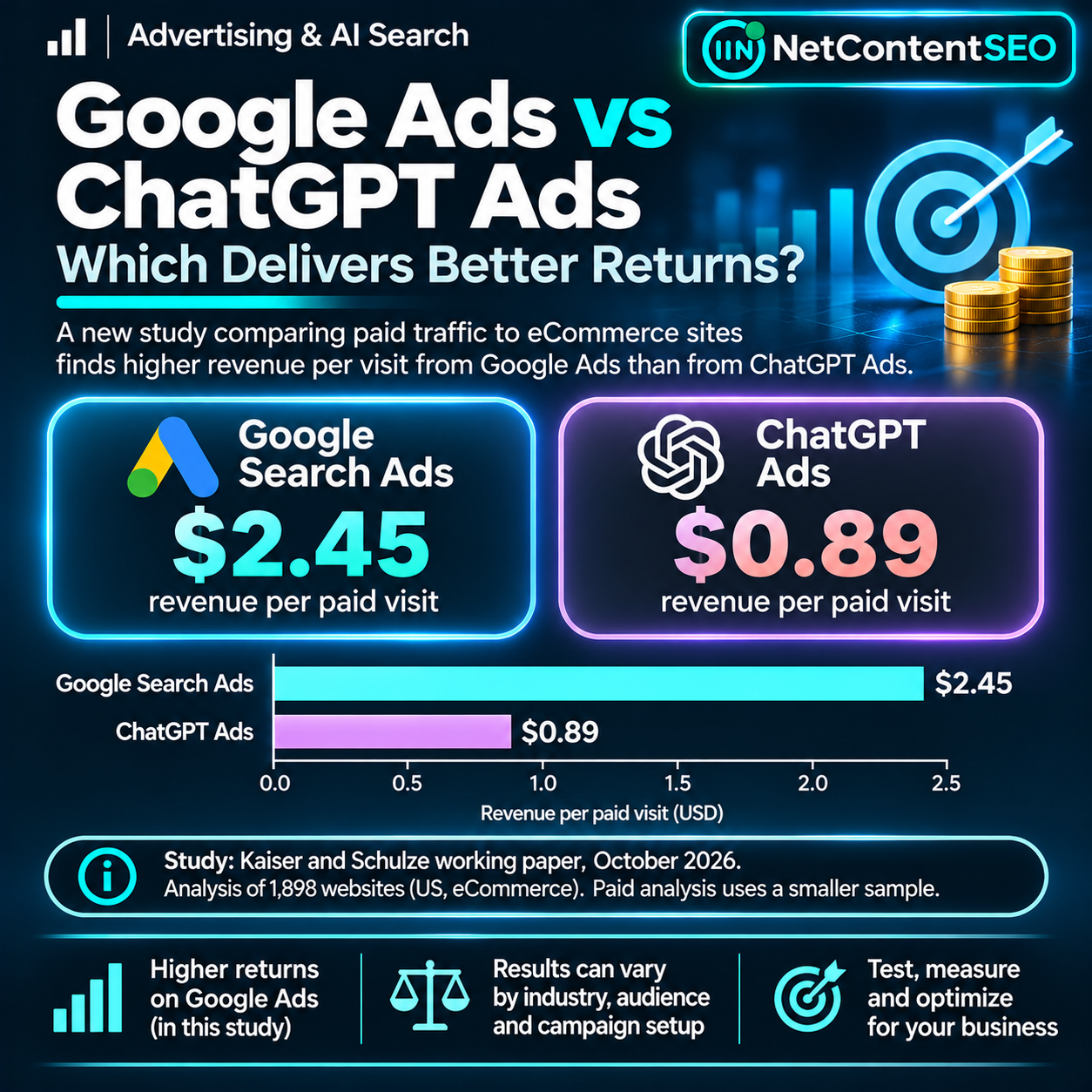

Updated November 5, 2026. A new academic study suggests that Google Search Ads currently generate substantially more measurable ecommerce revenue per paid visit than ChatGPT Ads. In U.S. traffic, the researchers observed $2.45 in revenue per Google paid-search session versus $0.89 per paid ChatGPT session, a 64% shortfall. Conversion rates were 1.17% and 0.37%, respectively.
These figures come from “Can Advertising Fund Free AI? Evidence from ChatGPT's International Advertising Rollout”, an October 2026 working paper by Maximilian Kaiser of WU Vienna and Christian Schulze of Frankfurt School of Finance & Management. The study is under review, not a settled industry benchmark. Its implications are significant, but advertisers should understand precisely what was measured before concluding that ChatGPT advertising cannot work.
What the researchers found
The broad dataset covers 1,898 online shops, nearly 10 billion sessions and 60 weeks of activity from June 2025 through August 2026. The shops collectively generated approximately $16 billion in annual sales. The paid-advertising analysis used a smaller subset: 387 websites with paid-channel behavioral data and 102 advertisers with complete financial tracking.
Among 87 advertisers purchasing both ChatGPT Ads and Google paid search in U.S. traffic, 84 earned less revenue per ChatGPT paid visit, and 85 recorded lower conversion rates. Seventy-three of those 87 advertisers generated no purchases from paid ChatGPT traffic across 18,726 sessions; the remaining 14 accounted for 570 purchases. One advertiser generated 66% of all paid ChatGPT purchases in the financial sample, highlighting how concentrated the early results were.
The headline figures should therefore be read as observed revenue and conversion per visit in a particular ecommerce dataset, not as universal return on ad spend across all industries, countries or attribution models.
Google Ads vs ChatGPT Ads: the numbers
| Metric | Google Search Ads | ChatGPT Ads |
|---|---|---|
| U.S. revenue per paid session | $2.45 | $0.89 |
| U.S. paid-session conversion rate | 1.17% | 0.37% |
| Illustrative parity CPC derived by authors | $0.72 reference CPC | About $0.26 |
| Sample for financial comparisons | 102 advertisers with financial tracking; 87 bought both channels in U.S. traffic |
Google's paid search generated approximately 2.75 times as much revenue per paid visit and 3.16 times the conversion rate in this sample. These ratios are not the same as a comparison of actual ROAS, because ad spend was not available for every advertiser. The researchers estimated an equivalent click price using a subset of observed search costs.
Why revenue per visit is not return on ad spend
Revenue per session tells an advertiser how much sales revenue is attributed to each tracked visit. ROAS, by contrast, is attributed revenue divided by advertising spend. A channel with lower revenue per visit can still be profitable if its traffic costs substantially less. A channel with higher revenue per visit can lose money if click costs are too high relative to margins.
For example, if 1,000 paid visits each generate the study's average $0.89, attributed revenue is $890. At a hypothetical CPC of $0.20, those visits cost $200 and produce a 4.45x revenue-to-spend ratio. At $1.72 CPC, they cost $1,720 and produce only about 0.52x. These are illustrative scenarios using the study's revenue figure, not observed results from a particular advertiser.
Similarly, 1,000 paid Google visits at $2.45 per session generate $2,450. At the study's reference search CPC of $0.72, that would imply approximately 3.40x ROAS. The comparison depends critically on the price of the traffic and on how much of the attributed revenue becomes gross profit.
What is the $0.26 ChatGPT parity CPC?
The paper estimates that, at the measured relative revenue per visit, a ChatGPT ad click would need to cost approximately $0.26 to deliver the same revenue per advertising dollar as paid Google search. The calculation uses a median Google paid-search CPC of $0.72 from a subset of 16 accounts with predominantly U.S. search traffic.
The general formula is:
ChatGPT parity CPC = Google paid-search CPC × (ChatGPT revenue per visit ÷ Google revenue per visit).
Using the reported numbers, $0.72 × ($0.89 ÷ $2.45) is approximately $0.26. This is an equivalence estimate, not an official ChatGPT Ads price or a universal bidding recommendation. The researchers' resampling placed the parity estimate roughly between $0.05 and $0.57 because paid ChatGPT revenue was heavily concentrated in one advertiser.
A separately publicized advertiser account reportedly paid $1.72 per ChatGPT click over a 15-day period, more than six times the estimated parity CPC. That $1.72 figure comes from one disclosed account, not a representative average market CPC. Comparing it with the $0.26 estimate is informative, but it should not be mistaken for a like-for-like market-wide cost study.
How to calculate your own parity CPC
Start with the same reporting window and attribution rules for Google Search Ads and ChatGPT Ads. Divide attributed ecommerce revenue by eligible paid sessions for each channel, excluding obvious bot or ad-review crawler traffic. Then multiply your Google paid-search CPC by the ratio of ChatGPT revenue per session to Google revenue per session.
Suppose your Google Ads traffic generates $3.00 per session at a $0.90 CPC, while ChatGPT Ads generate $1.20 per session. Your ChatGPT parity CPC would be $0.90 × ($1.20 ÷ $3.00), or $0.36. If you pay $0.25 per ChatGPT click, the channel could be competitive on revenue per ad dollar; at $0.80, it would not be competitive on that narrow metric.
For a profitability decision, replace revenue with contribution margin when product margins differ across channels. Include refunds, discounts, payment costs, lead quality and later purchases where measurable. If your sales cycle is long, a same-session ecommerce comparison may not capture the value of an early discovery interaction.
Does this mean ChatGPT Ads are a bad investment?
No. The study documents weak average early performance among the observed ecommerce advertisers, not an immutable property of the channel. Campaign targeting, creative, landing pages, measurement tools and the advertising platform itself are evolving. The data ends in August 2026, so it does not directly measure changes introduced afterward.
There are also favorable individual cases. In an August 31, 2026 company update, OpenAI reported an ecommerce advertiser achieving 3x ROAS over 28 days. That is a company-selected example, not an independently audited cross-advertiser average. Both the case study and the academic findings can be true because advertisers and measurement methods differ.
The right takeaway is to treat ChatGPT Ads as an experimental acquisition channel until your own campaigns demonstrate acceptable unit economics, rather than assuming that the platform's large audience guarantees profitable conversions.
Paid ChatGPT traffic and organic ChatGPT referrals behave differently
One of the most important findings is that unpaid ChatGPT referrals performed better than paid ChatGPT visits in the observed ecommerce data. The researchers reported higher conversion and revenue per session from organic ChatGPT traffic, suggesting that a user who voluntarily follows an answer's recommendation may have a different intent from someone clicking a sponsored placement.
That distinction matters for AI visibility strategy. A brand being cited or recommended organically is not equivalent to buying an advertisement, and performance in one channel should not be used to forecast the other. Organic AI referrals, paid AI clicks, brand mentions and assisted conversions should be reported separately.
Did ChatGPT advertising reduce organic referrals?
The working paper also exploited the staggered introduction of ads across countries. Relative to comparison markets, the researchers estimated that organic ChatGPT referrals declined by 5.9% in the first 13 weeks after advertising began. The initial 95% confidence interval ran from -12.6% to +1.2%, which includes zero and therefore does not establish a statistically significant decline in that specification.
After adjusting for assumed differences in regional ChatGPT adoption, the estimated drop became approximately 7.2% to 8.4%, with confidence intervals excluding zero. The authors summarize the possible effect as roughly 6% to 8% fewer organic referrals, while noting limitations of the identification strategy. Organic-referral conversion rates showed no detectable change.
These results are best described as suggestive evidence of a modest decline in unpaid referral volume under the study's assumptions, not proof that advertisements necessarily caused a universal loss of organic AI visibility.
Important limitations advertisers should know
The research is observational. Advertisers chose whether to buy ChatGPT Ads, and the tracked businesses were online shops with measurable web sessions and sales. The dataset does not represent all local services, enterprise software, offline retail, lead generation or subscription businesses.
The tracking captures website sessions and attributed purchases, but not every impression, prompt, assisted conversion, offline sale or purchase completed later through a different channel. That can understate the value of campaigns designed for awareness or long consideration cycles. Conversely, it can also overstate certainty about direct response performance if bot visits, tracking inconsistencies or very small samples are not handled carefully.
One advertiser accounted for much of the paid ChatGPT sales volume, making aggregate results sensitive to outliers. The study was a working paper under review as of November 5, 2026. The results deserve attention but should be revisited as peer review and newer datasets become available.
How advertisers should test ChatGPT Ads against Google Ads
1. Define the conversion you actually need. For ecommerce, use purchases and contribution margin. For B2B, track qualified opportunities and closed revenue rather than just demo-form submissions. Do not compare unlike objectives.
2. Start with a capped test budget. Keep established profitable Google Search campaigns running while testing ChatGPT separately. Choose a spending limit based on acceptable learning cost rather than diverting essential acquisition budget on the strength of platform reach.
3. Instrument attribution carefully. Use distinct UTM parameters and consistent channel definitions. Check whether ChatGPT ad-review crawlers are being recorded as paid sessions; exclude nonhuman visits before calculating conversion rates or revenue per session. Confirm conversion tracking through your analytics platform and the advertising platform where supported.
4. Use relevant creative and landing pages. A conversational advertising environment is not identical to keyword search. Align messaging with the user's decision stage, and send clicks to product, comparison or pricing pages that directly address the likely need. Avoid making claims about access to individual private conversations.
5. Measure the entire funnel. Review CPC, conversion rate, revenue per session, ROAS, contribution margin, new-customer rate and return/refund rate. Track later conversions separately where possible. Distinguish measured data from modeled attribution.
6. Calculate a parity CPC and a break-even CPC. The parity CPC compares ChatGPT with Google on a chosen outcome. A break-even CPC uses the contribution profit per visit and answers whether the campaign makes money at all. A channel can beat another on ROAS while still failing profitability targets.
7. Set a decision rule before launching. For example, continue the test only if enough eligible sessions have accumulated and the channel meets a pre-agreed cost-per-qualified-conversion threshold. Small samples with zero purchases should be treated as inconclusive until the expected event volume supports a meaningful estimate.
Frequently asked questions
Are Google Ads more profitable than ChatGPT Ads?
In this ecommerce study, Google paid-search visits generated more attributed revenue and converted more often. Profitability depends on actual ad spend, margins and attribution. The paper's price-adjusted comparison also favored Google, but it did not establish a universal rule for every advertiser.
What was the conversion rate for ChatGPT Ads?
For the study's U.S. paid-traffic comparison, ChatGPT Ads converted at 0.37%, compared with 1.17% for Google paid search. These are observed rates from the research sample, not platform-wide published benchmarks.
How much should I bid for ChatGPT Ads?
There is no universal correct CPC. The researchers estimated $0.26 as the price that would match paid search's revenue per advertising dollar in their sample. Calculate your own parity and break-even CPC from your conversion data, margins and current Google Ads costs.
Do ChatGPT Ads affect organic AI visibility?
The study estimated a possible decline in unpaid ChatGPT referrals after ads launched, but the unadjusted estimate was not statistically significant and adjusted results depended on assumptions. It does not prove that advertising reduces organic referrals for every website.
Should businesses stop using Google Ads and move to ChatGPT Ads?
The research provides no basis for replacing a profitable search program with ChatGPT Ads. Test ChatGPT as an additional channel and scale only if it demonstrates competitive performance on your own commercial outcomes.
The strategic takeaway for AI Search
ChatGPT's expansion into advertising creates a new way to reach users during research and decision-making. But attention, recommendations and paid clicks are not interchangeable measures of commercial value. The early academic evidence favors Google Search Ads for measurable ecommerce revenue per visit, while also showing why organic ChatGPT referrals deserve separate analysis.
For advertisers and SEO teams, the best response is not to dismiss AI advertising or assume it will replace search. It is to measure each route to discovery on its own terms: paid acquisition economics, organic AI visibility, qualified traffic and eventual business outcomes.
Sources
- Maximilian Kaiser and Christian Schulze, “Can Advertising Fund Free AI? Evidence from ChatGPT's International Advertising Rollout,” working paper, October 2026 — original study, methods, results and limitations.
- Digital Information World, “Google Ads vs ChatGPT Ads: Which Delivers Better Returns for Advertisers?” November 2026 — supplied secondary report; original article was not accessible for direct text verification.
- Search Engine Land, November 2, 2026 — independent coverage of the research.
- Search Engine Journal, November 2, 2026 — parity CPC calculation, caveats and advertiser comparisons.
- OpenAI, “A milestone in expanding access to AI,” August 31, 2026 — platform expansion and company-reported campaign example.