

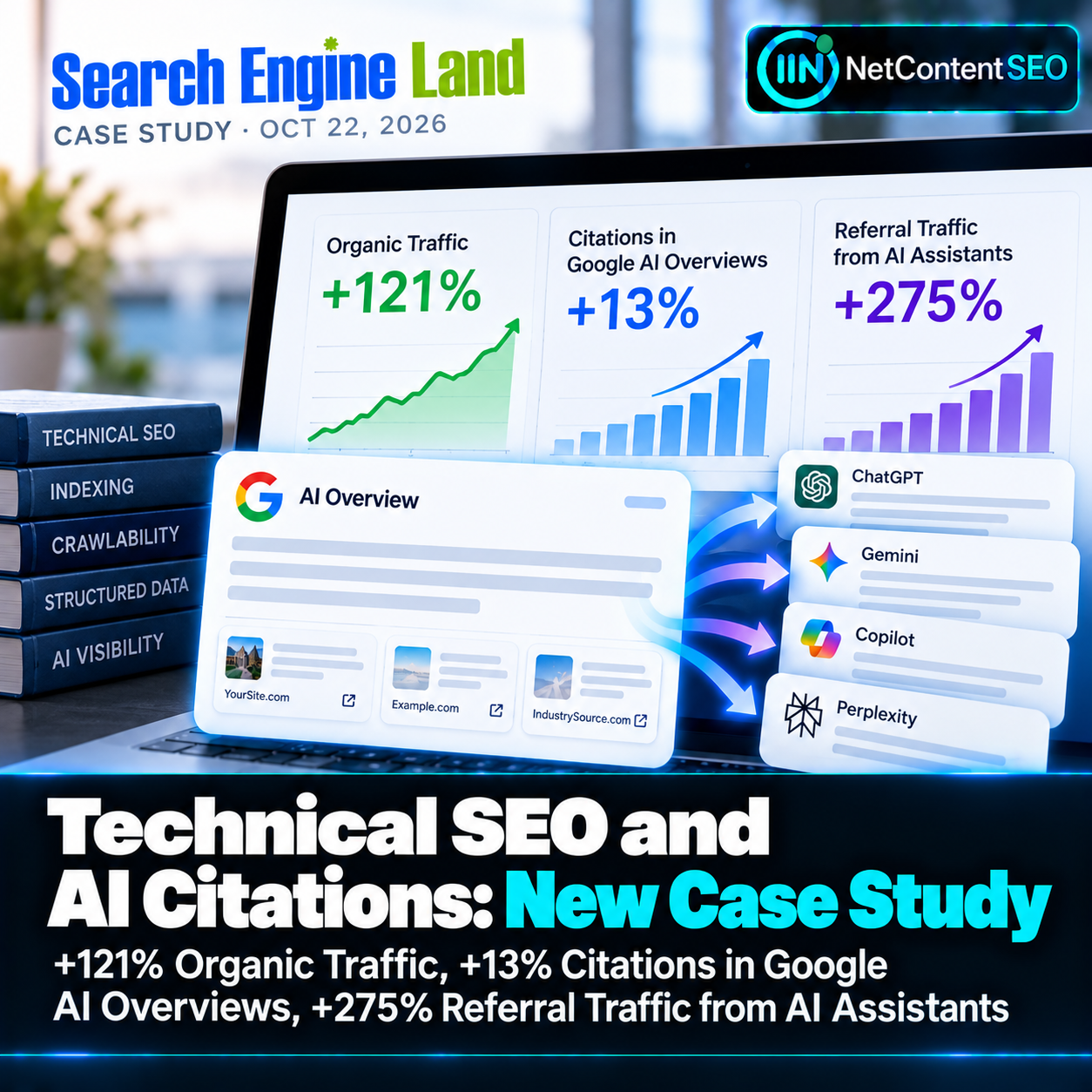

A new B2B case study published by Search Engine Land on October 22, 2026 reports substantial improvements in organic search and AI-related visibility after a post-migration technical SEO project. The reported month-over-month results include 121% more organic traffic, 13% more citations in Google AI Overviews and 275% more referral traffic from AI assistants.
Those figures come from a single client engagement described by Dan Lauer, Director of SEO + GEO at Walker Sands. They are not controlled experimental evidence that any one SEO fix caused the gains, nor a forecast of what other websites can expect.
The overlooked finding: order mattered more than a single fix
The project concerned a global B2B technology company following a website migration. The team used Screaming Frog, Google Analytics 4 and Google Search Console to identify technical problems and prioritize remediation. The audit found approximately 100 priority orphaned URLs with traffic, tens of thousands of redirect chains and loops, over 4,400 pages returning 404 errors, more than 7,800 parameterized URLs being crawled and indexed, and over 250 pages with canonical issues. Other problems included incorrect menu link mappings, missing hreflang tags and missing x-default declarations.
The team first tackled 404s, 301 redirect issues and canonical errors, alongside guidance on menu and redirect mapping. Crawl rates improved and indexing errors declined, but traffic and visibility did not immediately respond.
Metadata updates preceded the visibility improvement
The case study identifies metadata work in early August as the turning point after foundational fixes. With limited resources, the team used first-party GA4 data to prioritize pages for title and meta-description improvements rather than updating every URL.
Importantly, the author does not credit a single change. Technical work made priority pages more accessible and reduced problems that could interfere with discovery and indexing; metadata updates came later, before the observed visibility gains. This is a sequence of interventions and outcomes, not proof that a particular metadata field directly triggered AI citations.
The reported results
Comparing September with August, the team reported a 121% month-over-month increase in organic traffic, a 13% increase in Google AI Overviews citing the client and a 275% increase in AI-assistant referral traffic. The article also reports a 229% month-over-month increase in Google Search Console impressions.
These metrics measure different things. Organic traffic reflects visits from search; AI Overview citations indicate the site's presence as a cited source in Google's AI-generated results; and AI-assistant referrals reflect visits attributed to AI assistants. A citation is not necessarily a click, and an increase in referral visits does not prove an equivalent increase in total AI visibility.
Why the percentages need context
The report does not establish that these improvements would occur at other sites or that the same sequence always produces the same effect. Large percentage increases in AI referrals can also arise from small starting volumes, so absolute counts and longer-term trends matter when interpreting results.
Seasonality, migration recovery, content changes, competitive shifts and other variables may have influenced the outcomes. Without a control group or a method isolating each intervention, the most defensible conclusion is that the gains followed the combined work.
Practical lessons for technical SEO and GEO
The case offers a useful prioritization approach for teams with limited development resources: first identify obstacles to discovering and accessing valuable pages; fix serious redirect, canonical and internal-linking problems; then improve titles and descriptions on priority pages while monitoring indexing, organic search and AI visibility separately.
This does not mean every 404 or metadata warning deserves immediate attention. The team deliberately prioritized business-relevant pages rather than attempting to eliminate every issue across the site. Nor does the case establish a new Google ranking factor or a special metadata rule for AI Overviews.
NetContentSEO assessment
The most useful insight is not the headline percentage growth. It is the distinction between technical accessibility and measured visibility: removing crawl and indexing obstacles may create the conditions for growth without producing an immediate traffic increase. In this B2B case, subsequent metadata improvements preceded stronger search and AI-related metrics. For GEO reporting, the lesson is to measure indexing, citations and actual AI referrals as separate outcomes—and avoid turning one successful project into a universal causal claim.
Source: Dan Lauer, Search Engine Land — Why the order of technical SEO fixes matters (October 22, 2026).