


AI search may be creating far more commercial value than referral analytics can see.
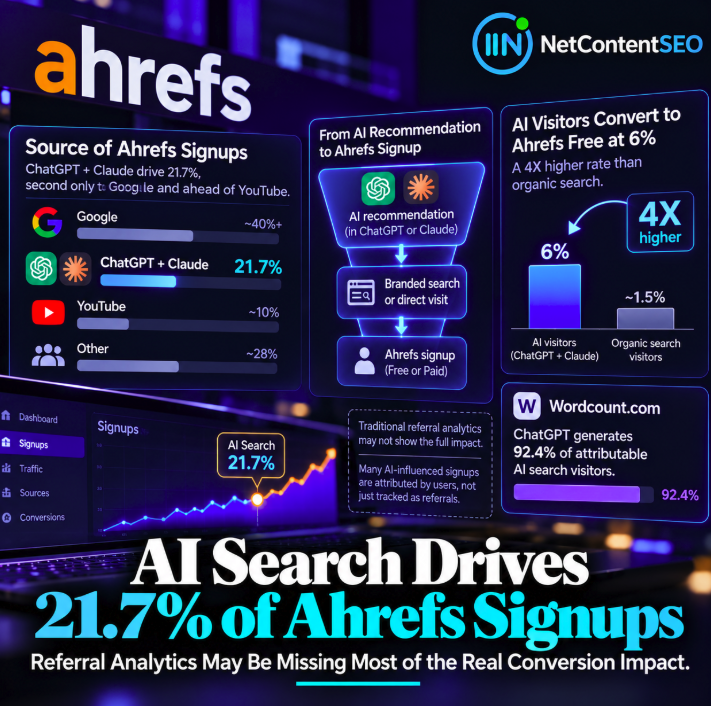
Ahrefs says ChatGPT and Claude together account for 21.7% of signups across its free and paid tools when customers are asked how they discovered the company. That puts the two AI assistants ahead of YouTube and behind only Google as a reported source of new Ahrefs users.
At the same time, the smaller slice of AI influence that is directly trackable through referral traffic appears unusually valuable: 6% of Ahrefs' AI search visitors create an Ahrefs Free account, a conversion rate the company says is four times higher than organic search.
The combination exposes a major measurement problem for AI visibility: the click data may represent only a fraction of the real influence.
21.7% is not a referral-traffic statistic
The most important detail in Ahrefs' October 6 analysis is methodological.
The 21.7% figure does not mean 21.7% of Ahrefs signups arrived through a measurable HTTP referral from ChatGPT or Claude.
Ahrefs derives the number from self-reported attribution: customers identify how they heard about the company, including during onboarding, surveys or sales conversations.
That distinction is precisely why the number is interesting. It captures influence that conventional web analytics can miss.
AI is second only to Google in reported signup influence
According to Ahrefs, more than one in five people signing up say they found the company through ChatGPT or Claude.
Combined, those assistants outperform YouTube as a source of signups and rank behind only Google.
For a company operating directly in the SEO and digital marketing market, that is a meaningful indicator of how quickly AI assistants have entered the product-discovery journey.
It is still Ahrefs' proprietary dataset, not a universal benchmark for every industry.
The visible AI referrals convert at 6%
Ahrefs also analyzed the trackable portion of AI traffic through its Web Analytics product.
It reports that 6% of AI search visitors sign up for an Ahrefs Free account.
Ahrefs says that conversion rate is 4X higher than its organic-search conversion rate.
Because Ahrefs Free is a free account, that conversion is not equivalent to immediate revenue. Ahrefs explicitly notes that teams would need to measure how many free signups later become paying customers and apply an appropriate customer value before turning the result into an ROI figure.
Why referral analytics can undercount AI influence
A user does not need to click directly from an AI answer for the answer to influence a purchase.
Someone can encounter Ahrefs in ChatGPT, remember the brand, search Google later and sign up from an organic or branded result.
Another user might type the domain directly into the browser.
In both cases, conventional last-click analytics can assign the session to Google or direct traffic even though the original discovery happened inside an AI assistant.
Ahrefs describes this as a substantial blind spot in AI attribution.
Some AI platforms also obscure referrer data
The problem is not only delayed conversion.
Ahrefs notes that some AI-originated visits can lose or omit referrer information, pushing sessions into the direct or no-referrer bucket.
This makes AI influence difficult to reconstruct retrospectively from analytics alone.
That is why Ahrefs recommends combining observable referral data with self-reported attribution, branded search demand, direct traffic trends and AI visibility measurements rather than relying on one channel report.
Wordcount.com shows how concentrated AI traffic can be
Ahrefs provides another useful example from Wordcount.com, a site it owns.
Within identifiable AI search traffic to that site, ChatGPT accounts for 92.4% of visitors.
Perplexity contributes 4.6%, Gemini 2.7% and Copilot 0.2% in the dataset shown by Ahrefs.
That distribution should not be generalized to the entire web, but it illustrates how dominant one assistant can become for a particular site's AI referral mix.
Tracked AI traffic is the visible tip
The direct referral is still valuable because it is the cleanest observable connection between an AI platform and a website conversion.
Teams can filter analytics for AI search traffic, identify landing pages and compare engagement or conversion events.
But Ahrefs' own numbers show why that cannot be the complete scorecard.
If 21.7% of signups report discovering Ahrefs through ChatGPT or Claude while only a subset arrives through directly attributable AI referrals, then a substantial amount of AI influence occurs before the measurable website session.
This changes how GEO and AI visibility ROI should be reported
A company measuring AI visibility solely as “sessions from ChatGPT” risks systematically undervaluing the channel.
A more useful measurement framework can combine several layers:
- AI referral sessions and conversions;
- self-reported discovery through ChatGPT, Claude and other assistants;
- changes in branded search demand;
- direct and no-referrer traffic patterns;
- brand mentions and recommendations inside AI answers;
- conversion quality and eventual paid-customer value.
None is perfect independently. Together, they provide a more realistic picture of AI's contribution to demand.
Self-reported attribution is useful but imperfect
There is an important limitation to the 21.7% figure.
People do not always remember exactly where they first encountered a brand. Some buyers interact with several channels before signing up, and a survey answer may credit the most memorable one rather than the only influential source.
Ahrefs acknowledges that self-reported attribution is not perfect.
Its value is that it exposes influence analytics systems cannot otherwise observe.
The number should therefore be read as reported discovery influence, not as a precise last-click attribution share.
AI traffic may be small and still commercially important
This is one of the most important lessons for SEO teams evaluating AI search.
Raw AI referral traffic can look small next to Google organic traffic. That does not necessarily mean the channel has little commercial value.
If AI visitors convert at materially higher rates, and if additional AI-influenced users later arrive through branded search or direct navigation, session share alone becomes a weak measure of impact.
Ahrefs' 6% conversion rate and 21.7% self-reported signup influence demonstrate exactly that mismatch inside its own business.
AI visibility can create branded demand before it creates a click
Ahrefs recommends monitoring branded search demand alongside AI mentions.
The logic is straightforward: repeated recommendations inside ChatGPT or Claude can make a brand familiar even when users do not immediately click.
Later, those users may search the company name directly.
From an SEO dashboard's perspective, that conversion can look like a branded organic-search success. From the customer's perspective, the journey began with an AI recommendation.
Web mentions may be an upstream indicator
Ahrefs also argues that third-party web mentions can act as an early indicator of future AI visibility.
Its analysis found branded web mentions among the factors most closely associated with AI brand visibility.
This is correlation, not proof that adding arbitrary mentions will directly cause an AI recommendation.
But it supports a broader strategy in which PR, authoritative third-party coverage and recognizable brand/entity signals are measured alongside prompt-level AI visibility.
There is no single “Search Console for ChatGPT”
Google gives publishers query and performance data through Search Console. AI assistants generally do not provide an equivalent publisher analytics layer showing every prompt that surfaced a brand and every downstream conversion.
That forces marketers to reconstruct the journey from partial evidence.
Referral traffic is one piece. AI answer monitoring is another. Customer surveys, branded search, direct traffic and conversion data fill in additional gaps.
The absence of perfect attribution is not evidence that the influence does not exist.
NetContentSEO take
Ahrefs' 21.7% figure is important precisely because it measures what referral analytics cannot.
ChatGPT and Claude are reportedly influencing more Ahrefs signups than YouTube, while the AI visitors that can be tracked convert to a free account at four times the organic-search rate.
The lesson for AI visibility measurement is not to replace analytics with surveys. It is to stop expecting one attribution system to capture the entire journey.
AI search increasingly operates upstream of the click: it creates awareness, recommendations and branded demand before the user ever reaches the website.
If marketers measure only the final referral, they may be measuring the smallest part of the channel.