

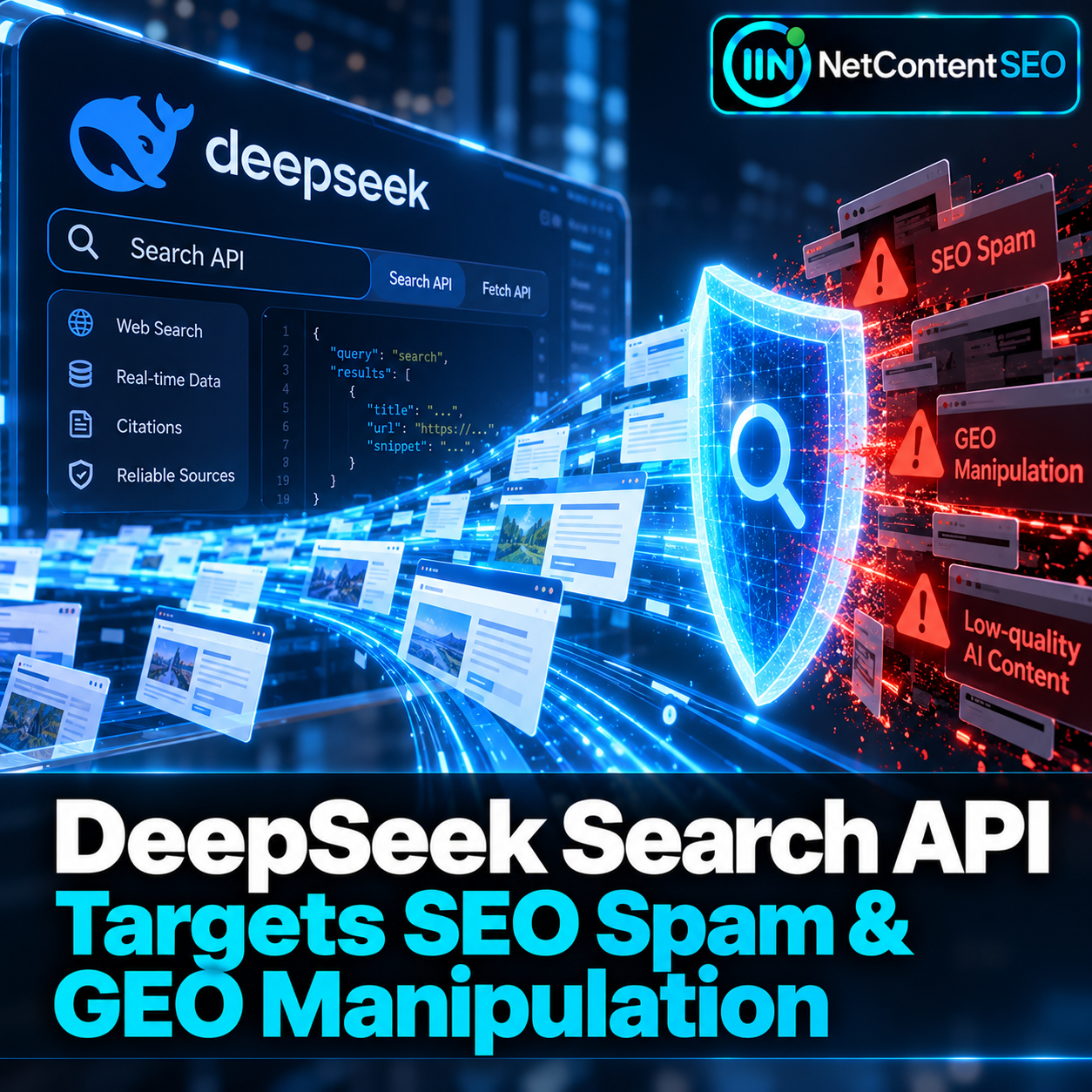

DeepSeek has opened access to its in-house Search and Fetch APIs, positioning its search engine as an AI-native retrieval layer for developers, agents and retrieval-augmented generation applications. In its official October 17, 2026 changelog, the company says the engine indexes hundreds of billions of web pages, handles hundreds of millions of search requests daily, and uses mechanisms intended to filter SEO spam, GEO manipulation and low-quality AI-generated content. These are company claims, not independently verified measurements.
DeepSeek opens its in-house search engine to developers
DeepSeek says its own web and API search experiences already run on this search infrastructure. Developers can now use two endpoints: Search, which returns structured web search results, and Fetch, which retrieves the content of an individual web page as Markdown. Both are JSON APIs using DeepSeek API authentication.
According to the official Search & Fetch guide, the endpoints are POST https://api.deepseek.com/v1/tools/search and POST https://api.deepseek.com/v1/tools/fetch. This makes the service relevant to agent workflows and applications requiring live web context.
DeepSeek explicitly targets SEO spam and GEO manipulation
The most significant statement for search professionals appears in DeepSeek's October 17 changelog: the company says it filters SEO spam, GEO manipulation and low-quality AI-generated content to surface more authoritative information to users and language models.
This wording matters because it names GEO manipulation as a distinct search-quality concern. It does not mean all GEO practices are prohibited, nor does it reveal a new universal rule for optimizing content for AI systems. DeepSeek has not published a detailed list of detection signals, enforcement thresholds, false-positive rates or independent test results for these filters.
What changes for AI visibility?
AI search visibility increasingly depends on whether information is discovered, retrieved and trusted by systems that may differ from conventional web search. An AI-native search API with its own index and relevance mechanisms adds another environment where publishers may need to understand how their content appears.
However, there is no evidence in this announcement that DeepSeek has changed Google Search rankings, Bing indexing, ChatGPT citations or any other provider's retrieval rules. Nor does an API launch alone establish how often particular publishers will be cited in DeepSeek's generated responses.
How Search and Fetch differ
The Search API discovers pages matching a query and returns structured results. The Fetch API accepts a specific URL and returns page content in Markdown. For developers building RAG or research agents, this separates discovery from document retrieval and can support more controlled source handling.
DeepSeek V4.1 Flash also receives an update
Alongside the search API announcement, DeepSeek released an updated DeepSeek V4.1 Flash model identified as DeepSeek-V4.1-Flash-1017. The company says the official web and app versions were also updated, while the API model name remains deepseek-flash and existing API pricing remains unchanged. Its published benchmark scores and efficiency improvements are vendor-reported and should not be treated as independent validation.
What publishers should monitor
Publishers can observe whether their content appears for relevant queries, compare retrieved results across search systems and check that pages are accessible, accurate and clearly attributed. They should avoid treating DeepSeek's reference to GEO manipulation as proof of a specific penalty for legitimate brand-building, structured content or authorship signals.
More useful questions for future research include how DeepSeek evaluates source authority, whether its filtering changes retrieval diversity, how it handles original reporting versus derivative AI-generated pages, and whether inclusion in its Search API correlates with citations in its conversational products.
NetContentSEO assessment
Confirmed: DeepSeek officially announced its own Search and Fetch APIs on October 17, 2026, and explicitly identified SEO spam, GEO manipulation and low-quality AI-generated content as filtering targets. Not confirmed: the precise detection methods, real-world effectiveness, effects on individual publishers, or changes to competing search engines.
This is a notable AI Search infrastructure announcement and a meaningful signal that the industry is increasingly distinguishing useful AI discoverability from attempts to manipulate generative retrieval systems.
Sources: DeepSeek official changelog and Search & Fetch documentation.