

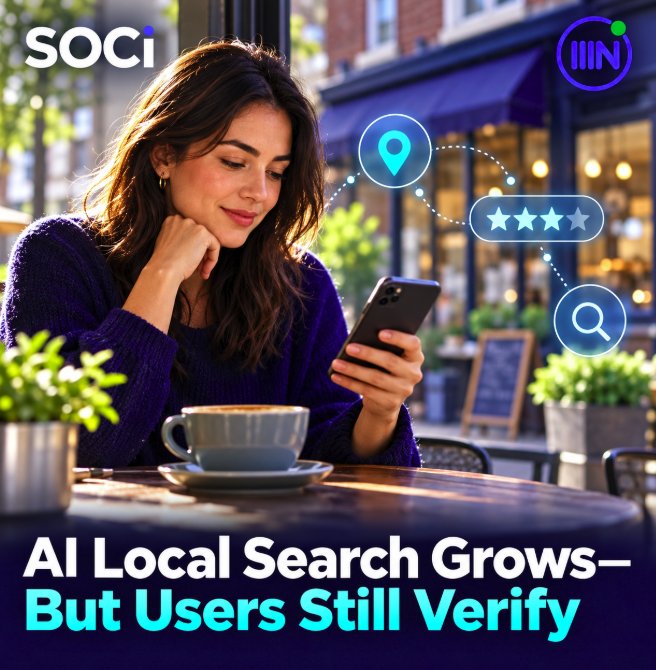
AI can put a local business on a consumer’s shortlist without completing the decision. New survey findings from SOCi suggest that many people use an assistant to discover a business, then consult other channels before making contact. For local marketers, the practical question is what happens after the recommendation.
A business can appear in an AI answer and still lose the enquiry when a customer checks its opening hours, recent reviews or service details. Our editorial interpretation is that local AI visibility should be evaluated alongside the information customers encounter during that subsequent check.
What SOCi measured
In its 24 September account of the 2026 Local Discovery Index, SOCi reports that 52% of surveyed consumers used an AI tool to find a local business within the previous 30 days, compared with 9% in the 2025 edition. That is about 5.8 times the earlier share, or a rise of 43 percentage points.
SOCi also reports that 81% take a verification step before contacting an AI-recommended business. Among consumers using AI tools, 67% say they have received incorrect local-business information at least once.
The study surveyed more than 1,000 US consumers and weighted results for age, gender and household income. These are self-reported survey findings, not platform search logs or an independently measured answer-error rate. They do not establish AI’s share of all local queries, a global adoption rate or a Google/OpenAI rollout.
Audit the recommendation and the next step
The first useful operational change is to test the customer journey beyond whether a brand name appears. Choose a specific location, a real service and a plausible customer question. Record what the assistant says, which sources it provides and what a person can verify after leaving the answer.
For example, an assistant might recommend a repair business for a weekend appointment. The business could be correctly identified while the availability claim remains unsupported. If its website explains weekend appointments but a directory lists different hours, the customer has to resolve the contradiction before calling.
This is a hypothetical audit scenario, not a measured cause of the survey results. Its value is practical: it separates being recommended from being accurately described, and both from being ready to receive the enquiry.
For each location, maintain a short reference record of the facts a customer needs to act: address, contact route, ordinary and exceptional opening hours, services actually offered, appointment requirements and any relevant eligibility conditions. Assign someone to update that record when the operation changes, then check the website and important public profiles against it.
Consistency does not require identical promotional copy everywhere. It requires compatible factual answers. A social post can be informal and a service page detailed while both correctly describe the same location and offer.
Make the evidence useful to the customer
A location page should answer the questions that arise during a decision, rather than merely repeat a town name and a list of keywords. Explain what happens when someone calls, books or visits. Identify which services belong to that branch, and make temporary changes distinguishable from normal operating arrangements.
Review management belongs in this workflow because reviews are part of what a person may inspect after discovery. Read recent comments for unresolved practical questions and respond with information that helps the customer. A public response should be accurate and proportionate; it should not manufacture praise or promise a result the business cannot provide.
Visual content can also support verification. A current photograph of an entrance or an explanation of an appointment process helps someone understand what to expect. The editorial recommendation is to publish useful evidence of the business as it operates, rather than create a decorative social presence disconnected from the location.
These actions can improve the information available to customers. The survey does not prove that any particular posting schedule, review response or page format causes an assistant to rank a business higher.
Measure outcomes without confusing them with mentions
Keep AI-answer monitoring separate from enquiries and completed business outcomes. An appearance in a test prompt is an observation about that answer; a booking is an observation about a customer action. Neither automatically explains the other.
A workable reporting view can track recommendation accuracy, unresolved information conflicts, location-page visits and qualified enquiries. Add a brief optional “How did you first hear about us?” question where appropriate, while recognising that customer recollection is another imperfect source of evidence.
Last-click reporting may identify the final channel without revealing the original discovery. An AI recommendation followed by a branded search is a possible journey to investigate, not a reason to reclassify every branded visit as AI-driven.
The opportunity for local SEO and GEO teams is to connect their work to the customer’s ability to verify and act. Audit the recommendation, correct the facts a person encounters next, and measure the resulting enquiries with clear limits on attribution.