

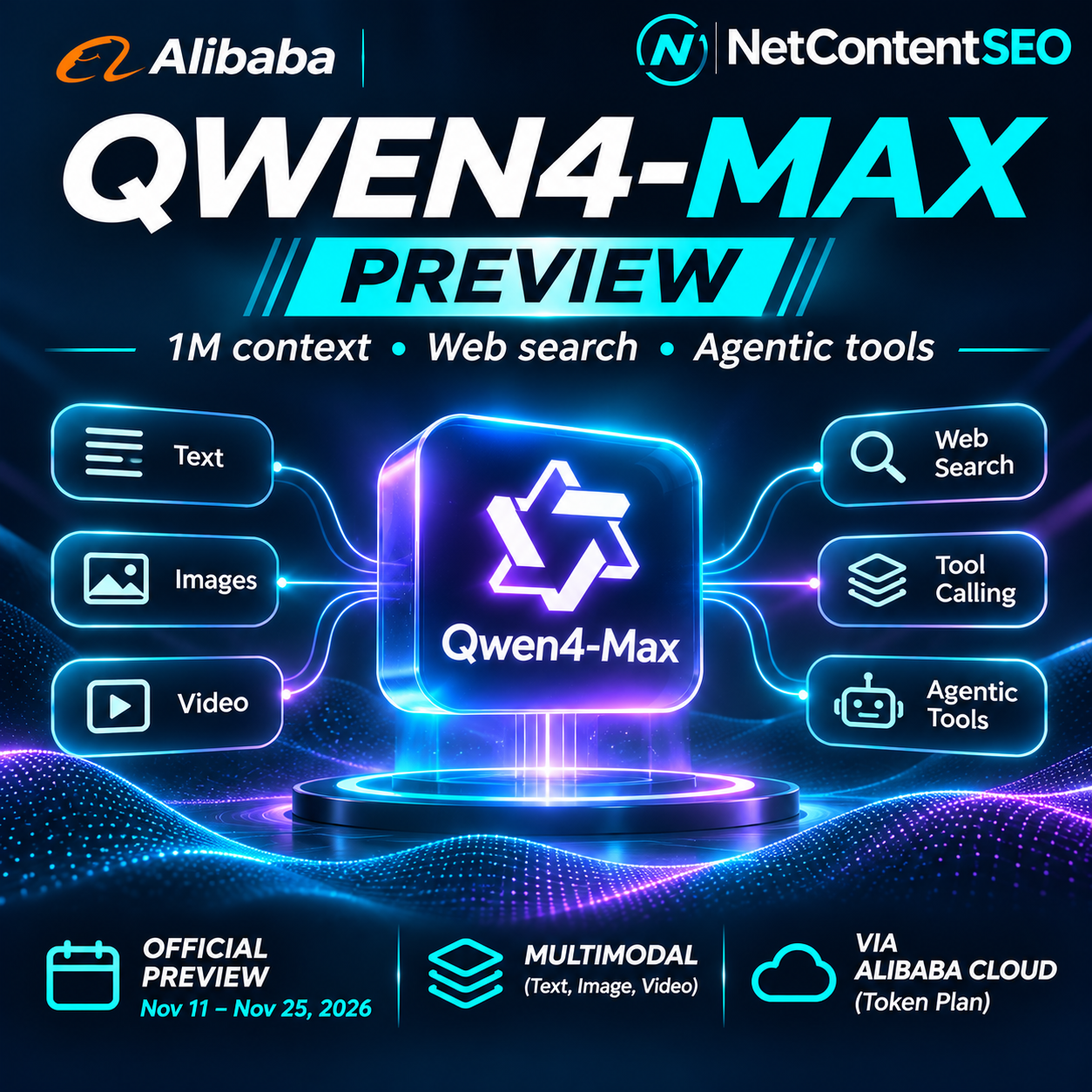

Alibaba has opened a time-limited preview of Qwen4-Max, its next-generation flagship multimodal AI model, with web search, tool calling, structured outputs and a one-million-token context window. The preview began on November 11, 2026, and ends on November 25. For developers building AI agents, the combination is notable; for SEO and AI Search teams, the key question is whether a model with retrieval and tool capabilities will eventually create new paths for content discovery and citations.
There is an important distinction at launch. Qwen4-Max-Preview is not a general release or an open-weight model. Alibaba Cloud's official documentation specifies that the model is available through its Token Plan subscription only. Pay-as-you-go API access is not supported during this preview, and the model ID will be retired after the preview window closes.
What Alibaba officially announced
Alibaba describes Qwen4-Max-Preview as a next-generation flagship in the Qwen family, designed for coding, office productivity, front-end design, complex reasoning and multi-step agentic tasks. The announcement covers text generation, image and video understanding, web search, function calling and structured JSON outputs. It also advertises compatibility with familiar OpenAI and Anthropic API formats.
These are documented product capabilities, not independently validated claims of superiority over other frontier models. Alibaba has not published a complete model card, independent benchmark results, final release schedule or open-weight availability for this preview.
Qwen4-Max-Preview specifications at a glance
| Feature | Officially documented detail |
|---|---|
| Model identifier | qwen4-max-preview; qwen4.0-max-preview is also an accepted alias. |
| Availability | Token Plan only, Personal or Team; no pay-as-you-go. |
| Preview window | November 11, 2026 at 10:00 to November 25 at 24:00, UTC+8. |
| Context window | 1,000,000 tokens. |
| Maximum output | 393,216 tokens, shared by reasoning and final answer. |
| Inputs | Text, images and video. |
| Reasoning | Enabled by default; adjustable using reasoning_effort. |
| Tools | Function calling, web search and built-in tools. |
| Structured output | JSON Object and JSON Schema. |
| API formats | OpenAI Chat Completions, Responses and Anthropic Messages compatibility. |
| Open weights | No open-weight release announced for this preview. |
| Retirement | Preview model ID scheduled to be retired after November 25. |
All specifications are taken from Alibaba Cloud Model Studio's November 11 documentation and its Token Plan documentation. Specifications and promotional terms may change after the preview.
How to access Qwen4-Max-Preview
Developers need an eligible Alibaba Cloud Model Studio Token Plan, rather than an ordinary pay-as-you-go API account. Alibaba's documentation describes the following process:
- Choose an eligible Token Plan Personal or Token Plan Team subscription.
- Generate the dedicated API key associated with that plan.
- Use the Token Plan endpoint appropriate to the account's region and protocol; Alibaba's documentation provides
https://token-plan.cn-beijing.maas.aliyuncs.comfor the Beijing environment, while other regional endpoints may differ. - Set the model to
qwen4-max-previewand configure the desired OpenAI-compatible or Anthropic-compatible client. - Run a small validation request before moving an existing workflow to the preview.
Alibaba lists promotional credit consumption for the preview, including calls that can use as little as 20% of the standard credit rate and an additional off-peak discount under the plan's terms. These are subscription-credit promotions, not a published universal per-million-token API price. Developers should check region, eligibility, credit balances and current plan conditions before estimating cost.
What the one-million-token context window means
A one-million-token context window allows the model to receive unusually large collections of text, code, transcripts or multimodal material within a single request. That can be valuable for document-heavy research, large repositories, complex support histories and multi-step workflows.
However, context capacity is not the same as accurate recall. A large input limit does not establish that the model reliably identifies every relevant passage, preserves source attribution or reasons correctly across a million tokens. Those properties require targeted long-context tests. It is also important to distinguish the one-million-token context window from the maximum output budget of 393,216 tokens, which includes both internal reasoning and the final response.
Reasoning and output-budget changes developers should notice
Qwen4-Max-Preview has reasoning enabled by default. The documented reasoning_effort settings include low, medium and xhigh, with xhigh as the default. Alibaba warns that the max_tokens parameter now acts like max_completion_tokens for this model in OpenAI Chat Completions: the configured budget covers reasoning and visible answer tokens together.
That change can affect existing integrations. An application that previously allocated just enough tokens for the visible answer may see truncated results if reasoning consumes much of the budget. Developers should allow adequate headroom, test structured-output completeness and avoid setting reasoning_effort and thinking_budget simultaneously.
Web search and function calling: why agents matter
Qwen4-Max-Preview's support for web search and tools makes it relevant to agentic applications. An agent can potentially interpret a user request, decide that current information is required, call a search tool, process the results and return structured data or invoke another authorized function. This differs from a model generating an answer entirely from its training data.
The release does not demonstrate that Qwen4-Max has a new public search engine, an independently measured citation ecosystem or a guaranteed ability to book services. The web-search feature is a tool capability within applications using the model. Its source selection, retrieval providers, citation formatting and referral behavior must be tested in the actual product environment.
What Qwen4-Max could mean for SEO and AI Search
For GEO and AI visibility research, three possible changes deserve attention. First, stronger intent interpretation may affect which documents an agent considers relevant. Second, web search and tool calling can make current public content part of an agent's workflow. Third, structured outputs can help developers convert retrieved facts into downstream applications without displaying a conventional results page.
These are plausible implications of the documented capabilities, not proven changes in search traffic. There is no public dataset showing that Qwen4-Max-Preview increases citations to publishers, favors particular websites or sends measurable new referrals. The preview also does not imply a change in Google, Bing or Naver ranking algorithms.
What publishers and brands can do now
The defensible response is to make information accurate, attributable and actionable rather than inventing a Qwen-specific optimization checklist:
- Publish clear descriptions of products, services, entities, locations and current availability.
- State prices, conditions, exceptions and dates explicitly when they affect a decision.
- Make key facts accessible in HTML and provide useful source references.
- Keep official documentation consistent across websites, product pages and support resources.
- Document booking, purchase or contact steps rather than relying on vague marketing language.
- Test whether a real Qwen-powered application retrieves and cites the correct source, and record the prompt, tool configuration, date and response.
- Measure citation inclusion separately from website clicks and completed business outcomes.
None of these actions guarantees a Qwen citation or a specific ranking. They improve the underlying quality and interpretability of the information an agent might encounter.
A repeatable test plan for Qwen4-Max-Preview
Because the preview is short-lived, teams should prioritize a compact, reproducible evaluation before November 25:
- Build a baseline: select 20–30 representative prompts covering branded questions, product comparisons, local service discovery and complex research.
- Control the tools: test with web search disabled and enabled where the API permits, recording exactly which tools are active.
- Inspect retrieval: record URLs returned by tools, URLs cited in final answers and whether the answer correctly represents the sources.
- Evaluate task completion: measure whether the agent extracts the right facts, produces valid structured output and successfully completes permitted tool calls.
- Track cost and latency: record consumed plan credits, total response time, tool-call count and errors, rather than relying on headline token prices.
- Test long context: place known facts at different positions in a large document and verify accurate retrieval with citations.
- Check security: include harmless prompt-injection probes in retrieved content to test whether the agent improperly follows instructions from untrusted sources.
- Preserve results: export prompts, settings and outputs before the preview endpoint is retired.
When comparing Qwen4-Max with other models, keep retrieval providers, tools, input data and success criteria as similar as possible. A benchmark using different search tools is not a clean comparison of underlying model quality.
What happens after November 25?
Alibaba explicitly says the qwen4-max-preview model will be retired after the preview period ends at 24:00 on November 25, 2026, UTC+8. That is a model-ID retirement, not a confirmed release date for a final Qwen4-Max product. The company has not committed to a successor endpoint, general pay-as-you-go availability, a specific price or an open-weight version.
Developers should therefore treat the preview as an evaluation environment, keep the model identifier configurable and avoid building an irreplaceable production dependency on an endpoint with a documented expiration date.
Frequently asked questions
Is Qwen4-Max released?
A time-limited preview is available from November 11 to November 25, 2026. A final general-availability release has not been announced.
Is Qwen4-Max-Preview open source or open weight?
No open-weight release has been announced for this preview. API access through Alibaba's Token Plan does not provide model weights.
What is the Qwen4-Max-Preview API model name?
qwen4-max-preview; Alibaba also documents qwen4.0-max-preview as an alias.
Can I use Qwen4-Max with pay-as-you-go billing?
No. The official preview documentation specifies Token Plan access only.
Does Qwen4-Max support web search?
Yes. Alibaba documents web search and tool calling, but actual retrieval and citation behavior depend on the application's configuration.
Can it analyze images and video?
Yes. The official documentation lists image and video understanding alongside text generation and reasoning.
How long is the context window?
One million tokens, according to Alibaba Cloud.
Does Qwen4-Max have published independent benchmarks?
No comprehensive independent benchmark record was available for this preview at the time of writing. Claims of superiority should be treated as unverified until reproducible comparisons are published.
Will Qwen4-Max improve my SEO rankings?
There is no evidence that this model changes conventional search rankings. Its relevance to SEO concerns possible future agent retrieval, source selection and AI-assisted task completion.
When does the preview end?
November 25, 2026, at 24:00 Beijing time (UTC+8). Alibaba says the preview model will then be retired.
The bottom line
Qwen4-Max-Preview is a substantive but restricted model announcement: one million tokens of context, multimodal understanding, web search, tools, structured output and familiar API interfaces. Its limitations are equally important: Token Plan-only access, no published independent benchmark record, no open-weight release and an endpoint scheduled for retirement on November 25. For SEO and GEO, the opportunity is to study how Qwen-powered agents retrieve and use sources—not to declare a new citation channel before evidence exists.
Sources
- Alibaba Cloud Model Studio — Qwen4-Max-Preview, updated November 11, 2026 (primary source).
- Alibaba Cloud — Token Plan Personal Edition (official access, alias and promotional-credit details).
- Alibaba Cloud Documentation Center — Qwen4-Max-Preview (regional documentation).
- Neural Brew — Alibaba Launches Qwen4-Max Preview, November 11, 2026 (secondary reporting).