

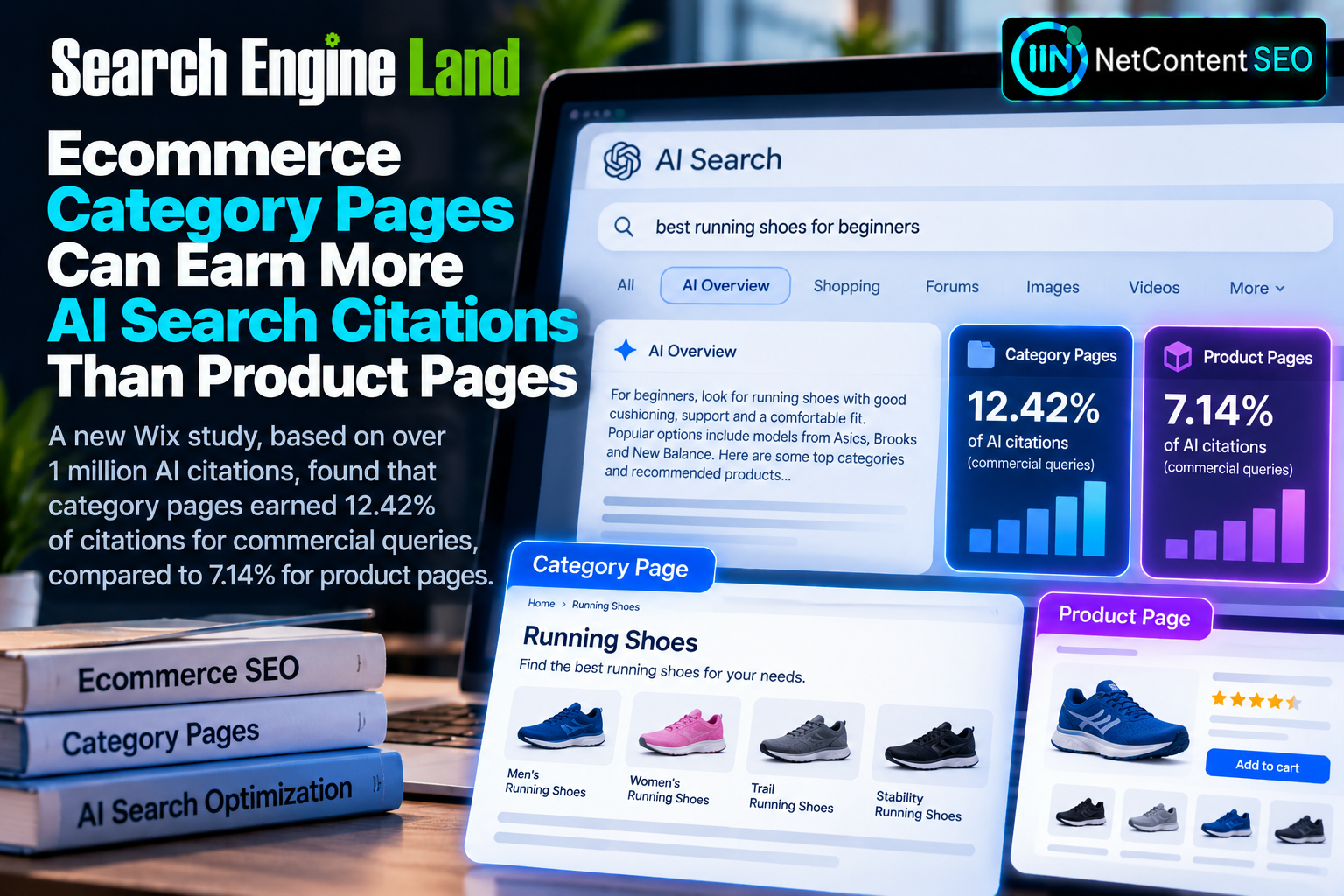

Ecommerce category pages may play a bigger role in AI Search than many retailers expect. An October 27, 2026 analysis published by Search Engine Land revisits research from Wix Studio showing that, for commercial-intent prompts, category pages accounted for 12.42% of AI citations, compared with 7.14% for product pages in the study's sample.
The numbers come from research examining 75,000 AI answers and 1,056,727 citations across ChatGPT, Google AI Mode and Perplexity. They do not mean that an individual category page has a 12.42% probability of being cited. They describe the distribution of cited page types within a particular set of prompts.
For ecommerce SEO teams, the more useful question is why category pages appear in commercial research journeys—and how to make those pages genuinely helpful to shoppers comparing options.
What the Wix Studio research found
The Wix Studio AI Search Lab research, originally published in March 2026, grouped citations by page type and query intent. The October 27 Search Engine Land analysis by Wasim Kagzi highlights a striking contrast: category pages earned 12.42% of citations for commercial-intent prompts, while product pages accounted for 7.14%.
Category pages performed much less strongly for informational queries, accounting for only 1.74% of citations in that intent group. This difference matters because a shopper asking which kind of product to buy needs different information from someone seeking a definition or troubleshooting advice.
Across the wider intent spectrum, product pages led in most categories. Commercial intent was the exception in which category pages outperformed individual product pages.
Why commercial intent favors useful category pages
Commercial queries often ask users to evaluate options rather than locate a single known product. Someone searching for the best running shoes for beginners, for example, may need a comparison of cushioning, fit, support, intended use and price range. A well-designed category page can provide an overview of several relevant choices in one place.
Individual product pages are valuable when the shopper already knows the exact model or configuration they want. Category pages can be more useful earlier in the decision process, when the task is to narrow down a selection.
This does not establish that AI systems universally prefer category pages. The observed pattern depends on the prompt's intent, the available sources and how the study classified URLs.
Three studies, different citation figures
Search Engine Land also compares other 2026 research. DeltaV Digital analyzed 21,075 AI responses and 25,337 citations from April through July, finding category pages represented 5.2% of citations in its sample. A Gradial study involving 28 retail and consumer brands reported that product listing pages appeared only rarely in its tests.
These findings need not be mutually exclusive. The studies used different prompts, brands, industries and measurement methods. In particular, DeltaV's eight-brand panel did not include ecommerce brands, making its overall share difficult to compare directly with the Wix commercial-intent subset.
Kevin Indig's Growth Memo research also looked at how often cited URLs were shared across three AI search engines. That is a different metric from overall citation share, so its percentages should not be placed beside the Wix figures as though they measured the same outcome.
The practical lesson is to evaluate AI citation studies by query mix, industry, platform and metric definition, not just by the headline percentage.
Important limitations in the data
Search Engine Land notes that Wix did not disclose its exact data-collection window or explain how pages were assigned to content-type categories. Those gaps limit how precisely the results can be reproduced or generalized.
Also, the study reports the share of citations attributed to categories of pages. It does not show that optimizing a particular category page will automatically produce a measurable increase in citations, recommendations or sales.
For that reason, the 12.42% versus 7.14% comparison is best understood as evidence of an opportunity within the analyzed commercial prompts—not a universal performance benchmark for every ecommerce site.
A citation is not the same as a recommendation
A critical distinction in AI Search is the difference between a source being cited and a brand or product being recommended. An AI answer may reference a category page for background context while ultimately recommending products from other merchants.
Search Engine Land points to separate research showing that category structure alone did not determine whether a brand was recommended. Other datasets also suggest that comparison pages can be referenced repeatedly, whereas category pages may appear only once during retrieval.
Retailers should therefore measure more than citations. Relevant outcomes include qualified visibility, brand mentions, product inclusion in recommendations, referral traffic and eventual conversion. These signals answer different business questions.
What AI-friendly category pages should contain
The strongest editorial opportunity is to turn a basic product grid into a useful decision-making resource. Category pages can explain what differentiates products, who each option suits and which trade-offs matter to the buyer.
For a running-shoe category, this could mean explaining the differences between stability and neutral shoes, offering guidance for beginners, clarifying fit considerations and highlighting which options suit road running or trails. For furniture, it could mean comparing materials, dimensions, room sizes and maintenance needs.
Useful enhancements include concise buying guidance, attribute comparisons, specific use cases, understandable filters, internal links to relevant subcategories and accurate descriptions of available products. Information should be written for shoppers first, not added as generic AI-generated filler.
Why product feeds do not replace category context
Product feeds describe individual items through attributes such as brand, availability, price and product characteristics. They are essential for many shopping experiences, but they do not always explain the logic of a collection: why certain products belong together, how to choose between them or which customer needs the assortment addresses.
A well-maintained category page can provide that missing context. This does not mean feeds or product structured data should be neglected. It means retailers should view category content, product data and navigation as complementary parts of the same discovery experience.
Should ecommerce sites add CollectionPage or ItemList schema?
Structured data can help describe page content in a machine-readable format, but claims that adding CollectionPage or ItemList markup by itself increases AI Search citations are not supported by controlled evidence cited in the Search Engine Land analysis.
Schema should accurately reflect visible content and follow the relevant search engine documentation. It is not a substitute for useful comparisons, clear merchandising or a technically accessible page.
How to test the opportunity on your own site
Start by grouping commercially relevant prompts by intent: broad comparison, specific use case, brand exploration and exact-product requests. Identify the category and product pages that genuinely answer each group.
Next, audit category pages for gaps in selection guidance. Do they explain differences among products? Are the attributes consistent and understandable? Can a shopper identify the best options for a specific need without opening dozens of product pages?
Finally, monitor a stable prompt set across the AI experiences most relevant to your audience, recording source citations separately from brand mentions and recommendations. Changes should be interpreted cautiously because AI answers can vary between runs, locations and platforms.
What this means for traditional SEO
The findings do not make conventional ecommerce SEO obsolete. Crawlable navigation, useful page titles, clear internal linking, canonicalization and sensible faceted-navigation rules still matter for discovery and indexation.
In fact, a separate October 23 Search Engine Land analysis of 100 ecommerce websites reported that category pages generated a large share of conventional Google Search clicks. That study measured Search Console traffic, not AI citations, so it supports the strategic importance of category pages from a different angle rather than validating the Wix percentages.
The combined implication is practical: category pages deserve deliberate content and technical investment instead of being treated as disposable templates.
NetContentSEO assessment
The opportunity is not to stuff more keywords into category pages. It is to make those pages explain how to choose. Commercial-intent AI queries often involve comparison, evaluation and uncertainty. A category page that helps resolve those questions can be a relevant source.
The Wix findings provide a useful research signal, but they are not a new Google ranking factor, a newly announced AI Search algorithm change or a guaranteed formula for citations. The October 27 article is a fresh analysis of earlier study data.
For ecommerce teams, the next step is straightforward: identify high-value commercial categories, improve their selection logic and measure citation and recommendation outcomes separately.
Sources: Search Engine Land, “How ecommerce category pages can earn AI search citations,” October 27, 2026; Search Engine Land, “Category vs. product pages: Which does Google favor?”, October 23, 2026.