

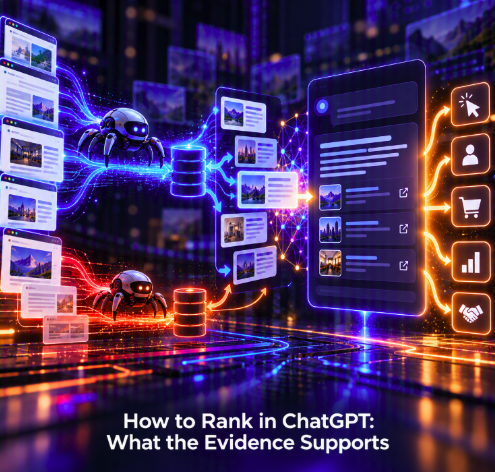

Businesses increasingly ask how to “rank in ChatGPT,” but the phrase imports a model from traditional search that does not cleanly describe generative discovery. ChatGPT can discover a page, retrieve it for a particular information need, cite it, use its evidence inside an answer and send a user to it. Those are related outcomes, but they are not the same event and there is no public evidence of one stable ChatGPT position that a publisher can optimize for in the way an SEO team tracks a conventional number-one ranking.
This distinction is the strongest idea in Michal Balsianka’s July 21, 2026 essay “How to Rank in ChatGPT: What the Evidence Supports”. Rather than treating GEO as a bag of formatting tricks, the article proposes a chain: content has to be discoverable, retrieved, selected, used and ultimately capable of producing a useful outcome. That framing is consistent with current official crawler documentation and with emerging research showing that a visible citation is not necessarily the same thing as answer-level influence.
The first requirement is technical eligibility
OpenAI’s current crawler documentation makes one prerequisite unusually clear. OAI-SearchBot is the crawler used to surface websites in ChatGPT search results. OpenAI says sites that opt out of OAI-SearchBot will not be shown in ChatGPT search answers, although navigational links can still appear in some circumstances. It recommends allowing the crawler in robots.txt and allowing requests from its published IP ranges.
This is eligibility, not optimization. Allowing the crawler does not guarantee retrieval or citation. It removes a technical barrier that can prevent the page from participating in the search layer at all.
Publishers should therefore audit more than robots.txt. A CDN, firewall or bot-protection system can reject an otherwise permitted crawler, and OpenAI’s advertiser guidance separately notes that automated defenses can mistakenly return 403 responses to legitimate OpenAI crawlers. Important pages also need to be publicly accessible and publishers should understand how noindex affects whether a discovered URL can be surfaced.
OAI-SearchBot and GPTBot represent different decisions
One of the most useful practical clarifications is that OpenAI separates search crawling from model-training crawling. OAI-SearchBot is for search. GPTBot crawls content that may be used to improve OpenAI’s generative AI foundation models. OpenAI explicitly says the settings are independent: a webmaster can allow OAI-SearchBot while disallowing GPTBot.
That means a publisher does not need to treat “being visible in ChatGPT Search” and “allowing content to be crawled for model training” as one all-or-nothing permission. The robots policy can express different choices for the two use cases.
Search Engine Roundtable has also tracked changes to OpenAI’s crawler documentation, including the July 2026 clarification that crawler user-agent version strings can change. That is another reason to follow OpenAI’s current bot documentation rather than hard-code operational assumptions from an old screenshot or third-party checklist.
“Ranking” is better understood as a sequence of competitions
The source article separates AI visibility into five practical questions. Can the content be discovered? Is it retrieved for the user’s question? Is it selected as a visible source? Does it materially influence the generated answer? Does that exposure lead to a useful action?
That model is more useful than collapsing every outcome into a single “AI ranking score.” A page can be crawlable yet irrelevant to the prompt. It can be retrieved but lose the citation to a more direct source. It can receive a visible citation while contributing little evidence to the response. And it can shape an answer without producing a click or commercial action.
NetContentSEO has examined the middle of this chain in its analysis of citation selection versus citation absorption. The underlying research uses an observational influence proxy rather than access to hidden model attention, but the conceptual point is important: a citation is evidence of source visibility, not proof that the source determined what the AI said.
Retrieval can expand beyond the words in the original prompt
Generative search systems can investigate subquestions before constructing an answer. Google documents this explicitly for AI Overviews and AI Mode, saying its systems may use “query fan-out” to issue multiple related searches across subtopics and data sources.
OpenAI does not publish an equivalent universal recipe saying every ChatGPT search follows Google’s exact fan-out mechanism. The Google documentation is useful as evidence for the broader retrieval pattern, not as proof of ChatGPT’s private architecture.
The SEO implication is nevertheless important. A user asking for the best AI coding tool for a small software team can create information needs around price, repository privacy, code review, reliability, implementation and alternatives. A useful page can become relevant to one of those subproblems even if it does not repeat every conversational variation of the original query.
Traditional SEO remains the foundation, not the complete explanation
The rise of GEO has encouraged a false choice between “old SEO” and “AI SEO.” Google’s current official guidance rejects that framing for its own generative Search products. Google says AI Overviews and AI Mode remain rooted in core Search ranking and quality systems and that foundational SEO practices continue to apply.
That means crawlability, clear site structure, useful titles, descriptive internal links, original information, reliable sourcing and people-first content have not become obsolete. What has changed is the output layer. A generative system can retrieve several sources, synthesize them and present an answer in which no conventional ranked list fully explains which evidence was used.
The sensible position is therefore additive. Strong SEO improves the probability that useful pages are accessible and understandable. AI visibility introduces additional questions about retrieval, source selection, representation and measurement.
Evidence should outrank formatting folklore
The source article is appropriately skeptical of claims that a universal GEO formula has already been discovered. AI products change quickly, platforms use different retrieval systems and generative responses can vary across repeated runs. A tactic associated with higher visibility in one experiment is not automatically a durable causal ranking factor across ChatGPT, Google, Perplexity and other systems.
This distinction is essential when reading GEO studies. A controlled rewrite that performs better is evidence for that experiment. A page appearing more frequently in a limited prompt set is evidence of an association in that setting. Neither automatically proves durable traffic or business impact across production platforms.
The appropriate response to uncertainty is not inactivity. It is measurement. Teams should form hypotheses, establish a baseline, make changes that also improve the human experience and test whether visibility and business outcomes move repeatedly rather than celebrating one favorable screenshot.
Publish information that an answer can actually use
If an AI system is assembling an answer from external evidence, commodity prose creates weak differentiation. A page becomes more useful when it contributes something concrete: a precise definition, original dataset, documented methodology, comparison, worked example, calculation with assumptions, procedural explanation or well-supported answer to a consequential question.
Google’s 2026 generative-search guidance similarly recommends valuable, unique, non-commodity and expert-led content rather than simply repackaging what is already available across the web.
Emerging citation-absorption research points in the same direction, with an important qualification. In one cross-platform dataset, definitions, comparisons, numerical evidence, procedures and code were associated with deeper apparent answer use under the study’s constructed influence proxy. Those are descriptive associations, not proof that adding a definition box or comparison table will causally improve ChatGPT visibility. NetContentSEO’s review of that research explains why evidence structure appears more interesting than superficial “AI-friendly” formatting.
Make factual claims easy to verify
A useful source distinguishes observed facts from vendor claims, estimates, assumptions and interpretation. That helps human readers evaluate the evidence and makes the page easier to use responsibly inside a generated answer.
Primary links matter especially for volatile subjects. If a product price, crawler policy or platform feature can change, citing the company’s current documentation gives both the reader and a retrieval system a path to verification. Methodology should accompany original research, and limitations should accompany statistics.
This is not a guaranteed citation tactic. It is durable publishing practice that also makes a page a better evidence object.
Build a coherent subject instead of duplicating query variants
A strong AI-search content strategy should not produce a separate shallow page for every paraphrase of the same question. The better model is a connected body of distinct work: one article on ChatGPT crawl eligibility, another on source selection, another on citation measurement, another on referral quality and another on brand representation.
Each page should solve a different information problem and link to related material descriptively. This creates topical depth without manufacturing near-duplicate pages designed only to capture wording variants.
AI systems can understand semantic relationships. Google’s official guidance explicitly says publishers do not need to rewrite content around every long-tail or conversational variation for its generative Search features.
Independent evidence is part of the public representation layer
A company’s own site is only one place from which an AI system may learn current facts during retrieval. Depending on the question and platform, the broader evidence environment can include documentation, customer reviews, reputable reporting, research, public discussions, comparison pages, partner material and regulatory records.
That makes public credibility relevant to AI visibility, but it does not justify manufacturing mentions. Google explicitly warns that pursuing inauthentic mentions is not a useful shortcut for its generative Search systems, which remain connected to ranking-quality and spam systems.
The durable objective is therefore accurate third-party representation earned through real products, research, customers, partnerships and events worth documenting—not a synthetic footprint created solely for an AI crawler.
llms.txt is not a Google ranking strategy
One recurring GEO claim is that publishers need an llms.txt file to rank in AI search. For Google Search, the company has now answered that question directly: Google says it does not use llms.txt for Search or its generative Search features, and maintaining the file neither helps nor hurts Google visibility or rankings.
Barry Schwartz documented that clarification when Google updated its guidance in June 2026.
This does not establish what every non-Google AI service may do now or in the future. An llms.txt file can be maintained for a system that explicitly supports it. The evidence does not support presenting it as a universal GEO ranking switch.
Artificial “chunking” is another unsupported shortcut
Clear sections and useful headings are good editorial structure. Turning a coherent article into dozens of tiny fragments because someone claims LLMs require “answer chunks” is different.
Google explicitly says there is no requirement to break content into tiny pieces for its generative Search systems and no universally ideal page length. It recommends creating pages for the audience rather than restructuring them solely for generative AI.
The useful principle is extractability without sacrificing coherence. A reader should be able to identify the answer, evidence and assumptions quickly, but the argument should remain professionally written rather than mechanically fragmented.
One prompt is not a measurement system
Generative answers can vary across runs, wording, time and product changes. A brand appearing once for “best software for X” proves that it appeared in that observation; it does not establish a stable position comparable to a conventional tracked rank.
A practical visibility study should therefore use a portfolio of questions reflecting how customers discover, evaluate and buy. Brand questions, category questions, problem questions and commercial comparison questions can reveal different forms of representation.
For each important question, teams can record whether the brand appears, whether the official website is cited, which third parties describe the brand, whether that description is accurate, which competitors appear and how much the response varies across repeated observations.
Visibility, representation, traffic and conversion are separate KPIs
AI visibility measurement becomes misleading when every outcome is compressed into one proprietary score. A brand mention measures presence. A citation measures visible sourcing. Answer influence attempts to measure how strongly evidence is reflected in the response. Referral traffic measures visits. Conversion measures whether those visits produce a desired outcome.
Those metrics can move independently. A publisher might gain citations without gaining clicks, improve brand representation without being cited from its own domain or receive fewer AI referrals that convert at a higher rate.
Google’s own measurement products are moving in this direction. In June 2026 Google introduced dedicated Search Generative AI performance reports in Search Console, and the company later updated the announcement to say the insights had reached all websites worldwide by August 31. The reports provide a dedicated view of visibility from generative features such as AI Overviews and AI Mode.
NetContentSEO has analyzed the reporting change in its review of Google’s dedicated AI visibility reports, which illustrates the broader measurement shift: AI exposure increasingly needs its own visibility layer rather than being inferred only from conventional clicks.
A practical ChatGPT visibility audit starts with questions, not hacks
The source article proposes a useful monthly workflow. First, confirm technical eligibility: OAI-SearchBot access, indexing controls, public accessibility and infrastructure behavior. Keep the separate GPTBot training decision explicit. Second, select a manageable set of commercially meaningful questions based on actual customer discovery and evaluation rather than only the prompts a monitoring tool happens to support.
Then establish a repeated baseline. Record source selection, brand representation, competitors and inaccuracies. Look for information gaps: questions the site does not answer, claims lacking evidence, stale product facts, weak comparisons and third-party sources that misrepresent the business.
Finally, publish the smallest number of pages needed to close the highest-value gaps. Each page should contribute something worth using as evidence and something worth visiting the source to explore further. Re-measure afterward instead of assuming the edit worked.
The evidence supports an extension of SEO, not a secret ChatGPT formula
The defensible answer to “How do I rank in ChatGPT?” is therefore less exciting than a ranking hack. Make the site technically eligible for search discovery. Publish pages that directly resolve real decisions. Provide evidence that can be verified and reused. Build coherent subject expertise. Maintain an accurate public record beyond the company website. Measure source visibility repeatedly and connect it to meaningful outcomes.
What the evidence does not support is the idea that ChatGPT exposes one stable ranking algorithm that can be reverse-engineered through a handful of universal formatting tricks. Even the strongest emerging GEO research remains sensitive to platform, prompt, retrieval system and time.
The businesses best positioned for AI search are likely to be those whose information is easiest to discover, understand, verify and use. That standard is familiar because much of it is strong SEO and strong publishing. Generative search adds new retrieval and measurement layers, but it does not remove the need to be a genuinely useful source.