
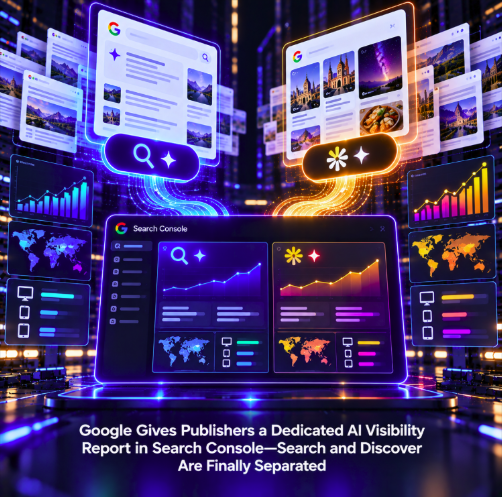
Google has given publishers something they have been asking for since generative answers began occupying a larger share of Search: a dedicated first-party view of where their pages appear inside Google’s AI experiences. Search Console now includes Search Generative AI performance reports, with separate reporting for generative features in Search and Discover rather than forcing those impressions to remain blended into broader performance totals.
Google announced the feature on June 3 in its official Search Central post. The company initially released the reports to a subset of sites for testing, then updated the announcement to confirm that the insights had reached all websites worldwide by August 31.
The change creates a distinct measurement layer for AI Overviews, AI Mode and generative AI experiences in Discover. Importantly, Google says the underlying data remains included in overall performance reporting. The new reports do not replace existing Search Console totals; they expose a dedicated view of the generative portion that was previously harder to isolate.
AI visibility can finally be separated from the aggregate
Before the dedicated view, Search Console could count activity from generative Search features inside broader performance data without giving publishers an equally clear way to isolate that visibility. That made a basic analytical question difficult: how much of a site’s exposure is coming specifically from Google’s AI-generated experiences rather than conventional results?
The new report is designed to answer that question at the impression level. Google says it shows how often URLs from a site appeared in generative AI features in Search and Discover, while allowing publishers to inspect the pages that surfaced and analyze visibility by country and date.
For Search results, the report also includes device information. Time analysis can be viewed at hourly, daily, weekly and monthly granularity, giving teams a way to monitor changes around content launches, algorithmic shifts or expansions of Google’s AI interfaces.
Search and Discover are separate AI distribution environments
Google’s decision to provide dedicated reporting for Search and Discover matters because the two surfaces represent different discovery behaviors. Search is initiated by an explicit information need. Discover is recommendation-driven and can surface content before a user formulates a query.
Generative AI can operate in both environments, but publisher strategy should not assume they behave identically. A page that earns substantial exposure in AI Mode may have little presence in generative Discover, while a story with strong recommendation appeal may perform differently from content optimized around explicit search demand.
The split makes that difference measurable. Instead of treating “AI visibility” as one undifferentiated metric, publishers can begin distinguishing conversational or answer-oriented Search exposure from AI-assisted recommendation exposure.
The report currently emphasizes impressions rather than a complete AI funnel
Google’s launch announcement is careful about what the new report exposes. It explicitly lists impressions, pages, countries, devices for Search, and date-based trends. The company says it is continuing to work with website owners on additional insights and metrics over time.
That means the report should not be mistaken for a complete retrieval-and-citation debugger. It tells publishers that their URLs appeared in covered generative experiences, but Google’s public launch documentation does not promise a view into every intermediate step that produced that appearance.
For example, it does not provide a complete trace showing every document retrieved by Google’s systems before an answer was generated, nor does the announcement expose a conversation-level path explaining which follow-up in AI Mode caused a particular source to enter the response.
This distinction is central to GEO measurement. Visibility in an AI interface is one observable outcome; retrieval, grounding, citation and user interaction are separate stages. A dedicated Search Console report materially improves first-party measurement without collapsing those stages into one metric.
AI Mode makes conventional position analysis harder
Generative interfaces also complicate familiar SEO metrics. A conventional result has a relatively understandable relationship to a ranked list, even if modern SERPs already contain many specialized modules. AI Mode can instead present multiple source links inside a generated response and then continue the interaction through follow-up questions.
NetContentSEO has already examined Google’s warning that AI Search position should not be treated as an absolute physical measurement. The interface can evolve, and Google’s methodology for recording impressions and positions must evolve with it.
The new generative AI report is therefore most useful when treated as a visibility instrument rather than an attempt to force conversational search into the exact analytics model of ten blue links. The important new capability is isolation: publishers can see that AI-specific exposure exists and identify which URLs participate in it.
AI Mode follow-ups create a new unit of discovery
Conversational Search also changes what a query means. Google has documented that follow-up questions in AI Mode can be treated as new queries for Search Console measurement. A user may begin with a broad question, inspect the generated response and then refine the information need without ever returning to a conventional search box.
That creates an analytical gap between the initial search intent and the eventual source exposure. A page may enter the experience only after the user asks a second or third question, even though the entire sequence feels like one research session to the user.
As NetContentSEO noted in its coverage of AI Mode’s automatic follow-up journey, the entry query alone may not explain why a publisher ultimately becomes visible. Dedicated AI reporting establishes the baseline, but conversation-path analytics would be a further step.
Discover makes AI visibility a recommendation problem as well as a search problem
The Discover report is strategically important because generative discovery can insert AI synthesis into a feed-driven environment. A publisher may be selected as a source or linked from an AI-assisted topic experience without the user ever typing the kind of query that keyword tools traditionally model.
Google has already been experimenting with deeper AI-assisted exploration inside Discover. NetContentSEO covered the company’s “Dive deeper” experience, where an AI-generated topic layer can appear before the user decides whether to visit a publisher.
This makes the dedicated Discover view more than a reporting convenience. It recognizes that generative visibility can arise in a personalized recommendation system, where the publisher’s opportunity is not necessarily tied to an explicit query or a conventional ranking position.
The data creates a baseline for Google’s new AI visibility controls
Dedicated measurement has become even more consequential because Google now also gives publishers a specific control over participation in generative Search experiences. Search Console’s Search generative AI setting can exclude a site from AI Overviews, AI Mode and covered generative features in Discover without requiring the site to disappear from traditional Search.
NetContentSEO analyzed that separation in our coverage of Google’s generative AI opt-out control. The performance reports provide the measurement layer publishers need before making that distribution decision.
A site can now examine its AI impressions, identify which pages receive exposure, compare Search and Discover visibility, and then evaluate what it would give up by excluding itself from those experiences. Google has effectively paired an AI distribution control with first-party reporting about the distribution being controlled.
AI Search is becoming a distinct analytics channel
The most important consequence is organizational. SEO teams have historically treated Google organic performance as one broad channel, then segmented it by query, page, country, device or search appearance. Generative Search increasingly deserves another analytical dimension because the mechanics of discovery are different.
A page can be conventionally ranked, appear as a source in an AI Overview, surface in AI Mode after query fan-out, or be exposed through generative Discover. Those outcomes may have different relationships to clicks, brand exposure and downstream conversion.
The new reports do not answer every business question about those outcomes. Google’s launch post does not present a full attribution model showing how an AI impression contributes to a later branded search, direct visit or conversion. Nor does it reveal every source considered by the generative system.
But the reporting boundary itself is significant. Google is acknowledging that generative visibility is important enough to deserve a dedicated Search Console view rather than remaining permanently hidden inside aggregate performance data.
Publishers can identify which URLs repeatedly enter AI experiences
The Pages dimension may prove especially useful for editorial and SEO teams. Rather than relying on manual prompts and screenshots to discover whether a site is appearing in AI Overviews or AI Mode, publishers can inspect which URLs Google reports as having generated AI impressions.
Over time, that creates a first-party dataset for comparing content types. Teams can examine whether original research, product pages, explainers, breaking news, evergreen guides or other formats are disproportionately represented in generative experiences.
Correlation still needs to be handled carefully. A page appearing frequently in the report does not prove that a specific formatting technique or content characteristic caused Google to select it. Search demand, topic coverage, authority, freshness and many other variables can differ at the same time.
The value is that publishers now have an outcome variable they previously lacked. Experiments around AI visibility can be evaluated against Google’s own impression data instead of depending entirely on third-party prompt tracking.
Third-party AI trackers now have a first-party benchmark
The GEO tooling market has grown rapidly around monitoring whether brands and URLs appear in generated answers. Those systems remain useful because they can run controlled prompt sets, compare multiple AI engines and inspect competitors. Search Console serves a different role: it observes actual Google visibility associated with the publisher’s verified property.
The two datasets should not be expected to match perfectly. A third-party tracker samples prompts selected by the tool or customer. Search Console measures eligible real-world impressions under Google’s reporting rules. Differences between them can reveal as much about methodology as about visibility.
For serious AI-search analysis, that creates a stronger measurement stack. Controlled prompt tracking can explain performance on a defined benchmark, while Search Console can show whether the site is actually accumulating generative exposure at scale across Google users.
Google has moved AI visibility from anecdote to a measurable property
For much of the AI-search transition, publishers had to infer their visibility from manual testing, referral traffic and third-party monitoring. That was an awkward foundation for a distribution surface increasingly capable of answering questions before users reached the source.
Search Console’s generative AI reports change that baseline. Google now provides a dedicated view of impressions in AI Overviews, AI Mode and generative Discover, with page, country and time dimensions and device information for Search. The reports began as a limited June rollout and, according to Google’s updated announcement, reached all websites worldwide by August 31.
The reporting is still incomplete as a full AI attribution system, and Google explicitly says it is considering additional metrics. But the structural change is already here: generative Search and generative Discover can be measured separately from the aggregate.
That makes AI visibility a first-party Search Console metric rather than an SEO hypothesis. Publishers can now see which parts of their sites enter Google’s generative surfaces—and begin treating that exposure as a distinct distribution channel with its own measurement, optimization and participation decisions.