
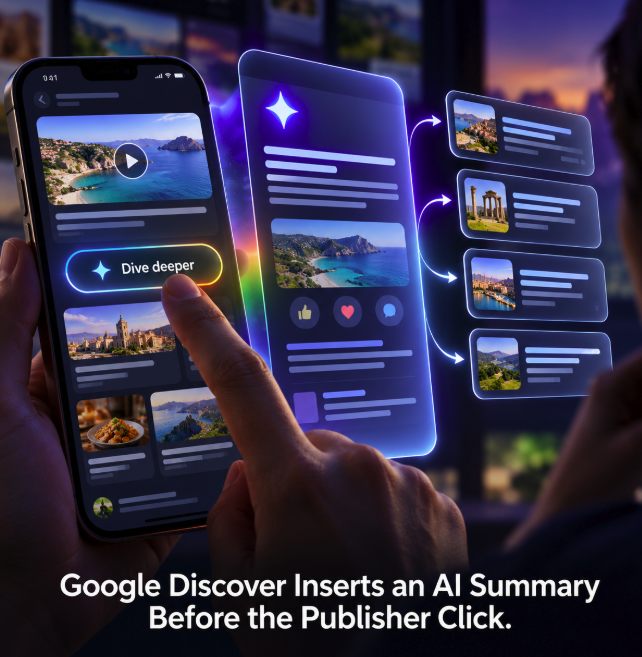
Google is testing a new Discover experience that adds another layer between a piece of content in the feed and the publisher behind it. The feature, called “Dive deeper,” opens a Google-hosted topic overview with AI-generated text, related stories, community reactions and links to original reporting instead of sending the user directly to a publisher page.
Robby Stein, vice president of product for Google Search, announced the experiment on September 18, describing it as a way to make exploring topics and discovering related web content easier inside Discover. Search Engine Roundtable documented the announcement and screenshots, which show the summary labeled as generated with AI and accompanied by Google’s warning that the output can make mistakes.
The distinction matters for publishers because Discover has traditionally been valuable precisely because a compelling card could become a direct visit. With Dive deeper, Google is testing a different journey: the first interaction can keep the reader inside Google, where an AI-generated overview provides context before the user decides whether any external source deserves another click.
What happens after users tap “Dive deeper”
According to Stein, tapping the new button produces a short topic overview with prominent links to related stories, community reactions and original reporting. Google is starting the experiment with videos and plans to test multiple designs in the coming weeks. The company has not publicly specified the countries or languages involved, how many users are included, or whether the experience will eventually expand broadly across article cards.
The screenshots are important because this is not simply a richer preview attached to a normal outbound link. The Dive deeper button opens a Google experience containing a longer summary and source cards. A further “Explore more stories” view groups coverage around subtopics and links to publishers from within that layer.
That means the original publisher can remain visible and clickable, but the sequence has changed. The user may first consume a synthesized explanation, inspect related coverage and evaluate multiple sources before deciding whether to leave Google at all.
The publisher click is no longer necessarily the first click
For SEO teams, the most consequential part of the test is not the existence of AI-generated text by itself. Google has already introduced AI summaries across several search and discovery surfaces. What is notable here is where the synthesis sits in the interaction funnel.
A Discover impression can now potentially lead to a Google-generated information layer rather than directly to the source. That creates an additional decision point between exposure and referral traffic. If the overview satisfies the user’s curiosity, the session may end without an external visit. If it increases curiosity or makes the underlying reporting more useful, it could still generate clicks to one or more publishers. Google has released no traffic data for the experiment, so either outcome remains an empirical question rather than a demonstrated effect.
That uncertainty is important. Search Engine Roundtable’s Barry Schwartz argued that the design could result in fewer publisher clicks because users may receive enough context from the generated overview. That is a reasonable publisher concern, but it is currently an interpretation of the interface, not measured evidence of traffic loss from Dive deeper.
Discover is becoming a synthesis surface, not only a recommendation feed
The test also illustrates a broader evolution in Google’s discovery products. A feed once centered on selecting and presenting individual pieces of content is increasingly capable of assembling a topic from multiple sources. The unit of discovery can shift from “this article may interest you” toward “this subject may interest you, and here is a synthesized entry point into it.”
For publishers, that changes what visibility means. Winning the initial Discover card may remain valuable, but it may no longer guarantee ownership of the next interaction. A source could instead appear inside an AI-generated overview, in a related-story card or as supporting reporting under a subtopic assembled by Google.
This resembles the measurement problem already emerging elsewhere in AI search. NetContentSEO recently examined research showing that Google Search and AI Overviews can surface substantially different source sets. Discover’s new experiment adds another potential source-selection environment that publishers may eventually need to monitor separately from traditional Search, AI Overviews and AI Mode.
Being used by the summary and earning the click are different outcomes
Dive deeper also makes the distinction between citation and traffic more visible. A publisher can contribute reporting that helps establish a topic, appear as a source in Google’s interface and still receive no visit from a particular user. Conversely, a source that is especially relevant to the user’s next question could gain a click after the overview creates additional interest.
That is why future Discover reporting may need to distinguish several layers of performance: feed exposure, inclusion within generated experiences, source visibility and actual outbound traffic. Counting only sessions arriving on the publisher site would miss the visibility that occurred inside Google, while counting only source appearances would risk overstating their traffic value.
The same issue is becoming central to generative engine optimization. NetContentSEO has previously covered research suggesting that a page can be cited by an AI system without meaningfully shaping the generated answer. Dive deeper introduces a related question for Discover: a publisher can be present in the experience without necessarily being the destination.
Publishers should watch the test, not assume the outcome
For now, Dive deeper is explicitly an experiment. Google says it will begin with videos and iterate through multiple designs. There is no announced general rollout, and no public evidence yet showing how the feature changes click-through rates, Discover sessions or source diversity.
Publishers therefore have good reason to monitor the test without treating traffic loss as an established fact. If the feature expands, useful measurements would include whether pages cited in the overview receive different click-through behavior, whether the original content card retains prominence, how frequently Google selects sources beyond the initial publisher, and whether Search Console eventually exposes enough data to distinguish these new interactions.
The strategic direction, however, is worth watching closely. Google is experimenting with an experience in which Discover does not merely recommend a publisher’s content; it can interpret a topic, summarize it and then offer publishers as possible next steps. That moves AI synthesis one stage earlier in the reader journey.
For news organizations and SEO teams, the question is no longer simply whether Google will cite their reporting. It is whether the citation remains a bridge to the publisher or becomes part of an experience that answers the reader before the publisher click ever happens.