

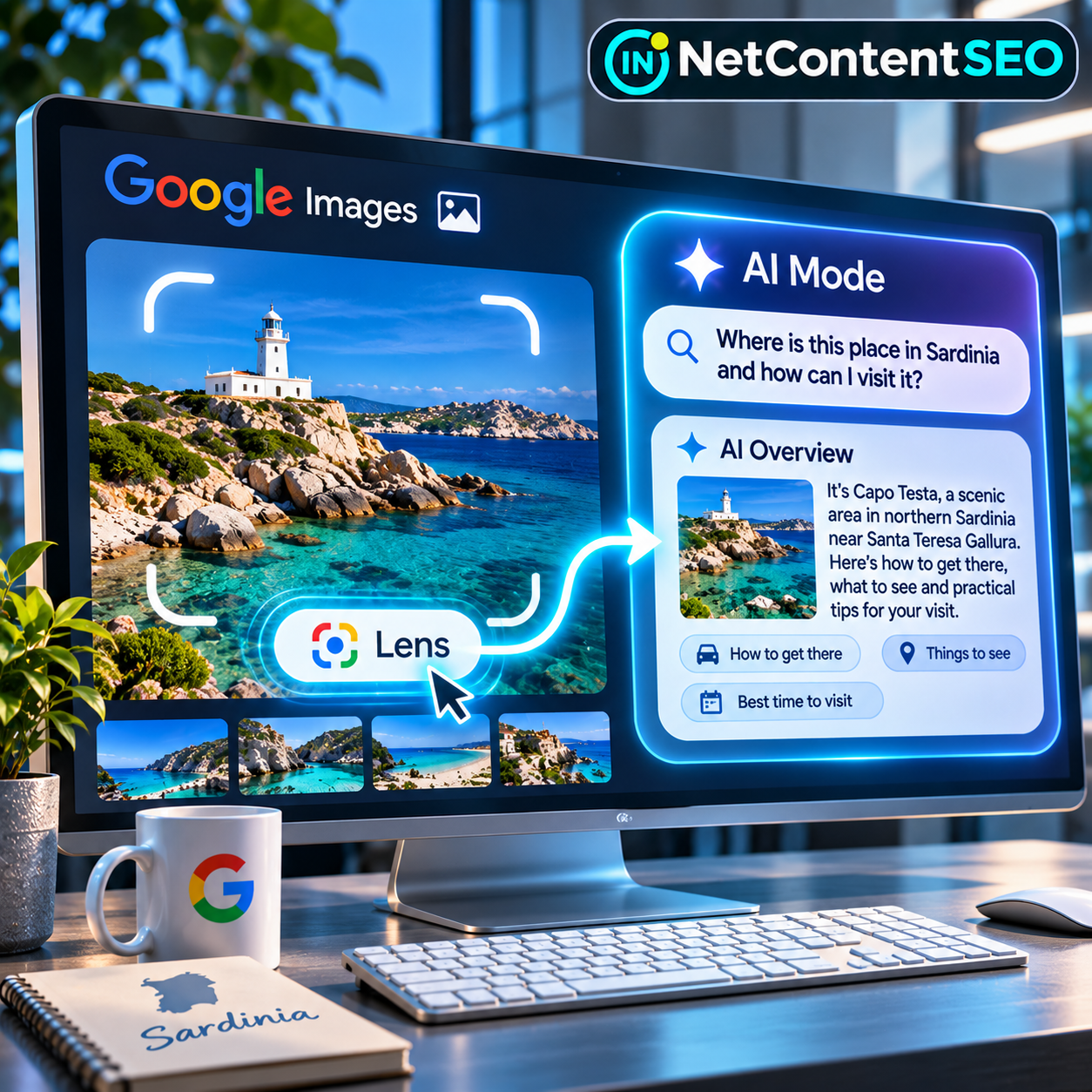

Google Images is becoming another entry point into AI-assisted search conversations. On November 19, 2026, Search Engine Roundtable documented an observed behavior in which tapping a Lens control on an image result can take a user into an AI Overview follow-up or an AI Mode conversation using that image as context. The report highlights an increasingly close connection between visual discovery and conversational search. It is an observation, not a confirmed worldwide rollout or a newly announced Google ranking change.
What was actually observed?
Barry Schwartz reported a demonstration by Damien Andell showing a combined AI Mode and Lens icon in the Images tab of the Google app. Selecting it opened an AI Mode chat with the associated image. Schwartz also tried the interaction outside the app and was directed to an AI Overview follow-up instead. These different outcomes matter: the destination appears to depend on the interface or environment, and the report does not establish one universal behavior. Read the November 19 observation.
The novelty is not the existence of Lens in image results. Google has offered Lens-based visual searching for some time. What is notable here is the reported transition from an image result into an AI-powered follow-up experience.
From finding an image to asking about it
Consider a traveler looking at a photograph of a Sardinian beach. Traditional image search might help identify the location or find visually similar photos. A conversational follow-up could ask where the beach is, whether access is restricted, how to reach it without a car or when to visit. That scenario illustrates the potential user journey; it is not evidence that the observed feature provides accurate answers to all such questions.
For visual-first publishers, the shift is important because an image may become the beginning of a multi-step information session rather than the end of a search. The user could continue exploring in Google's interface, click a cited source, refine the visual question or leave without visiting the original publisher. The actual distribution of these outcomes has not been measured in the reported observation.
Why this matters for image SEO
Images already carry discovery value through subject matter, surrounding page text, captions, filenames, alternative text and page context. Those fundamentals remain useful as search becomes more multimodal. Google's observed Lens-to-AI transition does not create a verified new image ranking factor, and it does not guarantee that adding a particular schema type or keyword will earn an AI citation.
Instead, publishers should treat image SEO and answer completeness as connected editorial disciplines. A compelling photograph should appear on a useful, indexable page that accurately identifies the subject and answers likely follow-up questions. For destination photography, that may mean including the place name, access conditions, seasonality, transport options and links to official rules where applicable.
What tourism and photography publishers should do
- Use original, relevant images: publish photographs that genuinely document the destination, attraction or activity described.
- Write accurate alt text: describe what the image shows, without stuffing unrelated keywords or repeating a generic promotional phrase.
- Add useful captions and context: identify locations, viewpoints and practical details where they are known and verified.
- Maintain technical accessibility: ensure important images can be discovered and rendered, avoid blocking them unintentionally and use suitable image formats and responsive sizing.
- Answer visual follow-up questions: explain where a place is, how to get there, what visitors need to know and when information was last checked.
- Measure carefully: monitor image-search impressions and clicks, landing-page engagement and referral trends, but do not attribute changes to this specific interface without supporting evidence.
A concrete example for Sardinia travel content
A guide featuring an original photograph of Capo Testa could connect the image to verified information about its location near Santa Teresa Gallura, road access, parking considerations, coastal trails and applicable visitor rules. The value is not merely helping Google identify the photo; it is giving readers a reliable destination resource if they choose to visit the source page.
For a publisher such as WikiSardinia, this suggests an editorial opportunity: pair strong visual storytelling with concise, accurate answers to the questions an image naturally inspires. It does not establish that WikiSardinia images are currently appearing in the new Lens-to-AI flow or receiving new AI-driven traffic.
AI Mode, AI Overviews and attribution are not the same
The reported behavior should not be collapsed into a single product label. AI Mode supports a conversational research flow; AI Overviews are AI-generated summaries within Search. The November observation showed transitions to both types of experience. A publisher's appearance as an image result, a cited web source or an organic page is also a different form of visibility, each with potentially different user behavior.
Search Engine Roundtable has previously documented other Google interface experiments that direct follow-up questions from AI Overviews into AI Mode. The visual-search observation fits that broader pattern, but it does not prove a deliberate policy to suppress publisher clicks or provide a measurable estimate of lost traffic.
What remains unconfirmed
Google has not been shown in the November report to have announced a global launch, published eligibility criteria, specified how often Lens routes to AI Mode rather than AI Overviews, or quantified changes in image-search click-through rates. The observation also does not disclose a new ranking or citation formula for image publishers.
The larger SEO takeaway
The line between searching with an image and continuing with an AI-generated answer is becoming less distinct. For visual publishers, the sensible response is not to optimize for an unverified shortcut, but to make original images discoverable, accurately described and supported by genuinely helpful pages. As visual search becomes conversational, the information surrounding an image may be just as important to users as the image itself.