

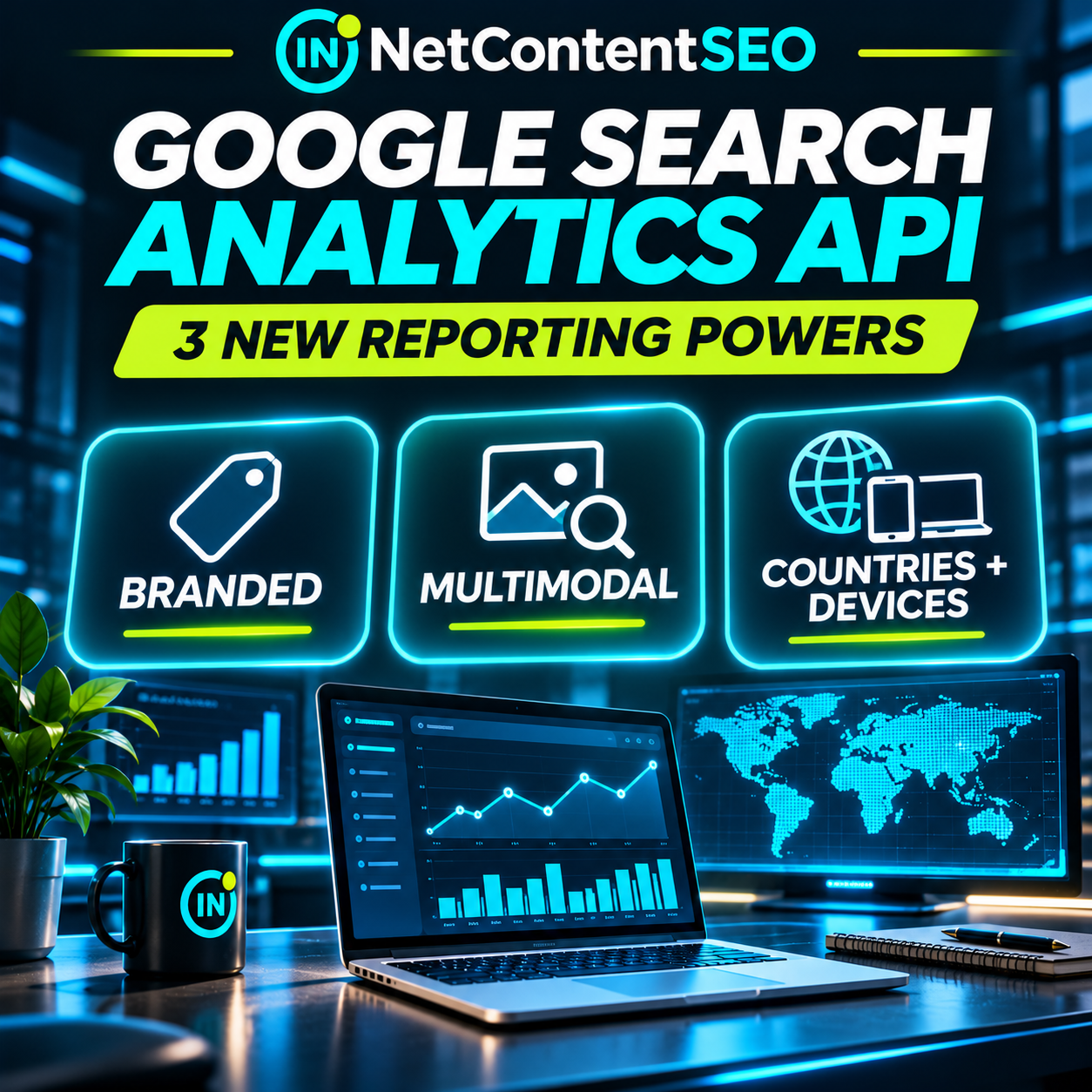

Google has expanded the Search Analytics API with three reporting capabilities that were previously introduced in Search Console: branded-query classification, web multimodal search performance and combined country/device filtering. Announced on November 16, 2026, the update makes these dimensions accessible to custom dashboards and automated workflows. It is an important change for international SEO, image-led discovery and brand measurement—but it is not a new ranking signal or a universal AI citation tracker.
In the official Search Central announcement, Google explains that developers can now automate analyses that previously required multiple requests, custom keyword rules or manual exports. The additions are brandedClassification, type=webMultimodal and filterLists.
The three changes at a glance
| Capability | New API option | Practical use | Important limit |
|---|---|---|---|
| Branded vs non-branded | brandedClassification | Compare awareness-driven and discovery-driven Search traffic | Only eligible properties; unsupported requests may return no rows |
| Visual and multimodal Search | type=webMultimodal | Monitor performance from image-led Google Search experiences | Not a standalone AI Overview or AI Mode citation count |
| Combined markets and devices | filterLists | Analyze several countries or devices together | Respect supported combinations and Search Console data limits |
1. Branded classification is now available to automated reports
Google says developers can group or filter Search Analytics results using brandedClassification. This brings a useful Search Console feature into automated reporting. Instead of manually maintaining lists of brand spellings, abbreviations and typos, eligible properties can use Google's own classification of branded and non-branded queries.
Google's earlier branded-query announcement explains that the classification is AI-assisted and may recognize product names, misspellings and other brand-related terms even when the exact brand name is absent. It also acknowledges occasional classification errors. That makes the data a helpful analytical signal, not a perfect ground truth.
Eligibility matters. Google states that branded classification is available only for eligible properties; for others, API queries using it return no rows. A zero-row response should not be interpreted as proof that a website has no branded demand. Teams should first verify availability in the relevant property and retain a clear “not available” status in dashboards rather than showing zero branded traffic.
2. Web multimodal reporting becomes programmable
The new webMultimodal search type allows developers to request performance data for image-led web searches, including Google Lens, Circle to Search on Android and image uploads in Google Search. Google's September 24 announcement also described Chrome's “Search this image” experience in the multimodal reporting family.
This is particularly useful for travel publishers, ecommerce sites and visual knowledge resources. A page with original photographs may be discovered when someone searches using a camera or an image rather than a typed keyword. With the API, teams can incorporate that traffic into a recurring performance report instead of relying exclusively on a manual export.
Google also says multimodal performance data will be available in BigQuery for properties with an active Search Console bulk data export. That creates an option for larger-scale analysis, though teams must still account for the reporting definitions, availability and limitations of each export.
3. Multi-country and multi-device filters simplify regional analysis
The filterLists field lets developers filter multiple countries or devices in one request. Google illustrates the value with groups such as EMEA, LATAM and DACH. These are useful business-region examples, not a claim that a geographic acronym is automatically a built-in country code: implementations should supply the supported country values specified in the API documentation.
For a multilingual publisher, one query can now examine a defined set of markets without requiring a separate request for each country and a separate post-processing step to combine results. Device combinations can similarly support cross-device reporting. This reduces orchestration overhead and can simplify the logic behind executive dashboards.
Filtering a combined group and grouping results by country are different operations. If a team needs individual country comparisons, it must still choose appropriate grouping dimensions and validate aggregation behavior. A combined metric should not be presented as a per-country breakdown.
How to approach the API implementation
The Search Analytics query method uses an authenticated POST request to https://www.googleapis.com/webmasters/v3/sites/{siteUrl}/searchAnalytics/query, where {siteUrl} represents the URL-encoded Search Console property identifier. The API requires authorization and a date range. Its response contains performance rows and metrics such as clicks, impressions, CTR and average position.
For a minimal multimodal request, the core body can be expressed as follows:
{
  "startDate": "2026-11-01",
  "endDate": "2026-11-14",
  "type": "webMultimodal",
  "dimensions": ["date"]
}
This is an illustrative request body, not an executed API test. It must be sent with valid authorization to an accessible property. The dates are examples, and the property must have eligible data for rows to appear. For branded grouping and filterLists, developers should consult the current Search Analytics query reference for supported field structures and combinations rather than guessing the JSON shape.
What the new reporting enables for publishers
Consider a travel publisher targeting readers in the United States, United Kingdom, Germany and France. It could maintain a recurring report comparing branded and non-branded discovery where eligible, tracking visual search traffic for destination pages and combining performance across selected markets and devices. That would help answer whether growth comes from existing brand awareness, generic discovery or visual search behavior.
For an SEO research publication, the same framework can distinguish brand demand from topic-driven search visibility. For a network of technology publications, separate properties and sections can be analyzed with consistent date windows and filters. These are suggested applications, not claims that Google has provided or verified metrics for any particular website.
Does this finally measure AI Overviews and AI Mode separately?
No. The new announcement should not be marketed as a universal AI visibility API. Google has separately introduced a Generative AI performance report covering supported AI features such as AI Overviews and AI Mode. That report has its own definitions and limitations. The November 16 API update specifically names branded classification, web multimodal search and multi-country/multi-device filtering; it does not announce a new feature-level API field that independently identifies every AI Overview citation, AI Mode appearance or referral.
Likewise, multimodal search does not mean “all generative AI search.” A user can search with an image without receiving a generated answer, and a generated answer may be prompted by text. Treating the two as interchangeable would produce misleading dashboards.
Important limitations before automating reports
The Search Analytics API does not guarantee that every query row is returned. Google's documentation explains that it prioritizes top rows and is subject to internal data limits. Grouping by query or page can change the completeness and aggregation of reported data. Some queries are anonymized, and the most recent data may still be preliminary.
Developers should also distinguish clicks, impressions, CTR and position from business outcomes such as sessions, leads and revenue. Search Console reports Search interactions, while analytics tools measure on-site behavior under different rules. A higher multimodal impression count is not necessarily a higher conversion count.
Finally, Google’s branded classification is algorithmic and eligibility-dependent. The correct dashboard design includes unavailable-data states, documentation of the chosen filters and explicit notes about metric definitions.
A practical rollout checklist
- Verify access to the intended Search Console property and confirm that the relevant reporting feature has data.
- Record the API request parameters, date windows, property identifiers and time-zone assumptions.
- Test
webMultimodalindependently before combining it with additional filters. - Check branded-classification eligibility and distinguish unavailable results from genuine zero activity.
- Use
filterListsfor explicit market or device sets, validating country identifiers and the grouping dimensions. - Compare a sample of API results with the corresponding Search Console interface, allowing for aggregation and freshness differences.
- Archive historical results and monitor unexpected empty responses or schema changes.
- Document what each metric does not measure, particularly around generative AI citations and attribution.
FAQ
What changed in the Search Analytics API on November 16, 2026?
Google added branded-query grouping/filtering through brandedClassification, multimodal search reporting through webMultimodal and combined country/device filtering through filterLists.
Is branded-query classification available for every website?
No. Google says it is limited to eligible properties, and unsupported properties may receive no rows when using that option.
What is included in web multimodal Search?
Google identifies image-led experiences including Lens, Circle to Search and image uploads. Earlier Search Console documentation also includes Chrome's image-search interaction.
Can I combine multiple countries in one request?
Yes. The new filterLists field supports combined country and device filters, subject to the documented values and combinations.
Does this update reveal all AI Overview citations?
No. The announced fields do not provide a comprehensive AI citation inventory or a new standalone AI Overview attribution mechanism.
Is this a Google ranking update?
No. It is a reporting and API functionality update, not an announced ranking algorithm change.
Conclusion: reporting infrastructure is catching up with modern Search
Google's November 16 release is significant because it brings useful Search Console analysis into programmable workflows. Branded classification, multimodal discovery and multi-market filtering are now easier to incorporate into repeatable reporting. For SEO teams, the opportunity is not to promise new visibility metrics that Google has not provided, but to build more transparent dashboards around the signals that actually exist.
Primary sources: Google Search Central, November 16, 2026: New filtering and reporting capabilities in the Search Analytics API; Search Analytics API query reference; Google branded-query filter announcement; Google multimodal reporting announcement; Google Generative AI performance report help. Barry Schwartz coverage: not checked. This article describes officially announced capabilities; no live property API request was executed for this report.