

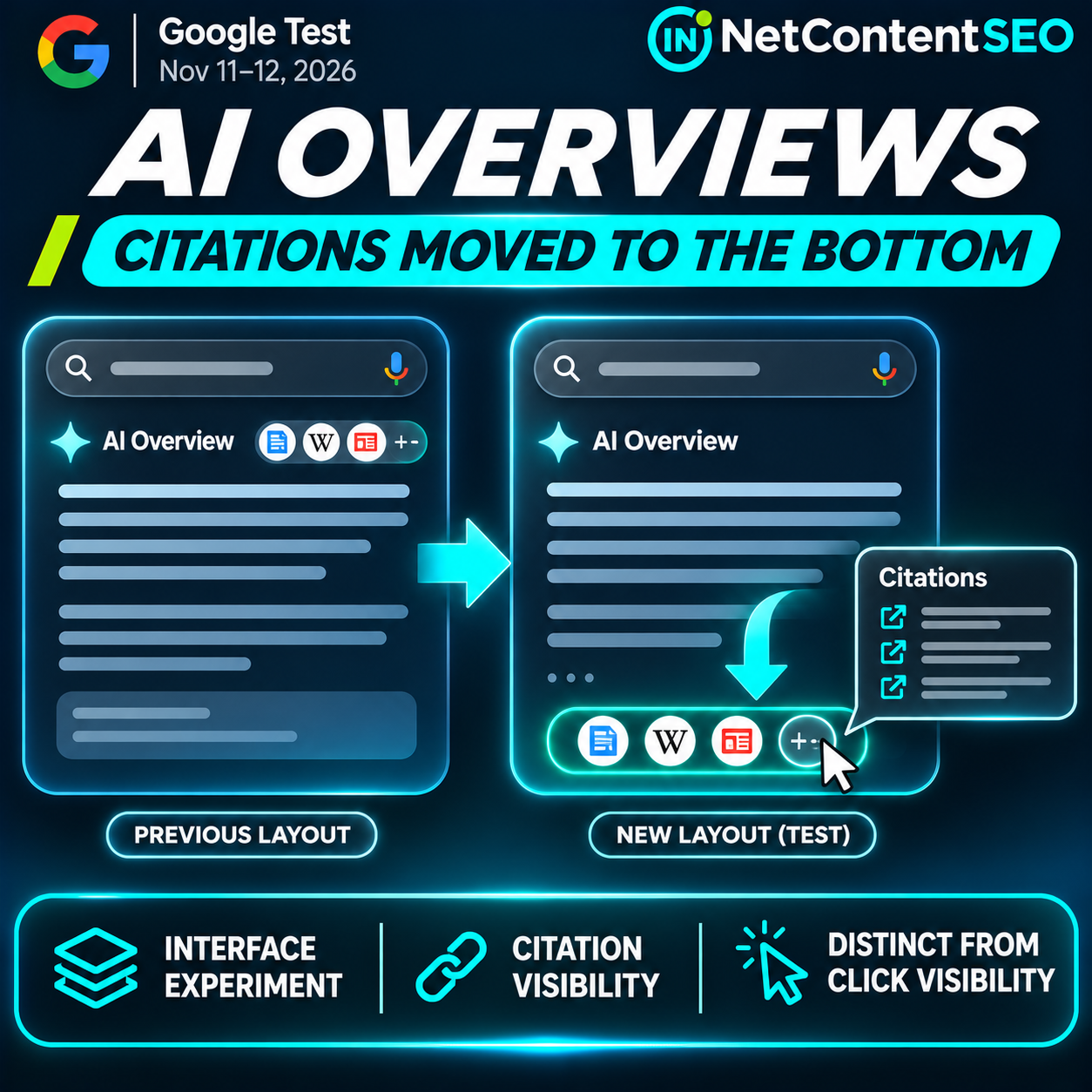

Google is experimenting with a subtle but consequential change to how sources appear in AI Overviews. In a desktop variant documented by SEO consultant Brodie Clark on November 12, 2026, the indicator showing how many sites an AI Overview references appears at the bottom of the generated answer rather than near its top. Hovering over that indicator reveals the citation list.
The change is a reported interface test, not a confirmed global rollout. Yet it exposes a critical weakness in how publishers measure AI Search performance: being selected as a source does not guarantee that the source is prominently displayed, and prominent display does not guarantee a click.
Clark recorded the variant in his SERP tracking notes. Barry Schwartz subsequently reported the observation at Search Engine Roundtable. Neither source presents a controlled click-through study or an official Google announcement of a rollout.
What exactly is Google testing?
In the observed version, the small interface element indicating the number of referenced websites sits beneath the AI-generated answer. A user who hovers over it can reveal the full list of cited sources. Clark contrasts that with an earlier version of the experiment in which the indicator appeared at the top of the AI Overview, directly above the citations.
This distinction matters: the reported element is a source-count and citation-discovery control, not necessarily the removal of every link inside an AI Overview. Some AI Overviews can include inline citations or other link treatments. The observed change should not be generalized to every citation format or every Google search result.
Clark's November 12 entry specifically labels the observation an AI Overviews desktop test. There is no verified information in the reporting about the proportion of users exposed, affected countries, query categories, mobile behavior or whether Google intends to keep the format.
Why source placement matters even when the citation remains
A source can pass through several stages before producing value for a publisher. First, Google's systems may use or reference the page when assembling an answer. Second, the interface may show the page as a citation. Third, the citation may appear in a location a searcher actually notices. Finally, the user must decide to open it.
Moving a source-discovery control below the generated response can add friction. A reader may already have obtained a satisfactory answer before reaching the bottom, and a hover-based interaction adds another step before the publisher's link becomes visible. This provides a plausible reason to investigate click-through effects.
But plausible is not proven. No public A/B-test data accompanying this observation establishes that the variant lowers citation clicks. A bottom-placed source area could perform differently for long and short answers, navigational and informational queries, or users who deliberately seek verification. Any quantified traffic-impact claim would require evidence not yet available.
Citation inclusion, citation visibility and click visibility are three different metrics
AI visibility dashboards often reduce a complex interface to a binary result: a brand or domain was cited, or it was not. That is useful for studying source selection, but it cannot explain the full experience of the searcher.
Citation inclusion asks whether the source appears among the referenced pages. Citation visibility asks whether the source is actually presented to the user and how prominently: above the fold, inside a collapsed area, behind a hover, or below a long answer. Click visibility asks whether there is a noticeable, usable path to the source that can plausibly generate visits. These are distinct from measured clicks, which require analytics or experimental data.
For example, two domains may each appear once in the source list for the same answer. If one has a visible inline citation near the first sentence while the other is accessible only through a control at the bottom, a simple citation-count report treats them as equivalent. The actual presentation is not equivalent, even though the click effect has not been measured.
This is part of a longer series of citation-interface experiments
The November test is not the first time Google has experimented with where AI Overview references appear. On September 29, Search Engine Roundtable reported a version that stacked citation cards below the answer rather than in a right-hand panel. That version, spotted by Glenn Gabe, included a way to expand the list and represented a different presentation from the latest source-count hover control.
On October 29, Schwartz covered another observation in which prominent citation cards appeared to be missing in some AI Overviews. He also noted that delayed loading might explain at least some cases and could not consistently reproduce the behavior himself.
These observations illustrate why it is risky to treat a single screenshot as a permanent product change. Google has tested multiple placements and disclosure mechanisms. An apparent absence of citations may reflect a variant, a collapsed state or a loading issue rather than the permanent removal of sources.
What changes for SEO and GEO measurement?
The immediate implication is methodological. A rank-tracking or AI visibility tool that captures only the answer text and the list of referenced URLs may miss the difference between a prominently displayed citation and one hidden behind a secondary interaction.
For teams evaluating AI Overviews, a richer observation record should include the query, device, location, date, visible answer state, citation URL, citation position, link type and whether a user action is needed to reveal the source. Screenshots or recorded interaction states can help preserve the evidence when Google changes the layout.
However, those observations are not interchangeable with real user clicks. Google Search Console does not provide a dedicated, comprehensive report that isolates AI Overview citation clicks and impressions by placement. Search Console performance data can show broader query and page trends, but it cannot, on its own, identify which clicks came from a top citation, an inline reference or a bottom hover list.
Teams should therefore avoid attributing every fluctuation in organic clicks to this experiment. Ranking changes, search demand, query mix, other SERP features, seasonality and measurement differences remain alternative explanations.
How to audit the experiment without overstating the evidence
- Build a stable query panel. Select representative informational, commercial and branded searches relevant to your site. Record the exact wording.
- Capture device and location context. Start with desktop because that is where the reported test was documented. Keep locale and browser settings consistent where possible.
- Record the initial viewport. Note whether an AI Overview appears and which source elements are visible without scrolling or interaction.
- Inspect the full answer. Check whether source counts, cards or links appear at the top, inline, at the side or at the bottom.
- Test disclosure interactions. Hover or expand where available and record which URLs appear. Do not assume a hover-only control behaves the same way on mobile.
- Repeat observations over time. A single screenshot establishes an observed variant, not its prevalence or duration.
- Separate inclusion from presentation. Track whether your URL was cited and whether its citation was readily visible as different fields.
- Compare with analytics cautiously. Monitor page-level clicks and query trends, but label any proposed causal relationship as a hypothesis unless you have controlled evidence.
- Audit your monitoring tools. Ensure the collector handles expanded, delayed and interactive citation elements; otherwise an apparent loss of citations may be a collection error.
A proposed visibility measurement framework
Publishers can use a practical four-part scorecard without pretending it is an official Google metric. Record source inclusion as yes/no; presentation type as inline, card, collapsed list or hover list; prominence as visible in the initial viewport or only after additional navigation; and observed traffic separately using whatever attribution data is actually available.
This framework avoids assigning arbitrary click-through multipliers to different placements. It also makes changes auditable: a site may retain the same citation count while its presentation shifts from a visible card to a collapsed list. That is a meaningful interface change even before any traffic effect can be measured.
What should publishers do now?
Do not redesign your content strategy around one unconfirmed test. Continue producing original, accurate and useful material that can be discovered and cited. But expand reporting beyond the number of AI Overview mentions, and insist that visibility vendors disclose what their crawlers actually observe.
For a publisher, the most actionable immediate step is to save evidence of how its pages appear for important queries. For an agency, it is to explain that citations and referral traffic answer different questions. For a tool provider, it is to make the capture method and its limitations explicit.
Google has not confirmed that the new layout will roll out broadly, and there is no public evidence that it changes the underlying criteria for selecting sources. It is a presentation experiment, not a documented ranking update.
Frequently asked questions
Is Google removing citations from AI Overviews?
No general removal has been confirmed. The November 12 observation concerns moving a source-count control to the bottom of the AI Overview and revealing the citation list on hover.
Who discovered the test?
SEO consultant Brodie Clark documented the desktop variant on November 12, 2026, and Barry Schwartz reported it on Search Engine Roundtable.
Has Google confirmed a worldwide rollout?
No. The evidence describes an observed experiment, with no confirmed rollout scope, timing or permanence.
Will moving citations to the bottom reduce website clicks?
It could add friction and make some links less prominent, but no public controlled click data has established an actual reduction from this specific test.
Are all source links hidden behind hover?
The reported variant uses a bottom source-count control that reveals its list on hover. That does not prove every inline citation or other link format disappears.
Can Google Search Console show clicks specifically from this citation control?
Not as a dedicated placement-level report. Search Console can help monitor broader search performance but does not directly isolate clicks on this particular AI Overview element.
Should AI visibility tools count a hidden citation as a citation?
Yes, if the URL is genuinely present in the disclosed source list, but they should separately record that its presentation requires an interaction. A binary citation metric is insufficient to describe prominence.
Does this test change AI Overview ranking factors?
There is no evidence that it does. The observation concerns how citations are presented, not an announced change to source-selection or ranking systems.
The bottom line
Google's latest AI Overview citation experiment makes a simple distinction impossible to ignore: a publisher can be included in an AI answer without receiving equivalent exposure or measurable traffic. The observed bottom placement and hover interaction could make source discovery less immediate, but the click impact remains unproven.
For SEO and GEO, the right response is better measurement rather than stronger assumptions. Track what the answer cites, what the user can see, what interaction reveals the source and what traffic actually arrives. Those four layers are not the same thing.
Sources
- Brodie Clark — Google SERP Feature & ChatGPT Updates, November 12, 2026.
- Search Engine Roundtable — Google Placing Source Icons At Bottom Of AI Overviews, November 11, 2026.
- Search Engine Roundtable — Google AI Overviews Testing Citations Cards At Bottom Again, September 29, 2026.
- Search Engine Roundtable — Is Google Testing Dropping Citations Cards From AI Overviews?, October 29, 2026.