

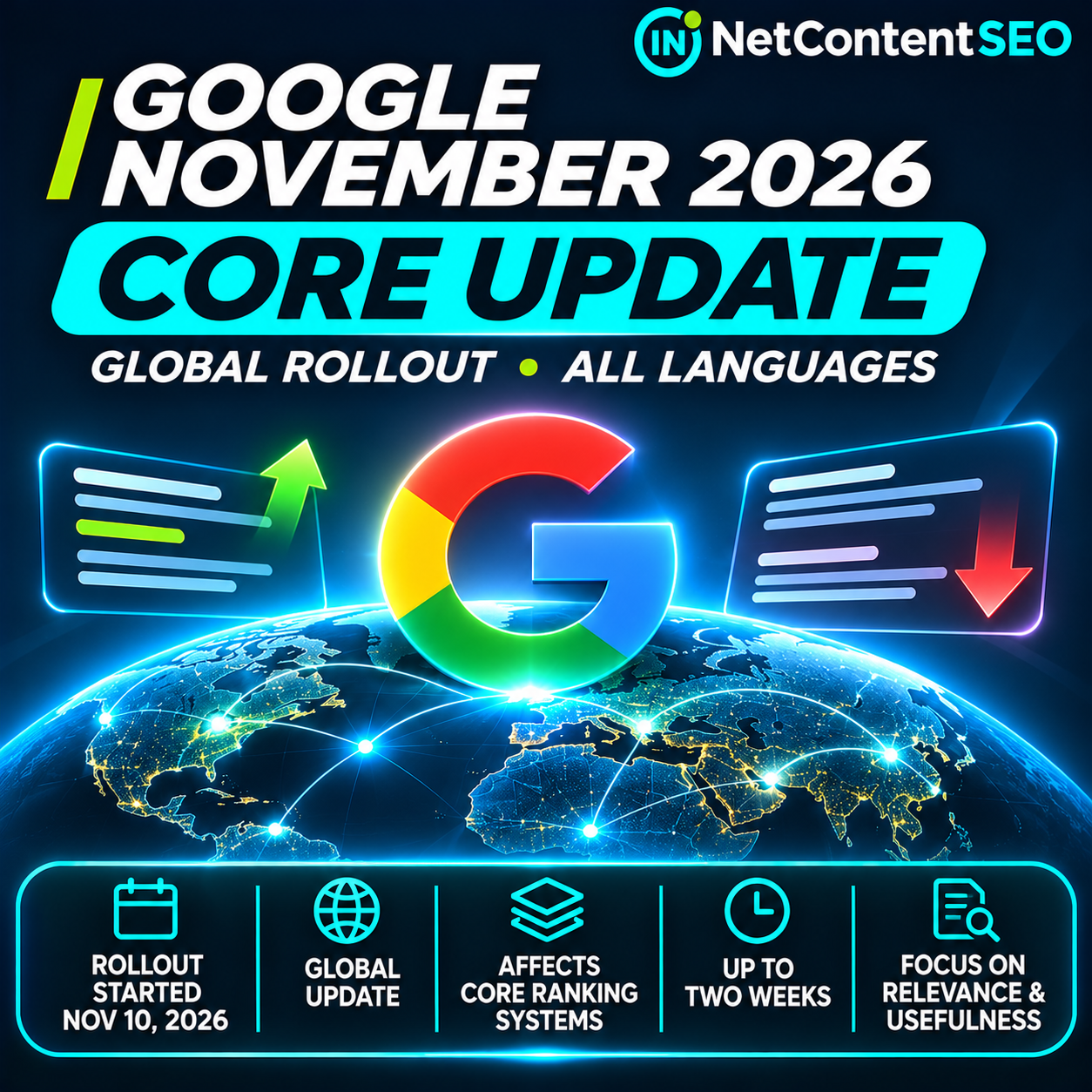

Google's November 2026 core update is officially rolling out. The company began deployment on November 10, 2026, at 10:06 a.m. Pacific Time (18:06 UTC; 19:06 in Italy), according to the Google Search Status Dashboard. The update applies globally and to all languages, and Google says the rollout may take up to two weeks. As of November 11, the dashboard still lists the update as active.
Google describes the release as a regular adjustment to its core ranking systems intended to surface more relevant, satisfying content from different kinds of websites. The company has not identified a particular content format, industry or ranking signal as the target of this update. That distinction matters: site owners should not mistake early ranking volatility for proof of a specific penalty or a new AI-content rule.
November 2026 core update: confirmed facts
- Official name: November 2026 core update.
- Start: November 10, 2026, 10:06 a.m. Pacific Time (18:06 UTC).
- Scope: Global, across all languages.
- Affected area: Google Search ranking systems.
- Expected duration: Up to two weeks, with a possible completion around November 24 if the estimate holds.
- Status on November 11: Active; completion not yet confirmed.
- Google's stated purpose: Better surface relevant, satisfying content.
These details come from Google's official status dashboard and its public Search Central communication, as reported by Search Engine Roundtable and Search Engine Land.
What is a broad core update?
A core update involves broad changes to Google's search ranking systems. Rather than focusing on one technical problem, such as a broken sitemap or a particular spam pattern, it changes how systems assess and order content across many queries. Pages can gain or lose visibility even when their content and technical configuration remain unchanged.
Google's core updates guidance emphasizes that a decline after an update does not automatically mean a site has violated a policy or requires a quick technical fix. A ranking system can reassess the relative usefulness of different results without assigning a manual action or site-specific penalty.
Because this release is global, publishers operating in several languages should monitor each relevant country and language market separately. A global rollout does not mean every query, page or market will experience the same change.
Is this a Google AI Search update?
Google has announced a core Search ranking update, not a new AI Mode model, a change to AI Overviews or a special algorithm for AI-generated content. It is reasonable to monitor how search-result features and referral patterns evolve during the rollout, but no official announcement establishes a direct, separate change to AI citations or AI-generated answers.
For GEO teams, the safest interpretation is that traditional Search visibility and AI visibility should be measured independently. A fall in organic clicks does not by itself prove that an AI answer replaced the visit; a change in AI citations does not establish that the core update caused it. Both claims require appropriate before-and-after evidence and control for other changes.
What should publishers do while the rollout is active?
First, document the baseline. Export or record Google Search Console performance before November 10, separating clicks, impressions, click-through rate and average position. Segment by country, device, query and landing page rather than relying on a single sitewide trend.
Second, monitor without overreacting. Ranking movements during a multi-day rollout can reverse. Avoid rewriting dozens of pages, changing canonical tags or deleting content solely because the first days look negative. Continue to fix genuine technical faults—such as a server outage or an accidental noindex directive—because those issues are independently actionable.
Third, annotate the update. Record November 10 at 18:06 UTC as the rollout start in your internal reporting. Note any deployments, content launches, migrations or tracking changes around the same time so they are not confused with ranking-system effects.
Fourth, wait for a stable comparison window. Google recommends assessing core-update impact after the rollout completes, allowing at least a full week before drawing conclusions. Compare a full post-rollout week with a comparable week before the update, using the same weekday mix and filtering out seasonal distortions.
How to analyze the update in Search Console
- Confirm the official end date. Use the Google Search Status Dashboard; November 24 is an estimate, not a confirmed completion date.
- Choose comparable periods. Compare seven full days after rollout completion with seven full days before November 10. If the completion date changes, adjust the analysis accordingly.
- Separate Search types. Review Web, Discover and other relevant reports independently. Do not combine them into one unexplained traffic change.
- Segment by page group. Compare news, evergreen guides, product pages, local pages and other meaningful content types.
- Inspect query intent. Identify whether affected queries are informational, navigational, commercial or local, and whether their search results have changed.
- Compare impressions and clicks together. A loss of impressions can indicate reduced exposure, while stable impressions with fewer clicks may suggest a CTR or SERP-layout change. Neither metric alone establishes the cause.
- Check average position carefully. It is an aggregate metric that can change with query mix and impression distribution. Inspect representative queries and pages before concluding that rankings fell uniformly.
- Rule out technical and measurement issues. Check indexing, server availability, canonicalization, analytics changes, bot filtering and data freshness.
- Evaluate meaningful losses. Focus on sustained declines in important query clusters and pages rather than isolated daily fluctuations.
- Document conclusions and uncertainty. Distinguish observed changes from hypotheses about why they occurred.
How to interpret common performance patterns
Impressions down, clicks down: investigate whether important pages lost exposure for their established queries. Compare positions, query mix and competing results; do not immediately assume a quality penalty.
Impressions stable, clicks down: examine CTR, changes in visible search features, title presentation, device mix and seasonality. A core update is one possible context, not the only explanation.
Impressions up, clicks flat: a site may be appearing for more queries or at lower positions. Analyze whether those new impressions correspond to relevant traffic opportunities.
Some page groups rise while others fall: a broad core update can alter the relative performance of content types. Investigate the affected intent clusters separately instead of applying one sitewide remedy.
A special caution for e-commerce: Black Friday overlap
If the rollout takes the full two weeks, it could end around November 24, shortly before US Thanksgiving, Black Friday and Cyber Monday. That creates a serious comparison problem for retailers. Search demand, promotions, product availability and paid activity can change substantially during those days.
A retailer should compare year-over-year demand, brand and nonbrand queries, relevant product categories and campaign activity before assigning traffic movements to the core update. The same caution applies to travel sites affected by holiday planning and regional seasonal patterns.
What to do if your site loses visibility
Start by confirming that the loss is sustained after rollout completion. Then inspect the affected pages against Google's people-first content guidance. Ask whether the page fully answers the user's main question, offers reliable and original information, makes important details easy to find and demonstrates appropriate expertise for the subject.
Compare your page with the results now ranking for the same intent. Look for meaningful differences in completeness, freshness, primary sourcing, practical usefulness and presentation. Avoid superficial changes made solely to signal that a page has been updated.
If a page has a real weakness, improve it because the improvement helps readers. There is no verified universal recovery trick, and Google does not promise that every improvement will immediately restore prior rankings.
What NetContentSEO, WikiSardinia and LMBDA should monitor
For a publisher operating several distinct websites, the most useful analysis is per property, not a blended portfolio total.
NetContentSEO: separate breaking SEO and AI news from evergreen technical explainers. Watch branded versus nonbranded queries, international search markets, article clusters and changes in impressions for recent news. A decline in an older news article may reflect changing interest rather than an update.
WikiSardinia: segment travel guides by destination, beach, transportation, activities and practical visitor questions. Compare US and European audiences separately and account for the November tourism season. Examine whether affected pages still give travelers specific, accurate answers and actionable next steps.
LMBDA: distinguish research pages, entity-focused material, editorial commentary and technical resources. Watch which query themes gain or lose visibility, and avoid interpreting small-volume fluctuations as statistically meaningful trends.
These are proposed monitoring priorities, not claims that any of the three properties has already gained or lost traffic. No Search Console data from those sites was inspected for this article.
What Google has not said
Google has not disclosed a special target involving AI-written content, affiliate websites, travel publishers or small independent sites. It has not published a November-specific list of ranking signals that changed, nor has it announced that the update will increase or decrease AI Overview citations.
Volatility reports from third-party tracking tools can help identify unusual movements, but they do not reveal Google's internal cause or prove how a particular website was affected. Barry Schwartz reported notable movements before the official launch; those earlier observations should not automatically be attributed to the update that began November 10.
Frequently asked questions
When did the November 2026 Google core update begin?
November 10, 2026, at 10:06 a.m. Pacific Time, equivalent to 18:06 UTC and 19:06 in Italy.
Is the rollout complete?
As of November 11, 2026, Google's Search Status Dashboard still marks it active. Google expects the rollout to take up to two weeks.
Does the update affect every language?
Google says the update applies globally and to all languages. That does not mean every query or website will experience a visible change.
Is it a penalty for AI-generated content?
No such target has been announced. Core updates broadly reassess search results and are not equivalent to manual penalties.
Should I rewrite articles immediately if clicks fall?
Not solely because of early rollout volatility. Fix verified technical problems immediately, but wait for stable post-rollout data before making broad content decisions.
When should I compare Search Console data?
After Google confirms completion, allow at least one full week and compare with a comparable pre-update week. Account for holidays and seasonality.
Will AI Overviews and AI Mode citations change?
They may fluctuate for many reasons, but Google has not established a November-specific citation effect. Measure AI visibility separately and avoid causal claims without evidence.
What is the most useful first action?
Annotate the official start date, preserve baseline Search Console data and monitor affected query and page groups without making speculative sitewide changes.
The bottom line
The November 2026 core update is a confirmed global Google Search ranking release, not a rumor and not a newly announced AI Search feature. The rollout began November 10 and may continue for two weeks. For publishers, the most defensible response is disciplined measurement: record the baseline, distinguish real technical issues from temporary volatility, wait for completion and evaluate sustained changes against the actual search intent.
Google has not provided a November-specific shortcut to better rankings. Useful, accurate content and careful diagnosis remain more valuable than reacting to every daily chart movement.
Sources
- Google Search Status Dashboard — November 2026 core update (official status).
- Google Search Central — Core updates and assessment guidance.
- Google Search Central — Creating helpful, reliable, people-first content.
- Search Engine Roundtable — Barry Schwartz, November 10, 2026.
- Search Engine Land — November 10, 2026.
- Search Engine Journal — November 2026 core update.