

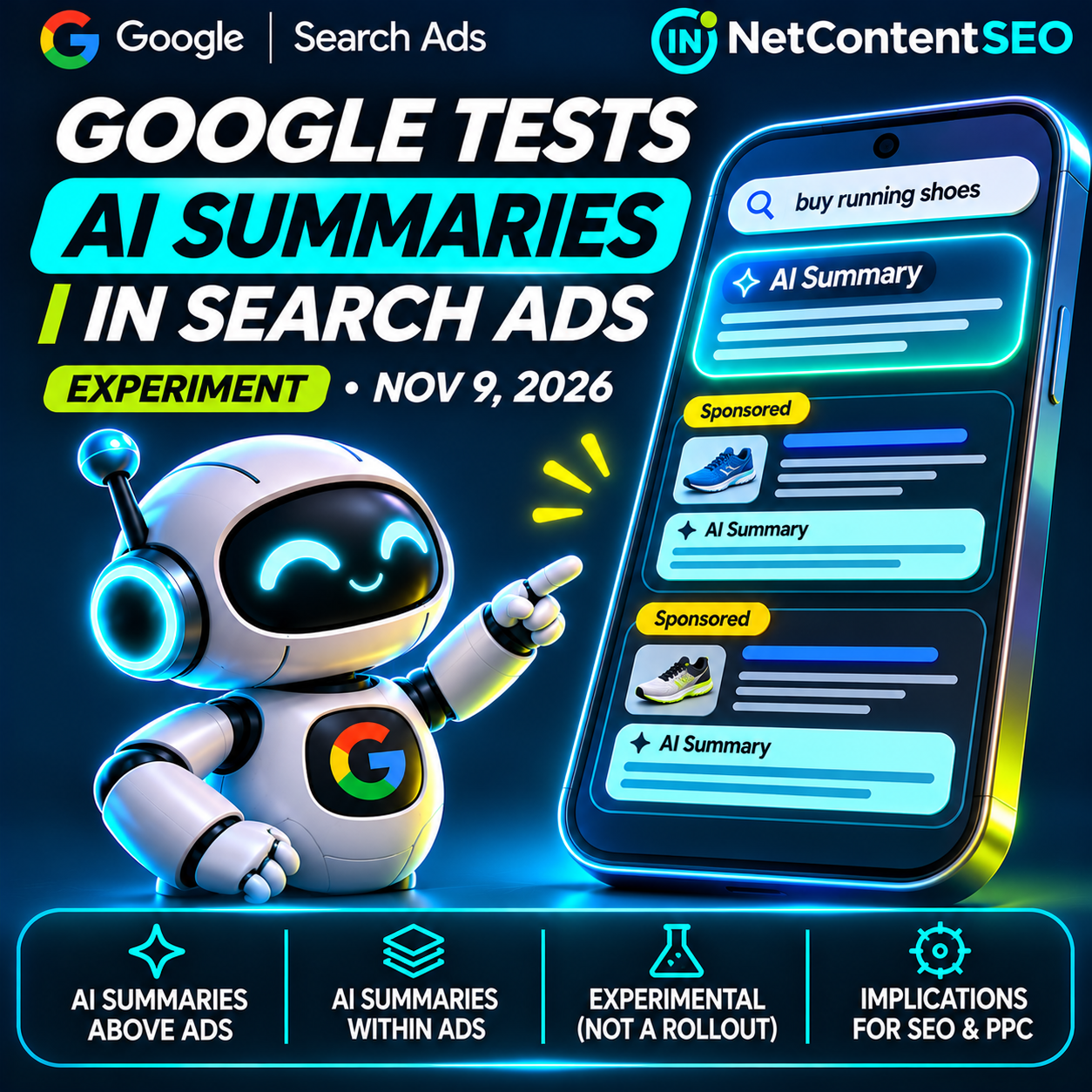

Google is testing a more generative presentation of sponsored Search results, with AI-written text appearing both above a group of ads and within individual ads. The latest mobile example was documented by search analyst Brodie Clark on November 8, 2026, and reported by Barry Schwartz at Search Engine Roundtable on November 9. It is an observed experiment, not a confirmed general rollout.
The difference is important. Google is not merely experimenting with one additional line of AI text attached to a single advertiser. In the observed interface, an AI-generated summary sits above the sponsored group, names the brands in that group and provides links toward their ads. Individual sponsored listings also receive their own generated descriptions. A loading animation appears as the summaries are produced.
This raises a question for advertisers: when an AI system writes the framing around a paid placement, who controls the message that prospective customers actually read?
What the November 2026 test shows
According to Brodie Clark's SERP feature observations, the test was visible on mobile on November 8. The sponsored group displayed an AI-written introduction at the top that referenced multiple brands and linked to their ads. Each individual ad also had an additional AI-generated business description. Search Engine Watch separately described the same observed format and linked to a video demonstration.
The most distinctive element is the group-level summary. Traditional paid search ads are individual placements, even when Google organizes them under a common Sponsored label. A generated introduction to several ads creates an additional editorial-looking layer that users may read before comparing individual offers.
Neither the observation nor the coverage establishes how many users see this interface, which queries trigger it, or whether Google plans to deploy it broadly. It is also not evidence that the generated summaries improve click-through rates or conversions.
This is not Google's first experiment with AI-written ad text
In July 2026, advertisers and search professionals observed AI-generated summaries below individual Search ad descriptions. Search Engine Land reported that Google described the feature as a small experiment intended to help people make more informed decisions about Search ads. Barry Schwartz documented the same tests in Search Engine Roundtable.
The November observation extends that visible pattern by adding a summary of the sponsored group, not just descriptions beneath individual advertisers. It should not be confused with an official announcement that Google has replaced advertiser-written copy or introduced a mandatory new ad asset.
Google has also documented a distinct feature called AI-generated review summaries in Search ads. Those summaries synthesize online customer reviews for eligible ads, as Search Engine Land reported in October. Review summaries, the experimental ad descriptions and the new group-level summary are related examples of AI appearing in paid search, but their inputs, eligibility and control mechanisms should not be assumed identical.
Why the group-level summary changes the advertising question
In a conventional Search ad, advertisers prepare assets such as headlines, descriptions and landing pages, while Google determines eligible combinations and placements under its advertising systems. A group-level AI summary adds another layer of interpretation: Google may describe several advertisers together, potentially selecting which attributes to emphasize before a user reaches any individual listing.
That could make the presentation more useful for users who want to compare options quickly. It could also create risks if the generated description is incomplete, overly generic, inaccurate or inconsistent with an advertiser's current offer.
The evidence does not establish that Google systematically favors one advertiser over another in these summaries. It does justify asking how brand mentions, link ordering, factual accuracy and attribution are determined.
What advertisers may lose control over
The central concern is message fidelity. A business can carefully write its landing page and ad assets, but a generated layer may choose different words to characterize its products, services or positioning. The generated text could emphasize a price, feature or comparison that was not the advertiser's intended primary message.
For example, an advertiser promoting premium running shoes might prioritize fit, specialist advice and durability. A generic AI summary might instead frame the group around discounts or convenience. That example is hypothetical; the observed test does not establish that Google made this particular error.
Advertisers should also avoid assuming that they can edit, approve or opt out of the new summaries. The available reporting does not confirm a dedicated control for this specific experimental format. Google has published controls and rules for other AI-powered advertising features, but those cannot automatically be applied to this one.
Could AI summaries influence clicks and conversions?
Potentially, but the direction is unknown. A summary that clarifies differences among offers could help qualified users choose an advertiser. A misleading or overly broad summary could create confusion, reduce clicks or send poorly matched traffic. A group-level link might also change which part of the sponsored block attracts attention.
There are no verified public performance results for this November test. No reliable CTR uplift, conversion-rate effect, cost-per-click change or revenue impact can be attributed to it from the observed screenshots and video.
Even if an advertiser notices a performance shift, correlation is not causation. Query mix, bidding, competitors, seasonality, device changes and other SERP experiments can affect paid search metrics simultaneously.
What does this mean for PPC measurement?
Paid search teams should separate observed presentation from measured business outcome. The first can be documented with screenshots, device and location details. The second requires campaign, landing-page and conversion data.
For advertisers who encounter the experimental format, a useful audit should record the exact query, date, market, device, displayed ad assets, generated summary, linked destination and any apparent factual errors. It should then compare the actual user-facing claims with the landing page and current offer terms.
Do not assume that standard Google Ads reports provide a dedicated segment for these generated summaries. The reviewed evidence does not identify a specific reporting field that isolates impressions or clicks attributable to the new group-level text.
Brand accuracy becomes a practical SEO and PPC issue
Although the test concerns paid placements, it intersects with a wider search problem: Google's interfaces increasingly synthesize information about businesses rather than displaying only publisher- or advertiser-authored snippets.
Accurate, consistent business information matters across advertising assets, landing pages, product data, local profiles and other publicly accessible sources. However, the mechanism by which this particular test generates its summaries has not been disclosed. It would be unjustified to claim that a specific Schema.org property, review source or landing-page optimization guarantees inclusion in the summary.
For teams working across SEO and PPC, the immediate opportunity is to establish a shared process for checking whether AI-generated descriptions match verifiable business facts. The objective is quality control, not a speculative new ranking tactic.
Is this part of Google AI Mode?
No direct connection has been confirmed for the November observation. Brodie Clark documented the interface in mobile sponsored Search results. Google separately operates ads within AI Overviews and AI Mode, including other generative advertising experiments.
These surfaces should be measured independently. An AI-written summary above ordinary Search ads is not the same as a sponsored recommendation embedded inside an AI Mode answer. Conflating them can lead to misleading conclusions about the growth of AI search advertising.
How does it relate to GEO and AI visibility?
Generative engine optimization generally focuses on whether brands are understood, selected, cited or recommended in AI-mediated discovery. The new advertising test illustrates an adjacent but distinct phenomenon: AI-mediated interpretation of paid commercial listings.
A brand might be present in the sponsored results yet have its offer summarized differently from its own copy. That suggests future visibility audits may need to examine not only whether a brand appears but also how an AI interface describes it.
Still, there is no evidence that the experimental summaries are generated using the same systems as AI Overviews, AI Mode or other assistants. There is also no basis to treat the feature as a new organic ranking or AI citation signal.
A practical monitoring checklist for advertisers
- Capture the complete ad block. Preserve the group-level AI text, individual summaries, sponsored labels and link destinations.
- Record the environment. Note the query, country, language, device, date and whether the feature appeared consistently.
- Verify factual claims. Compare generated statements with current prices, services, inventory, restrictions and landing-page content.
- Check brand differentiation. Identify whether the summary preserves the business's distinguishing characteristics or collapses competitors into generic descriptions.
- Inspect the click path. Confirm that linked destinations are appropriate and that tracking remains functional.
- Monitor performance cautiously. Review CTR, conversion rate and cost per acquisition without attributing changes to an unsegmented experiment.
- Document problems. Retain evidence of inaccurate claims and use established Google Ads support channels where appropriate.
- Wait for official controls. Do not promise clients a specific opt-out, edit mechanism or reporting feature unless Google documents one.
What remains unconfirmed?
Google has not publicly confirmed a broad rollout of the November group-level summary format. The observed reporting does not establish its geographic coverage, eligibility, triggering queries, model architecture, advertiser controls, reporting availability or effect on ad performance.
The July test did receive an official Google characterization as a small experiment. That historical statement supports caution but should not be presented as a fresh confirmation of every detail in the November variation.
Frequently asked questions
What is Google testing in Search ads?
An observed mobile format places AI-generated text above a group of sponsored results and additional generated descriptions within individual ads.
Who first documented the November example?
Search analyst Brodie Clark posted the observation on November 8, 2026. Barry Schwartz reported it on November 9.
Has Google launched the feature worldwide?
No worldwide rollout has been confirmed in the sources reviewed.
Is the AI summary written by the advertiser?
The reported summaries are AI-generated. The available coverage does not establish the precise source inputs or editing rights for this experimental format.
Can advertisers turn off the new summaries?
No dedicated opt-out control for this specific November test was verified. Advertisers should consult current Google Ads documentation rather than assume one exists.
Is this the same as AI-generated review summaries?
No. Google has separately documented review summaries based on customer feedback. The observed test includes group-level and individual ad descriptions.
Will the summaries increase ad CTR?
There are no verified performance results showing an increase or decrease.
Does this affect organic SEO rankings?
No direct organic ranking change has been announced.
Is this a Google AI Mode feature?
The reported November example concerns mobile sponsored Search results. It should not be conflated with separate AI Mode advertising formats.
What should brands do now?
Monitor representative mobile SERPs, verify generated claims and link destinations, and distinguish presentation tests from proven conversion effects.
The bottom line
Google's November test shows how generative AI may increasingly shape the language surrounding paid search results. The addition of a summary for the entire sponsored group is the key development: Google is experimenting not just with describing individual ads but with introducing several advertisers through an AI-written layer.
For brands and PPC teams, the immediate priority is to watch for inaccuracies, preserve evidence and measure outcomes carefully. For SEO and GEO professionals, the broader lesson is that digital visibility is not only about appearing in a result; it is also about how an intermediary describes the entity once it appears. Until Google confirms a wider release and supplies performance evidence, this remains a noteworthy experiment—not a proven new advertising standard.
Sources
- Search Engine Roundtable — Google Ads AI-Generated Summaries Above & Within Ads, November 9, 2026.
- Brodie Clark — Google SERP feature observations, November 8, 2026.
- Search Engine Watch — Google sponsored results on mobile are getting more generative, November 9, 2026.
- Search Engine Land — Google tests AI-generated summaries in Search ads, July 1, 2026.
- Search Engine Roundtable — Google Ads Tests AI Generated Summaries Under Descriptions, July 1, 2026.
- Search Engine Land — Google confirms AI-generated review summaries in Search ads, October 26, 2026.