

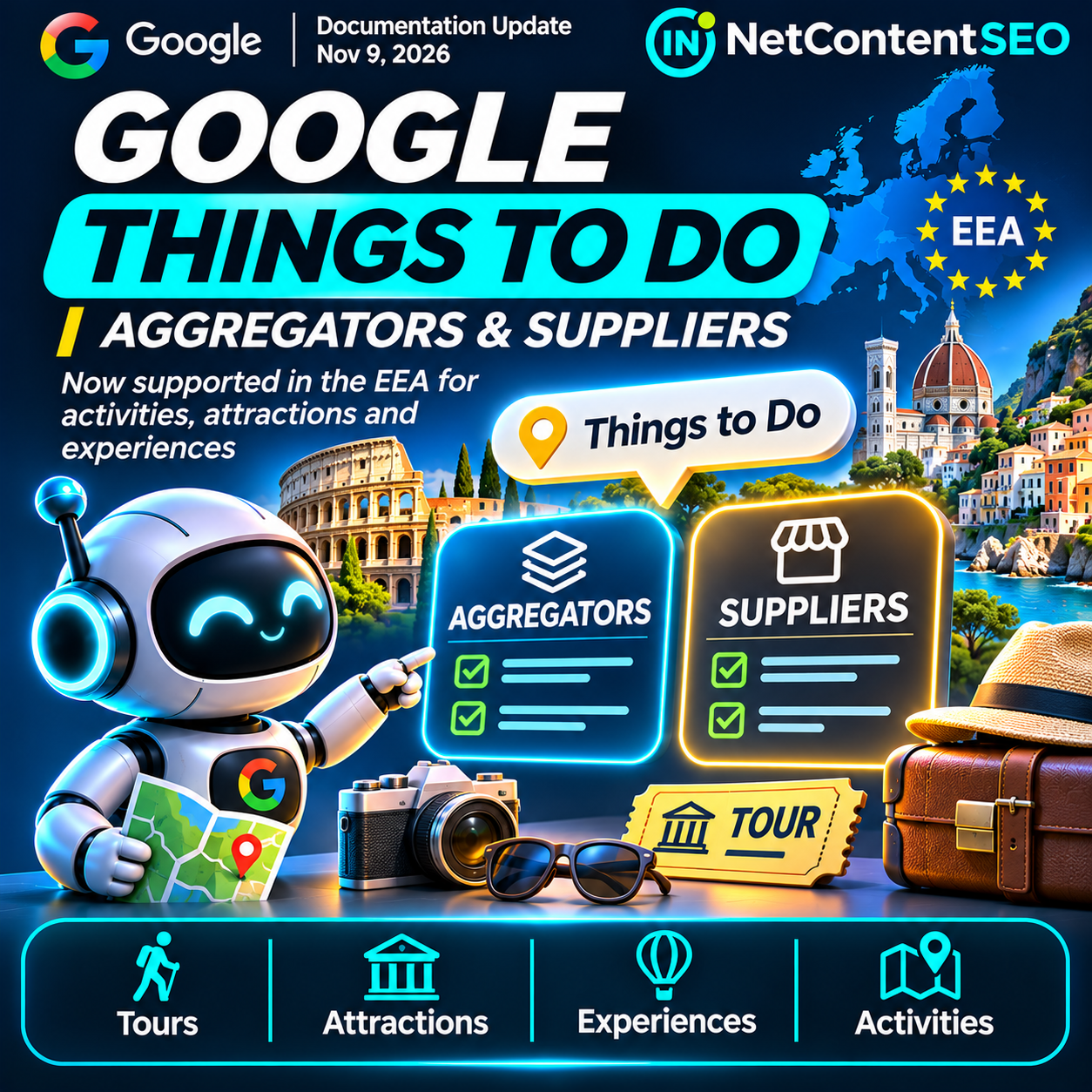

Google has officially expanded its European Search aggregator and supplier units to support “things to do” queries. The change, documented on November 9, 2026, matters to tour operators, attractions, activity-booking platforms and travel search services competing for visibility in the European Economic Area (EEA). It does not announce a new Google AI Mode feature, and it does not guarantee placement for every tourism website.
Google's Search Central documentation changelog explicitly records the addition of “things to do” query support to both units. Barry Schwartz independently highlighted the update in Search Engine Roundtable on November 9. The update builds on September 2026 documentation introducing regional Search experiences and adding local-business queries to the same units.
What changed on November 9?
Google updated the supported query types for two specialized Search result features: the aggregator unit, which presents listings from eligible vertical search services, and the supplier unit, which is designed to give direct providers visibility. The documented scope now includes things to do alongside hotels, flights, ground transportation, products and local businesses.
This is a narrow but meaningful product-documentation change. “Things to do” already existed as a category of Google travel discovery. What is new is its inclusion in these particular regional units, with their own eligibility and participation processes. Google's announcement does not say that every relevant query will display a unit or that a ranking algorithm has been changed.
Aggregator units versus supplier units
Understanding the difference is essential for tourism SEO. An aggregator is an intermediary such as an online travel agency, activities marketplace, metasearch engine or qualifying directory. An eligible direct supplier is the business actually providing an activity or service, such as a tour operator, attraction or experience provider.
Google's aggregator-unit documentation describes a multi-provider interface. Eligible vertical search services populate the unit with relevant results. One provider's results may be expanded by default, and users can select alternative providers. Clicks lead to pages supplied by the aggregator. Google says a separate supplier unit can appear alongside it to support direct providers.
The distinction affects where the customer goes after discovery. An aggregator listing may send the user to a marketplace; a direct-supplier listing can support a route toward the operator itself. The existence of the units does not establish which option will receive more clicks.
Where are the new units available?
Google documents both units as regional experiences for users in the European Economic Area. That is a user-location condition, not a blanket promise that every website based in an EEA country will appear.
The EEA includes EU countries such as Italy, France, Germany and Spain, as well as Iceland, Liechtenstein and Norway. A tourism business serving these markets should assess whether its target searches display the relevant units. A company located elsewhere but serving EEA users should consult the participation criteria rather than assuming that its headquarters location alone determines eligibility.
The change should not be described as a worldwide rollout. Google has not supplied evidence in the cited announcement of equivalent support in the United States, United Kingdom or other non-EEA markets.
How can an aggregator participate?
Google's official aggregator-unit page provides a concrete participation route. The business must qualify as a Vertical Search Service (VSS), provide relevant content and data, meet quality standards and comply with Google Search content policies.
For things-to-do queries, eligible aggregators can express interest using the Google Search Aggregator Features form linked from the official documentation. Google points participants to the Local and things to do Point of Interest Feed specification for the data required to populate the unit. For things-to-do and local-business queries, Google says the unit is populated through direct data feed integrations, not simply by ordinary on-page markup.
Submitting interest does not constitute approval. Eligibility depends on Google's review, technical data requirements and applicable policies. Operators should use the current official form and documentation because onboarding requirements may change.
What should direct suppliers do?
Direct operators should start with Google's regional Search experiences guide and follow its supplier-unit documentation. The supplier unit is a distinct route from the aggregator unit, so a small operator should not assume it must become an OTA or a comparison service to be considered for direct-supplier visibility.
However, the evidence reviewed does not establish a universal self-service enrollment process or automatic eligibility for every attraction and activity business. Direct providers should verify the current supplier requirements and any relevant feed or registration instructions before investing in an integration.
A travel publisher that merely writes editorial guides is not automatically a direct supplier. A marketplace that lists third-party activities is not automatically an approved VSS. Business model and eligibility need to be assessed separately.
What data matters for tourism listings?
Google recommends comprehensive, accurate entity information for aggregator units. Depending on the business, that includes clear titles, detailed descriptions, high-quality original images, verified reviews and ratings, specific categories, relevant operating hours and accurate prices and availability.
For tours and activities, the practical implication is to maintain consistent names, locations, descriptions, meeting points, schedules, ticket conditions and booking details across the website and any participating feeds. These are sensible quality controls; Google has not declared that every one of these fields is a mandatory ranking factor for every things-to-do query.
Google explicitly recommends keeping feed prices and availability aligned with landing pages and refreshing data to remove expired offers. A stale tour listing can frustrate users even when it successfully appears in a search feature.
Is Schema.org enough to appear?
No. The aggregator and supplier units should not be confused with the separate structured data carousel feature. Google's regional differences documentation lists structured data carousels separately and identifies markup as part of their eligibility.
The aggregator unit instead has a specific VSS participation process and feed integration requirements. Adding TouristAttraction, Event or another Schema.org type to a page does not enroll a business in an aggregator unit, approve a feed or guarantee supplier-unit placement.
Structured data can still help represent entities accurately where supported, and clear on-page information remains valuable for ordinary organic search. The point is to avoid promising that markup alone unlocks this new placement.
Why this matters for European travel SEO
Tourism discovery is increasingly split across multiple result surfaces. A search for experiences in a city may expose traditional organic pages, maps, specialized booking results, activity marketplaces and other vertical features. The November update adds things-to-do queries to two documented EEA units that have their own participation rules.
For aggregators, the opportunity is to apply for an additional discovery surface and provide a reliable feed of relevant experiences. For direct operators, the strategic question is whether supplier-unit visibility can support direct discovery alongside marketplace distribution. For independent publishers, the priority is to understand how the search results change, rather than assume their informational articles qualify as suppliers.
There is no published evidence in the announcement showing increased clicks, lower click-through rates or higher bookings for any participant. Such effects need to be measured after the units appear in real searches.
A Sardinia example: tours, attractions and local experiences
Consider an EEA user searching for “boat tours Alghero,” “things to do in Sardinia,” or “guided tours near Cagliari.” These are illustrative query examples, not a verified list of triggers. An approved aggregator could potentially supply relevant activity listings when Google chooses to show an aggregator unit; an eligible direct operator might be represented through the supplier experience.
For a destination publisher covering Sardinia, the right response is to audit representative tourism SERPs, record which types of businesses and platforms appear, and keep editorial coverage useful for questions that booking listings may not answer: accessibility, seasonal restrictions, transport, meeting points, cancellation policies and local practical advice.
For a tour operator, ensure that the official website and booking pages provide consistent descriptions, prices and availability. For a marketplace, investigate the formal VSS application and data feed requirements. These are different actions for different business models.
How to monitor the rollout without misreading SEO data
- Define a query set. Include activity, attraction, tour and experience searches relevant to the business, in the languages used by target customers.
- Test from EEA markets. Record location, device, language and date for each SERP observation.
- Separate result types. Track aggregator units, supplier units, organic results and structured data carousels independently.
- Document participating brands. Note which marketplaces and direct operators appear and where their links lead.
- Check Search Console. Segment relevant pages and queries, accounting for data delays and the fact that Search Console may not isolate every specialized unit in a dedicated report.
- Measure bookings separately. Compare attributable visits and conversion outcomes in analytics and booking systems where tracking is available.
- Audit feed accuracy. For participating businesses, check whether listings match current prices, hours and availability.
- Avoid premature conclusions. A lower organic CTR may reflect several SERP changes; one screenshot cannot prove this unit caused it.
Does this change Google AI Mode or agentic search?
The November 9 announcement concerns regional Google Search units, not a newly announced AI Mode capability. It does not confirm a new agent booking flow, AI-generated recommendation system or change in how Gemini selects citations.
There is a broader relevance to agentic discovery: structured inventories, accurate entity data and reliable availability feeds are useful foundations for systems that help users compare and select services. But that is an infrastructure interpretation, not evidence that these units are powered by a particular AI model or that they improve visibility inside AI-generated answers.
SEO and GEO reporting should keep these concepts distinct: visibility in a specialized Search unit, ranking in ordinary results, inclusion in AI answers and completed bookings are different outcomes.
What remains unknown?
Google has confirmed the expanded query scope but has not provided a public forecast of how often things-to-do units will appear, which exact queries will trigger them, how much traffic participants will receive or whether the change will alter organic click distribution.
The documentation also does not provide a guarantee of approval for any specific aggregator or supplier. Search professionals should avoid turning eligibility into a promise of placement, or interpreting the documentation update as evidence of a new AI ranking factor.
Frequently asked questions
When did Google add things-to-do support to aggregator and supplier units?
Google recorded the documentation update on November 9, 2026.
Is this a confirmed Google change?
Yes. The official Google Search Central changelog confirms support for things-to-do queries in both units.
Which countries are covered?
The units are documented for users in the European Economic Area, not as a global rollout.
What is an aggregator unit?
A multi-provider Search unit for approved vertical search services such as qualifying OTAs, comparison platforms and directories. It can show relevant listings and link to the aggregator's pages.
What is a supplier unit?
A separate regional Search unit intended to provide visibility for eligible direct suppliers rather than intermediaries.
Can a tour booking platform apply?
Potentially, if it meets Google's VSS eligibility, data and quality requirements. The official aggregator-unit documentation links to an expression-of-interest form.
Can a small tour operator appear?
Direct suppliers should consult the supplier-unit participation requirements. The documentation update does not guarantee that every operator qualifies or appears.
Do I need a special feed?
Google documents direct data feed integration for aggregator things-to-do queries and points to the Local and things to do Point of Interest Feed specification.
Will Schema.org markup automatically unlock these units?
No. These units have distinct eligibility and participation processes. Structured data carousels are a separate Search feature.
Is this part of Google AI Mode?
No. The confirmed update concerns regional Search result units, not an AI Mode release.
Will it increase bookings or reduce organic clicks?
Neither outcome is established by the announcement. Monitor real SERPs, attributable traffic and conversion data before drawing conclusions.
The bottom line
Google's November 9 change is a concrete expansion of European tourism discovery infrastructure. Things-to-do queries now fall within the documented scope of both aggregator and supplier units, giving qualifying marketplaces and direct providers a reason to review participation requirements.
The opportunity is real but conditional. Eligibility, accurate feeds, search relevance and Google’s presentation choices all matter. For tourism SEO teams, the immediate task is to audit EEA search results, understand the correct participation route and measure outcomes without confusing these units with AI Mode or assuming guaranteed visibility.
Sources
- Google Search Central — Latest documentation updates, November 9, 2026.
- Google Search Central — Aggregator unit in Google Search.
- Google Search Central — Regional differences in Search experience.
- Search Engine Roundtable — Google Aggregator & Supplier Units Gain Things To Do Query Support, November 9, 2026.