

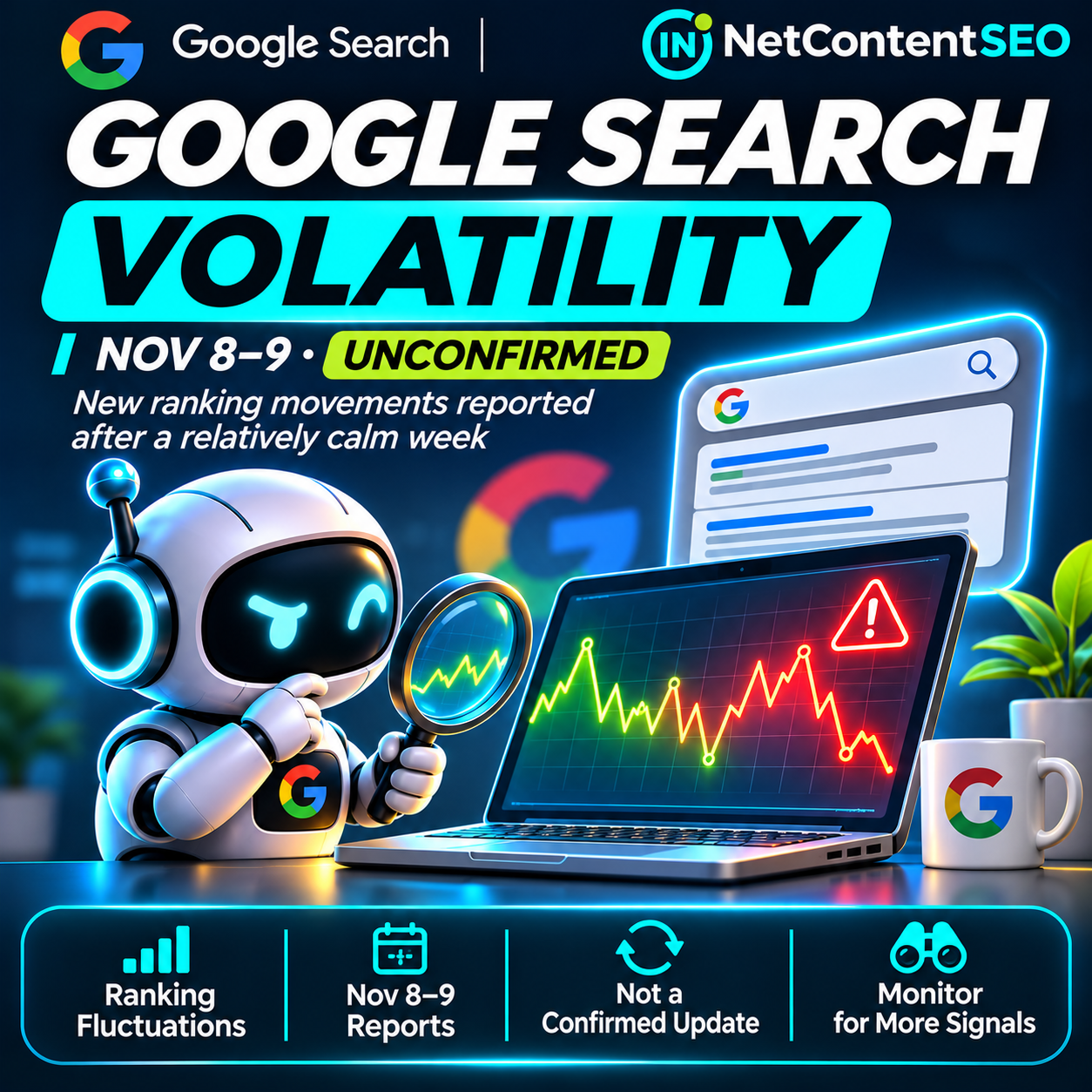

November 9, 2026. Early signs of renewed Google Search ranking volatility are emerging around November 8 and 9, following a relatively quiet period after the late-October fluctuations. Barry Schwartz reported the development in Search Engine Roundtable, citing a modest increase in SEO community discussion and uneven movement across third-party tracking tools.
Evidence status: REPORTED / UNCONFIRMED. Google has not announced a new core update associated with these dates. The observations are worth monitoring, but the evidence does not yet support a conclusion that a specific algorithm change caused them.
What Barry Schwartz reported on November 9
Schwartz described roughly two weeks since his previous coverage of a possible Google ranking update. The October 27 volatility appeared to continue for about a week, followed by a calmer period. Over the preceding 24 hours, he began seeing fresh discussion and isolated spikes in monitoring systems. He characterized the signals cautiously rather than declaring a confirmed rollout.
The reporting included observations from tools such as Semrush, Wincher, Sistrix, Mozcast, AccuRanker, Similarweb, DataForSEO and others. Those tools do not all measure the same queries, markets or ranking features, and their outputs should not be treated as interchangeable evidence. Some reported elevated movement; the article did not establish uniform disruption across every tracker.
Why the tracker data needs extra caution
A notable part of Schwartz's report is his warning about the reliability of automated SERP measurement. Google has introduced mechanisms that can interfere with automated collection, and ranking tools may encounter blocking or distorted results. If a tracker fails to retrieve a result correctly, it can produce an apparent ranking change even when the live result shown to users has not changed in the same way.
That does not mean every volatility spike is false. It means the data-collection process must be evaluated alongside the rankings. An analyst should verify whether a tool recorded an actual destination URL, an intermediate redirect, an access challenge or an incomplete response. A large anomaly in one tool, without corresponding evidence from live searches or independent data, is insufficient to diagnose a Google update.
What SEOs are saying
Schwartz noted renewed discussion in Search Engine Roundtable comments and WebmasterWorld, including reports of weaker Discover or Search traffic, unusual movements in UK and German results, and some sites experiencing stronger commercial performance. The anecdotes point in different directions.
These accounts are useful early signals, not a representative sample of the web. They may involve different industries, locations, devices and technical conditions. A single publisher's traffic decline cannot establish a system-wide update, and an individual recovery does not prove the update has finished.
The October context
The November reports follow several earlier periods of unconfirmed volatility. Search Engine Roundtable covered possible changes on October 16, October 20–21, October 24 and October 27. Schwartz said the October 27 movement persisted into the following week. Those reports provide context for the latest observations, but do not establish that all dates belong to one continuous algorithm rollout.
The last officially confirmed event referenced in this sequence was Google's September 2026 spam update, which began September 24 and finished October 8. A later ranking fluctuation should not automatically be attributed to that completed rollout. Nor should the absence of an official announcement be interpreted as proof that Google made no changes at all.
Is this a November 2026 Google Core Update?
No confirmed core update has been identified for November 8–9 in the evidence reviewed. A core update is an officially identified broad change to Google's ranking systems. Volatility and SEO discussion can accompany such updates, but they also occur for other reasons, including smaller ranking adjustments, changes in SERP presentation, shifts in competitors' pages, indexing events and measurement errors.
Google's Search Status Dashboard is the appropriate official reference for announced ranking incidents and updates. The dashboard should be checked before labeling any observed movement as an officially confirmed rollout.
How to check whether your site was affected
The first step is to establish whether the site has a real performance change, rather than relying on a volatility headline. Use Google Search Console to compare relevant periods while accounting for its reporting delays and any current data-quality issues. Schwartz noted that some publishers were experiencing problems with Search Console performance reporting, which makes cross-checking especially important.
- Choose comparable windows. Compare November 8–9 with the same weekdays in earlier weeks, allowing for data delays. A two-day fluctuation is not enough to establish a trend.
- Separate Search and Discover. Their traffic patterns and reporting are different. A Discover decline is not automatically evidence of an organic Search ranking change.
- Segment by country and device. A localized movement can disappear in a global average.
- Review page and query groups. Look for patterns across categories, templates and search intents instead of focusing on a single keyword.
- Compare impressions, clicks, CTR and average position. A click decline with stable impressions and positions may indicate a change in click behavior or SERP presentation rather than lost rankings.
- Validate indexing and crawling. Check page availability, robots rules, canonicals, server responses, redirects and recent releases before blaming an algorithm.
- Cross-check independent evidence. Compare a reliable rank tracker with representative live searches, server logs and analytics where possible.
- Document the timeline. Record site changes, competitor movements, traffic anomalies and confirmed Google announcements in one chronology.
When not to make immediate SEO changes
Do not rewrite titles, remove pages, change internal linking or initiate a site-wide content overhaul simply because a volatility chart spikes. First determine whether the movement is real, sustained and relevant to your own query set. Large interventions during a short-lived or poorly measured event can make it harder to identify the original cause.
If a technical fault is independently confirmed—for example, pages returning errors or a broken canonical deployment—fix it promptly. But that is different from reacting to an unconfirmed ranking update. The right response depends on evidence from the site itself.
What this means for AI Search and GEO
Traditional organic rankings and AI-generated answer visibility are related but distinct measurement problems. A Google ranking fluctuation does not automatically prove that Google AI Overviews or AI Mode changed their source-selection systems. Likewise, a change in AI citations cannot be inferred from third-party blue-link volatility charts alone.
For GEO teams, maintain separate measurements for organic rankings, Search Console performance, AI answer mentions, cited URLs and attributable referral traffic. Where AI responses are sampled, record the date, prompt, market and interface so that a changing answer is not mistaken for a stable citation ranking.
The bigger lesson from this episode may be about measurement integrity. If automated SERP collection is increasingly affected by blocking, apparent ranking movements can contaminate dashboards and downstream AI visibility analyses. The quality of the underlying observations matters before any explanation of the change.
A practical 72-hour monitoring plan
Day 1: capture a baseline of affected queries, countries and landing pages. Confirm whether Google Search Console and analytics show corresponding changes. Note data freshness and any reporting limitations.
Day 2: repeat checks on the same query set. Compare at least two independent sources, investigate any crawler or redirect anomalies, and check the official Google Search Status Dashboard.
Day 3: assess whether the movement persists, reverses or remains limited to one measurement provider. Only then decide whether deeper technical or content-level analysis is justified. Continue monitoring if the evidence remains inconclusive.
Frequently asked questions
Did Google release a core update on November 8 or 9, 2026?
There is no official core update confirmation in the evidence reviewed. Search Engine Roundtable reported possible ranking volatility and early community discussion.
What did Barry Schwartz observe?
He reported new chatter and scattered tracker spikes after a calmer period following late-October volatility, while emphasizing uncertainty about automated measurement quality.
Are Google rankings changing worldwide?
The available reports do not establish a uniform worldwide change. Observations vary by tool and by the individual publishers commenting on their traffic.
Can SERP tracking tools produce false volatility?
Yes. Automated collection can be affected by blocking, access challenges, incomplete results or URL handling. Apparent changes should be validated before being treated as ranking movements.
Should I update content immediately?
Not solely because of the reported volatility. Confirm a sustained, site-specific impact and rule out technical issues and reporting anomalies first.
How do I know whether my site was affected?
Compare Search Console and analytics data by query, page, country and device, verify live rankings and check server or indexing issues. Account for data delays and reporting problems.
Is this connected to the September 2026 spam update?
No direct connection has been established. Google's September spam update completed on October 8, while the current signals concern November 8–9.
Does this prove Google AI Mode changed its citations?
No. The reported observations concern Search ranking volatility. AI answer citations require separate evidence and measurement.
Bottom line
There may be renewed Google Search volatility around November 8–9, but it is too early to call it a confirmed algorithm update. Barry Schwartz's reporting is valuable precisely because it distinguishes early signals from official announcements and acknowledges problems with ranking-tool reliability.
For publishers and SEO teams, the priority is not to guess what Google changed. It is to establish whether their own performance has genuinely shifted, validate the measurement process and wait for stronger evidence before making broad decisions.
Sources
- Search Engine Roundtable — Google Search Ranking Volatility Status: Update November 8th/9th? (November 9, 2026).
- Search Engine Roundtable — Unconfirmed Google Search Ranking Update: Volatility & Chatter Spike (October 27, 2026).
- Search Engine Roundtable — Google Search Ranking Volatility Gets Heated October 24th (October 25, 2026).
- Search Engine Roundtable — Google Search Ranking Volatility & Chatter Heats Up October 20 & 21 (October 21, 2026).
- Google Search Status Dashboard — official update and incident history.