

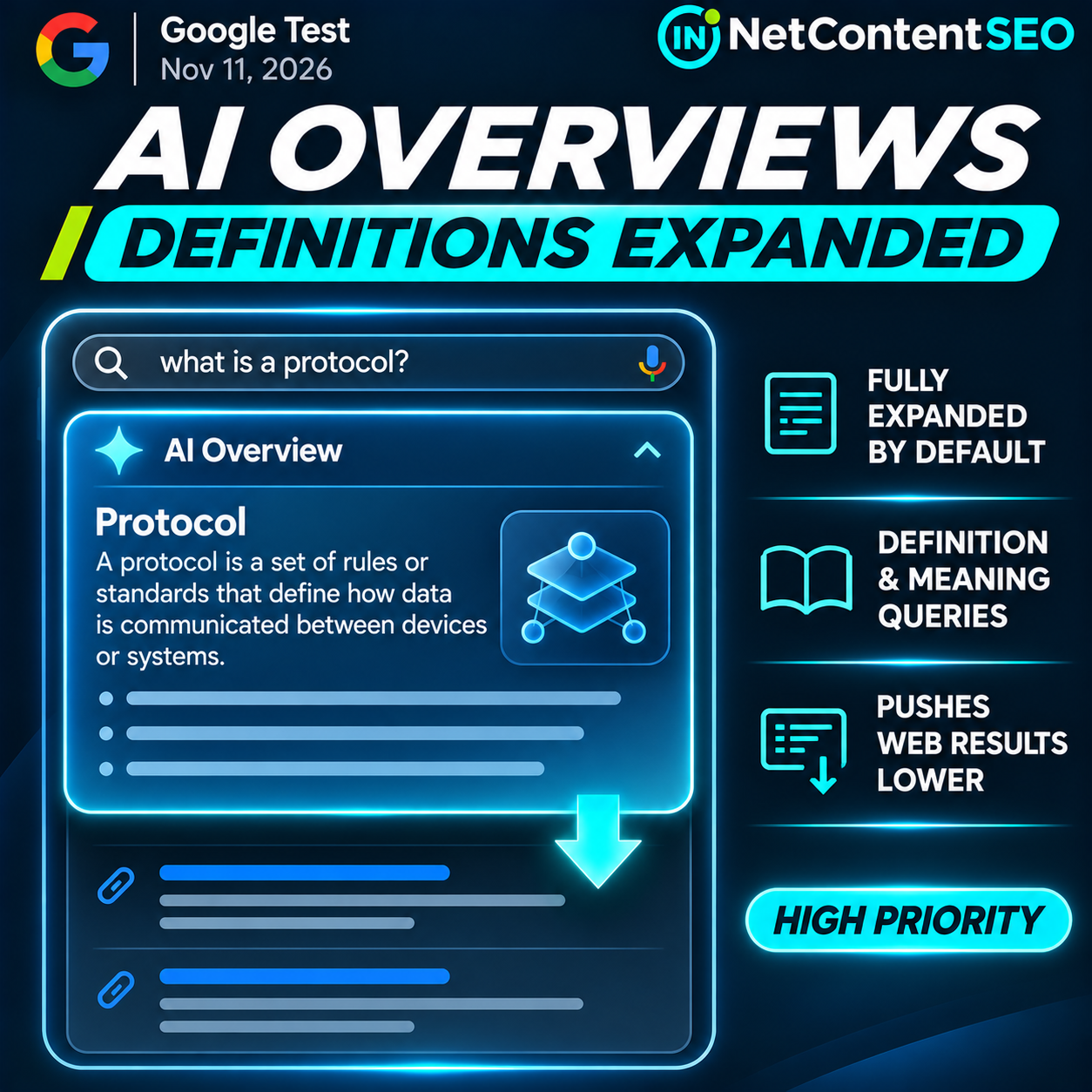

Google is showing fully expanded AI Overviews by default for some definition and meaning searches, according to observations published on November 11, 2026. SEO consultant Glenn Gabe documented queries that recently displayed collapsed AI answers—or no AI Overview at all—but now display the complete generated response immediately. Barry Schwartz reported the examples on Search Engine Roundtable.
The immediate concern for dictionary publishers, glossaries and educational websites is visual: when the AI answer occupies almost the entire initial screen, traditional web listings may be pushed below the fold. That does not prove a traffic decline, but it changes the amount of attention a user must devote to reaching organic results.
What Glenn Gabe observed
Gabe shared screenshots on November 11 showing AI Overviews fully expanded for definition-style searches without the familiar “Show more” interaction. His earlier saved SERP snapshots showed the same kinds of answers collapsed or absent. One example highlighted by Schwartz was a search for “define expandable,” where the AI Overview occupied the visible search-results area and the user had to scroll to reach conventional web results.
The observations are strong evidence of a live interface variant. They are not evidence that every definition query worldwide has changed. Google has not publicly confirmed a definition-specific universal rollout, affected markets, percentage of users exposed, or a permanent deployment schedule. Query wording, language, device, account state and location can all affect what appears.
Google had already acknowledged dynamic expansion
This behavior is not entirely new. In August 2026, Google Search's Robby Stein explained that AI Overviews could expand dynamically when Google's systems determined the additional answer was useful. He also said expansion could stop once the user began scrolling, helping preserve the reader's place on the page. The new November observation is notable because definition queries appear to be receiving a fully expanded answer immediately, without requiring a click.
The distinction matters for accurate reporting: the general capability to expand AI Overviews was previously acknowledged by Google, while the apparent concentration of fully expanded answers on definition searches is a new observation from independent SEO monitoring. No separate algorithm or ranking update has been announced as the cause.
Why definition queries are particularly exposed
A query such as “what does latency mean?” or “define canonicalization” often has a short, self-contained answer. Users may not need to open a dictionary or glossary page once a satisfactory definition appears directly in Search. A fully expanded AI Overview makes that immediate answer more visually dominant than a collapsed preview.
This can create an additional obstacle for publishers whose traffic depends on basic informational searches. Even when a glossary page remains highly ranked in the traditional results, it may no longer be visible on the first screen. The ranking position is therefore only one part of the searcher's experience.
There are important exceptions. Users researching technical, legal, medical or specialized definitions may still need authoritative context, examples, qualifications or primary documents. A definition can also lead to a follow-up question that a publisher is well positioned to answer. The existence of an expanded AI Overview does not make every definition page commercially or editorially irrelevant.
Ranking visibility is not viewport visibility
Traditional SEO reports usually emphasize rankings, impressions, clicks and click-through rates. An expanded AI answer introduces another dimension: how much of the screen is occupied before the first conventional result becomes visible.
Consider two otherwise similar SERPs. On the first, a short AI Overview leaves the top organic listing visible near the bottom of the initial viewport. On the second, the AI Overview is fully expanded and the first organic listing requires scrolling. The publisher's traditional ranking might be unchanged, but the presentation differs substantially.
This does not justify inventing a new universal “pixel penalty.” Screen size, browser zoom, device and answer length vary. But it does justify recording whether the first organic result is above or below the fold and how many user actions are required to reach it.
Does the change reduce clicks?
There is no verified click-loss figure for this November 11 observation. The hypothesis is reasonable: when an answer satisfies a user's intent immediately and pushes web links down, fewer users may proceed to those links. But the screenshots do not measure click behavior, and the effect may differ between generic definitions and specialized concepts.
Google says AI Overviews are designed to provide a starting point for exploration, with links to relevant sources. In its AI features documentation, Google states that ordinary SEO fundamentals remain relevant and that pages must be indexed and eligible for snippets to appear as supporting links. Those eligibility requirements do not guarantee inclusion or traffic.
Google's Search Console methodology counts clicks on external links within AI Overviews as clicks, but a standard search-performance view does not by itself explain how much traffic came from a particular expanded-answer layout. Even a fall in clicks after November 11 would not prove causation without accounting for other changes.
A crucial confounder: Google's November 2026 core update
Google began rolling out a November 2026 core update on November 10, according to Search Engine Roundtable's reporting of Google's announcement. This timing is important for anyone investigating glossary traffic in the same week.
A site can experience changes in ranking, impressions or click-through rate because of the core update, the expanded AI Overview presentation, query demand, competitors, other SERP features or a combination of these factors. A before-and-after comparison around November 11 should therefore be treated as exploratory, not a controlled causal test.
The most reliable approach is to keep separate evidence of the SERP layout and of the site's performance. If rankings are stable, the same query begins showing an expanded AI Overview, and clicks decline across repeated observations, that strengthens the hypothesis. It still does not eliminate every competing explanation.
How to audit glossary and definition exposure
- Identify the affected pages. Export glossary, dictionary, encyclopedia, FAQ and explanatory URLs. Prioritize those receiving the most organic clicks and impressions.
- Build a fixed query sample. Include patterns such as “define [term],” “[term] meaning,” “what is [term]” and domain-specific variations. Do not assume all informational queries behave like dictionary definitions.
- Capture the actual SERP. Record date, country, language, device, viewport size, presence of AI Overview, expanded or collapsed state, and whether the first conventional listing is visible without scrolling.
- Compare saved snapshots. Repeat the same queries under comparable conditions and retain screenshots or reliable interface observations. One isolated capture cannot establish rollout prevalence.
- Segment Search Console performance. Compare clicks, impressions, CTR and average position for relevant pages and queries over meaningful periods. Account for reporting delays and the November core update.
- Check AI citation inclusion separately. Note whether the publisher is cited in the generated answer. Being cited and receiving a click are different outcomes.
- Review query intent. Separate users who only need a short definition from those seeking examples, comparisons, troubleshooting, regulatory context or tools.
- Test content improvements carefully. Add genuine utility and measure outcomes instead of assuming that longer text will defeat a fully expanded answer.
What glossary publishers can do beyond rewriting definitions
A definition page should still explain its term clearly and accurately. Removing the concise definition would make the page less useful and could weaken its relevance. The stronger opportunity is to provide something the AI summary may not fully deliver: original examples, diagrams, calculators, implementation steps, comparative tables, industry-specific exceptions, primary references or regularly updated evidence.
For example, a page defining “canonical URL” can move beyond a one-sentence description to include redirect and canonical-tag examples, a decision table for duplicate URLs, troubleshooting cases and links to official Google documentation. A page defining “heat pump efficiency” can explain seasonal performance with actual worked calculations and climate assumptions. A legal glossary can identify jurisdictional differences and cite controlling sources.
The aim is not to manufacture extra words. It is to serve the follow-up intent that remains after the user has read the definition. Internal links should connect the concept to relevant tutorials, comparisons, products or services only when that connection genuinely helps.
What not to do
Do not conclude that Google has officially rolled out fully expanded AI Overviews for every definition search. Do not claim that a particular percentage of traffic has been lost without measurement. Do not confuse the expansion of an answer with a new ranking signal. And do not add speculative structured-data markup or remove important content merely to influence AI Overviews: Google's guidance does not prescribe a special schema type or AI-specific optimization to force inclusion.
Equally, do not rely solely on a ranking tracker that ignores the visible interface. A URL can remain in the same organic position while being substantially harder to notice on the first screen.
Frequently asked questions
Are Google AI Overviews automatically expanded for definition searches?
Glenn Gabe observed fully expanded AI Overviews on definition queries on November 11, 2026. The evidence supports a live interface behavior or test, but not a confirmed worldwide rollout across all definition searches.
What does “expanded by default” mean?
The full AI-generated answer is shown immediately instead of requiring the user to click a “Show more” control to reveal the remainder.
Who first reported this change?
SEO consultant Glenn Gabe shared the observation, and Barry Schwartz covered it in Search Engine Roundtable on November 11, 2026.
Does this affect all informational searches?
That has not been established. The new observation specifically concerns definition and meaning queries, while Google previously acknowledged dynamic expansion for selected topics more broadly.
Will dictionary and glossary websites lose organic traffic?
They may face greater click competition when an expanded AI answer fills the initial viewport, but no verified traffic-loss figure has been established for this specific test.
Does a top organic ranking guarantee first-screen visibility?
No. Large AI Overviews and other SERP features can push conventional results below the initial viewport even when their organic ranking remains unchanged.
Can Search Console prove an expanded AI Overview caused a click decline?
Not on its own. Search Console can show search-performance trends, but causal analysis also requires evidence of the actual SERP layout and consideration of other changes such as the November core update.
Should publishers remove their definitions or block AI Overviews?
There is no general reason to do so based on these observations. Preserve clear, useful definitions and evaluate any search-feature controls against the broader impact on discoverability and traffic.
How should a glossary page evolve?
Retain an accurate concise definition, then add genuinely useful material such as examples, procedures, comparisons, original data and answers to likely follow-up questions.
The bottom line
The November 11 observations suggest that Google is making some definition searches more answer-first by showing AI Overviews fully expanded without a click. The visible consequence can be dramatic: conventional web results may disappear below the initial screen even when their ranking has not changed.
For publishers, the immediate task is to measure search-result presence, first-screen visibility, AI citation inclusion and actual traffic as separate things. The potential pressure on clicks is real enough to investigate, but the evidence does not yet justify declaring a measured traffic collapse or a universal rollout.
Sources
- Search Engine Roundtable — Google Search AI Overview Definitions Expanded By Default (November 11, 2026).
- Glenn Gabe — public post archive showing the November 11 observation.
- Google Search Central — AI features and your website.
- Google Search Console Help — how impressions, clicks and position are counted.