

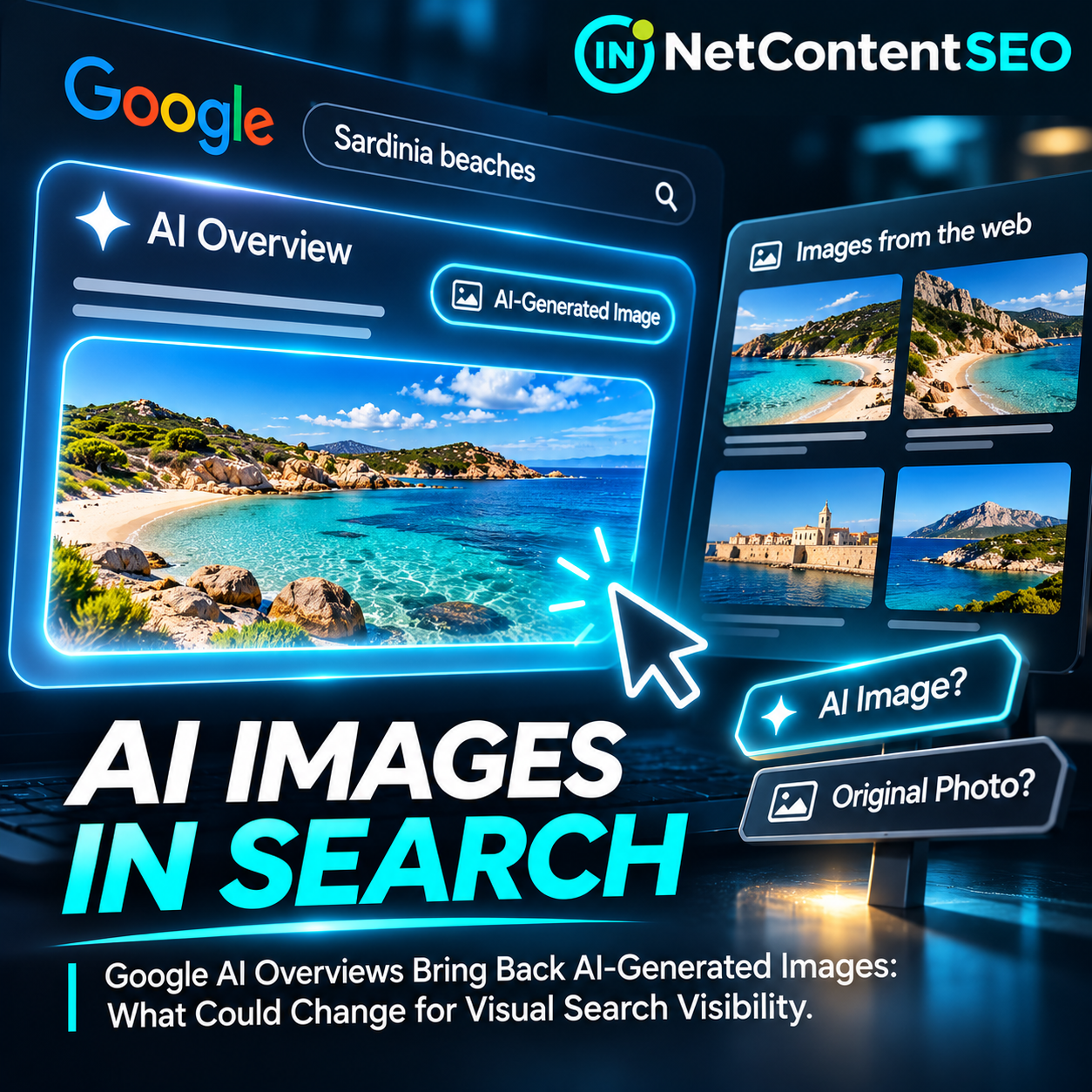

Google is once again showing AI-generated imagery directly within some AI Overviews, according to observations published on November 13, 2026. The development may seem like another small interface experiment. For photographers, publishers, travel sites and other businesses that depend on original visual content, however, it raises a larger question: what happens to image discovery when a search engine can generate a picture instead of directing users to one made by a publisher?
There is an important limit to the evidence. This is an observed, inconsistent test, not a confirmed universal rollout. There is currently no verified measurement showing that the test has reduced image-search traffic or publisher revenue.
What was actually observed on November 13?
Barry Schwartz reported at Search Engine Roundtable that Derek Hobson had spotted AI-generated images appearing within Google's AI Overviews. Schwartz said he could reproduce the behavior in some browsers but not others. In other browser sessions, the AI Overview responded that it could not generate images directly.
That variation matters. It could reflect an experiment restricted to particular sessions, queries, accounts, browser contexts or other factors, but the available report does not establish which factor controls access. It would be inaccurate to say that every Google user can now generate images in AI Overviews.
The reporting also speculated about a possible relationship with a contemporaneous Google Search model upgrade. That connection has not been established as the cause of the observed behavior.
Google had introduced—and then paused—a related experiment
The November observation follows an earlier sequence. In July 2026, Google announced plans to bring image generation directly into AI Overviews. In August, Google's Robby Stein said a small experiment was no longer running. He also distinguished it from a separate feature that generates an image when a user explicitly asks for one.
The distinction remains central: an image created within an AI-generated answer is not necessarily the same product experience as an explicit image-generation request. A return of some observed behavior in November does not establish that the earlier experiment has resumed unchanged or that Google has committed to a permanent rollout.
Why this matters for visual search
Traditional image discovery often gives users a reason to visit the page where a photograph, diagram or illustration was published. A travel photo might lead to a destination guide; a product image to a merchant; a technical diagram to a tutorial; and an original illustration to the publication that commissioned it.
When a search interface generates an image itself, the relationship can change. For some requests, a generated illustration might satisfy the user without a visit to a source page. But other searches require verifiable images of real-world conditions, actual products, historical documents or specific places. A synthetic image is not a substitute for that evidence.
Consider a query about a beach in Sardinia. A generated image could convey the general idea of turquoise water and rocky coastline. It cannot independently verify the beach's current condition, access rules, crowding, weather or precise appearance. For a publisher, that difference is an opportunity to demonstrate the value of original, dated and geographically accurate photographs.
Three possible effects—and what remains unproven
First, visual attention could shift. A large generated image in an AI Overview might occupy space and attention that would otherwise go to thumbnails linked to websites. This is a plausible interface effect, not yet a measured traffic loss.
Second, attribution could become more complicated. A generated illustration may not have a single identifiable source page in the way an indexed photograph does. Questions about labeling, provenance and links to supporting material become more important. The November report does not establish a universal attribution policy for these generated images.
Third, the value of original imagery could become more specialized. Generic decorative visuals may face stronger competition from generated alternatives. Original reporting photographs, documented experiments, authentic product imagery and location-specific visual evidence can still serve needs that synthetic pictures cannot reliably meet. This is an editorial interpretation, not an observed ranking change.
How is this different from Google Images?
Google Images indexes and presents images associated with webpages and other sources. The newly observed AI Overview behavior concerns an image created as part of an AI-generated search response. These experiences may coexist, and the observation does not mean Google Images is being replaced or that indexed photographs will disappear.
Likewise, this does not demonstrate a new image-ranking factor, a penalty for original photographs, or an official change in image SEO requirements. Publishers should avoid rewriting their entire image strategy on the basis of a limited test.
What publishers and SEOs should monitor now
A sensible response begins with a controlled observation log. Record the exact query, date, country, language, device, browser, logged-in state, whether the generated image appeared, whether it carried a label, and whether source links were visible. Repeat the query across comparable sessions. Screenshots should be archived with timestamps rather than circulated as proof of a universal release.
Next, establish a baseline for pages where original imagery is central to the user experience. Track Google Search Console's Web and Image search performance separately where available, and monitor landing-page engagement and conversions in analytics. Search Console does not provide a dedicated report isolating clicks lost specifically to AI-generated images inside AI Overviews. A traffic movement alone therefore cannot establish causation.
Publishers should continue established image practices: use accurate alt text, descriptive filenames, relevant surrounding copy, crawlable image URLs, suitable image dimensions and appropriate structured data where applicable. Keep copyright and licensing information accurate. For journalistic or location-sensitive imagery, include useful provenance such as photographer, location and capture date when appropriate.
Above all, invest in visual information that adds evidence: comparison photos, original screenshots of documented tests, diagrams derived from measurements, verified product photographs and authentic images of places. The point is not that AI cannot make attractive pictures. It is that an attractive picture and a trustworthy record are different products.
A test plan for measuring impact
To establish whether AI-generated visuals affect publisher discovery, researchers would need a repeated sample of relevant queries, matched observations with and without generated images, and a consistent way to measure changes in clicks to source pages. The study would need to account for ranking changes, query mix, seasonality, geography and device differences.
For a practical publisher experiment, start with a fixed panel of visual queries and a baseline of Image and Web search clicks. Document when generated imagery is observed, then examine whether affected query groups change differently from comparable unaffected groups. Even then, observational results should be described as associations unless the study design supports causal inference.
The larger question: who supplies the visual evidence?
The emerging tension resembles a broader issue in AI Search: platforms increasingly answer questions within their own interfaces while the open web supplies much of the underlying information. For visual search, the stakes extend beyond referral economics to authenticity. A generated image can illustrate a concept, but it should not be confused with evidence that a particular real-world scene exists.
That is why this November test deserves attention without sensationalism. The observation is real, its availability is inconsistent, and its commercial effects remain unmeasured. The most important question is not whether Google can generate a convincing image. It is whether search can preserve clear distinctions between synthetic illustration and original visual evidence—and continue giving users meaningful paths to the sources that create the latter.
Frequently asked questions
Has Google officially launched AI-generated images in all AI Overviews?
No. As of November 15, 2026, the evidence is a reported test reproduced in some browsers, not a confirmed universal rollout.
Who observed the return of AI-generated images?
Derek Hobson reported the behavior, and Barry Schwartz independently reproduced it in some browser sessions, according to Search Engine Roundtable on November 13.
Will AI-generated images reduce Google Images traffic?
That is a potential concern, not an established result. No verified traffic-loss figure specific to this test has been published in the cited reporting.
Should publishers stop producing original images?
No. Original images remain important for accurate documentation, evidence, brand identity, product representation and real-world reporting. There is no evidence that the observed test makes original visual content obsolete.
How can a publisher check whether this affects its site?
Track repeatable query observations and compare Web and Image search performance over time, while controlling for other changes. Do not attribute every click decline to AI-generated imagery.
Sources: Barry Schwartz, Search Engine Roundtable, November 13, 2026 (including references to Derek Hobson's observation, Google's July announcement and Robby Stein's August clarification). Editorial classification: observed experiment, limited availability; no confirmed traffic impact. Illustrations used to accompany this article are conceptual, not authentic screenshots of the live Google interface.