

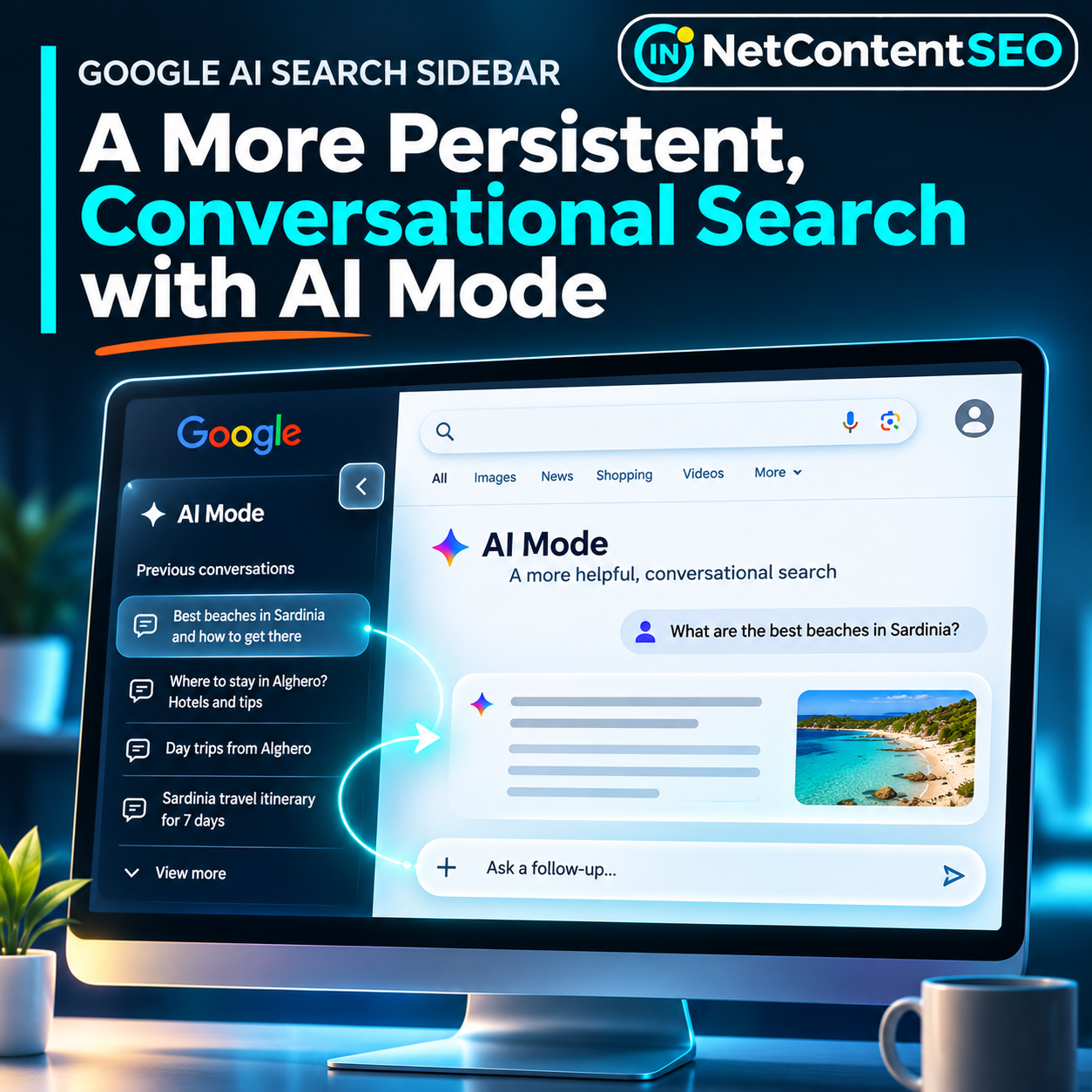

Google is making AI-powered search easier to resume rather than restart. On November 19, 2026, Robby Stein, Google's vice president of product for Search, confirmed a global rollout of a collapsible sidebar on the desktop Google Search homepage. The panel lets users find recent AI searches and return to previous AI Mode conversations. The update is an interface change, not an announced search ranking update, but it could influence how people research complex topics and encounter publishers over multiple questions and visits.
What Google confirmed
Stein announced that Google was rolling out a collapsible sidebar on its desktop homepage globally to help people find and resume recent AI searches. He said testing indicated that the feature helped users make progress on questions that are not completed in a single interaction. Google did not provide a numerical uplift in task completion, engagement or click-through rates in the announcement.
Barry Schwartz documented the official confirmation in Search Engine Roundtable on November 19. Earlier reports had identified a left-hand AI Mode sidebar on standard Search results in October, initially as a limited test. The new announcement changes its status from an observed experiment to an officially announced global desktop rollout, although individual users may receive the interface at different times.
How the collapsible sidebar works
On supported desktop interfaces, the left-side rail can expand to show recent AI Mode threads. Users can return to an existing conversation and continue with a follow-up question instead of recreating the original search. Reporting on the interface also describes controls for starting new threads and finding past threads. The precise arrangement may vary as the rollout progresses.
The important distinction is between global rollout and immediate universal availability. Google has confirmed deployment worldwide on desktop, but that does not mean every account, language, browser or region already shows the same sidebar. Google has not announced an equivalent rollout for the mobile homepage as part of this specific update.
From one-off queries to continuing research
Traditional search often begins with an isolated query: a user enters a phrase, reviews results and starts again with a different phrase later. AI Mode already supports conversational follow-ups. The new sidebar makes that capability more prominent by letting users revisit a research thread from the main Search experience.
Imagine someone researching a week-long trip to Sardinia. The initial question might compare Alghero, Olbia and Cagliari. A later question could focus on airport transfers, beach access or accommodation rules. Returning to the same thread makes it easier to preserve the broader research context. That example illustrates the potential user experience; it does not prove that any particular destination website will receive more or fewer visits.
Google's May 2026 Search announcement already emphasized contextual follow-up questions from AI Overviews into AI Mode. The sidebar extends that direction by making previous research conversations easier to recover.
Why persistent AI Search matters for SEO and GEO
The direct ranking impact is unconfirmed. Google has not announced a new ranking factor, indexing rule, AI Overview citation policy or Search Console metric because of the sidebar. Its possible consequences concern discovery behavior and attribution across longer research journeys.
First, the unit of analysis may become broader than a single keyword. A user can ask an initial question, compare several options and return later to refine a decision. A brand or publisher could appear at different stages of that sequence. Visibility in the first answer is not necessarily representative of visibility in the full conversation.
Second, follow-up questions may change which sources are useful. A broad answer about the best Sardinian destinations may need different evidence from a later answer about parking restrictions or transport schedules. Publishers with precise, current and practical information may be relevant to those deeper questions, although no guaranteed citation mechanism follows from that observation.
Third, clicks may occur at different moments. Some users may continue researching within AI Mode before visiting a source; others may open cited pages early or not click at all. The new sidebar alone does not demonstrate a loss of organic traffic, a gain in AI referrals or an increase in zero-click searches.
How publishers should measure multi-turn AI visibility
SEO teams can begin testing multi-step research scenarios instead of evaluating only isolated prompts. A useful approach is to construct representative question sequences and record what happens at each stage.
- Start with realistic tasks: choose research journeys such as planning a holiday, comparing business software or selecting a professional service.
- Record each turn: note the original question, follow-ups, date, locale, device, displayed sources and whether a link to the publisher appears.
- Separate mention from citation: a brand named in an answer, a linked source and an actual referral visit are different outcomes.
- Test return sessions: where the interface is available, revisit an existing thread and observe whether sources and recommendations change as the user adds constraints.
- Monitor business results: compare qualified traffic, conversions and branded demand with historical baselines, accounting for seasonality and other product changes.
- Avoid unsupported causation: do not attribute a change in Search Console clicks to the sidebar without corroborating evidence.
What should content teams change?
There is no verified sidebar-specific optimization trick. The strongest response is to make content useful across a range of related questions. That means answering the primary query clearly while also covering relevant constraints, exceptions, costs, dates, eligibility and next steps. Information should be maintained and backed by reliable sources.
Clear headings, descriptive links, consistent entity names and accessible page structure help human readers navigate a topic. They can also make source material easier to interpret, but they do not guarantee inclusion in AI Mode. Publishers should avoid manufacturing large volumes of repetitive follow-up pages solely to target speculative AI citations.
What this could mean for travel publishers
For a destination publisher such as WikiSardinia, a continuing AI Mode thread could span an entire travel-planning process: destination selection, transport, accommodation, beaches, local rules and activities. That creates a reason to publish interconnected, accurate guides rather than isolated articles that answer only a narrow keyword.
For example, an Alghero beach guide can explain access rules, parking, public transport, accessibility and seasonal conditions, with clear references to official information. A traveler may need those details at a later stage of research. Whether Google will cite that guide, and whether the citation will generate traffic, must be measured rather than assumed.
What remains unknown
Google has not publicly quantified how the sidebar changes the number of follow-up questions, organic clicks, publisher referrals or conversions. The announcement also does not establish that a source cited early in a conversation remains cited later, or that past conversation history is used as a new ranking signal. Availability may differ during rollout, and the mobile experience should not be presumed identical.
The bigger picture
Google Search is increasingly designed around research sessions, not just individual search queries. The collapsible desktop sidebar makes that shift visible on the homepage itself. For SEO and AI Search practitioners, the immediate task is not to chase an unproven ranking update. It is to understand how users move through multi-turn research, identify which sources support different stages of the journey and measure the business value of visibility beyond the first answer.
Sources: Search Engine Roundtable, November 19, 2026; Search Engine Roundtable, October 14, 2026, earlier test; Google Search I/O 2026 announcement.