

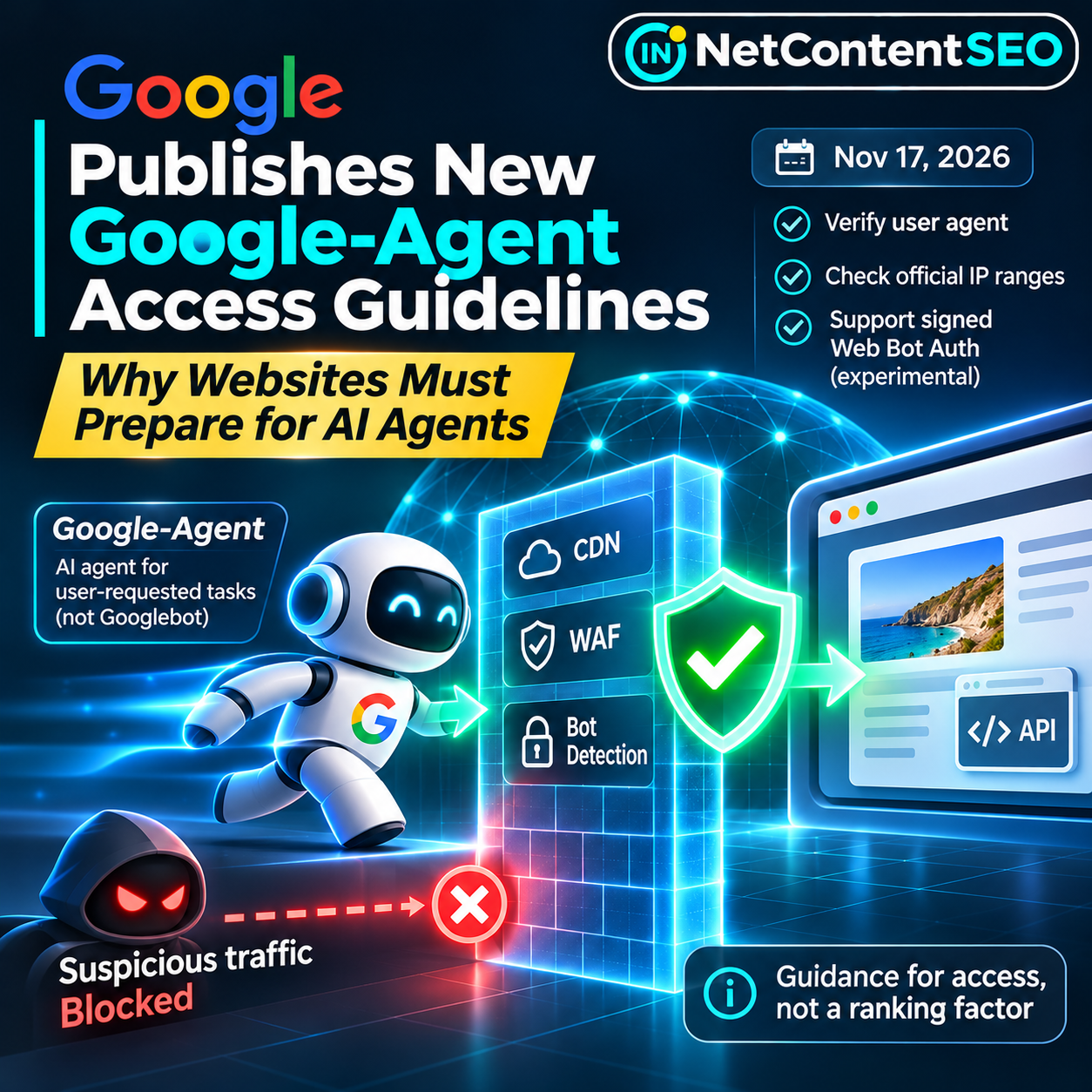
Google has published official technical guidance for websites that want to allow its user-triggered AI agents through CDNs, web application firewalls and bot-detection systems. Added to Google's crawling documentation on November 17, 2026, the guide explains how to verify Google-Agent traffic and avoid blocking legitimate user-requested web actions. It does not introduce a new ranking signal, and Google-Agent must not be confused with Googlebot.
What changed on November 17?
Google's official crawling documentation changelog records a new guide titled “Allow Google-Agent traffic.” Its purpose is to help publishers that choose to enable Google-Agent access. Barry Schwartz also covered the documentation update on November 17, noting that Google-Agent itself had already been documented earlier in 2026. The news is the new operational guidance, not the creation of the agent.
Google defines Google-Agent as an agent hosted on its infrastructure that navigates websites and performs actions at users' request. That may include interacting with on-site search, filters, detail pages, shopping carts, booking interfaces and supporting API requests. It is different from Googlebot, the crawler used for ordinary Search discovery and indexing.
Google-Agent versus Googlebot: an essential distinction
Google categorizes Google-Agent among its user-triggered fetchers. Unlike Google's common crawlers, which follow robots.txt for automatic crawling, user-triggered fetchers generally ignore robots.txt rules because a user has initiated the fetch. This does not give an agent permission to bypass authentication or other access controls. It means robots.txt alone is not a reliable way to govern these user-requested interactions.
Blocking Google-Agent is not equivalent to blocking Googlebot. Conversely, allowing Google-Agent does not guarantee improved indexing, organic rankings, AI Overview citations or referral traffic. Site operators should make an explicit access decision based on the workflows they wish to support.
How to authenticate legitimate Google-Agent traffic
The official guide identifies two established signals: the HTTP User-Agent contains Google-Agent, and the source IP falls within Google's published user-triggered-agents.json ranges. The User-Agent string alone is not sufficient because it can be spoofed. The IP list should be synchronized as Google updates it.
Google is also experimenting with cryptographic authentication under Web Bot Auth. Participating requests use the identity https://agent.bot.goog and headers including Signature-Agent, Signature and Signature-Input. Their signatures can be checked against Google's published keys. However, Google explicitly says not every Google-Agent request is signed, so signature-only enforcement would reject legitimate unsigned traffic during the experiment.
Once a request is verified, Google recommends allowing it to bypass automated bot challenges that would prevent the agent from completing the requested task. That is a narrowly scoped exception to bot detection, not a reason to disable the WAF, remove application authentication or grant elevated privileges.
Why a simple allowlist may still fail
Google identifies six troubleshooting areas. First, rule priority matters: broad cloud-ASN blocks or managed bot policies may run before a Google-Agent allow rule. Second, CAPTCHAs and JavaScript challenges can remain active even after an HTTP-level block is removed. Third, access must cover the full user journey, including internal search, filtering, detail pages, XHR requests, GraphQL calls and relevant api.* endpoints.
Fourth, per-IP rate limits may misinterpret legitimate concurrency because multiple users' requests can share Google's egress addresses. Fifth, published IP ranges change and need updating. Sixth, reverse proxies and load balancers must preserve the original client IP and relevant identity and signature headers for verification. These details make the guidance particularly relevant to sites using CDNs, managed WAFs and multi-layer hosting.
Practical implications for Laravel and WordPress
For a Laravel website, the first step is to inspect existing CDN and WAF rules and server logs rather than adding an application-level bypass immediately. Verify Google-Agent at the trusted edge using the official IP ranges and, where supported, valid cryptographic signatures. Log the verification result and monitor whether public routes and their required API calls can be reached without interactive bot challenges.
For WordPress, the same principle applies to CDN services, security plugins and hosting firewalls. A legitimate agent may load a public article but still be blocked by a JavaScript challenge, a protected search endpoint or a restrictive API rule. Test a representative public user journey rather than merely checking whether the homepage returns HTTP 200.
In both environments, preserve normal authorization for admin panels, account pages, private data and actions that change records. Verification of an agent's identity is not authorization to access a user's private information or publish, purchase or submit forms without appropriate consent.
A safe implementation checklist
- Inventory the security stack: identify the CDN, WAF, bot manager, reverse proxy, origin firewall and application-level rate limits.
- Verify identity: match the User-Agent and Google's current official IP ranges; validate Web Bot Auth signatures when present and supported.
- Scope the exception: skip bot challenges for verified requests while retaining authentication, authorization and other relevant security checks.
- Test complete public journeys: check public content, site search, filters, pagination, detail pages and necessary API endpoints.
- Keep private routes private: do not exempt admin panels, account data, payment confirmation or write operations from their normal access controls.
- Review rate limiting: account for shared Google egress IPs without creating an unrestricted route for excessive traffic.
- Monitor and maintain: log blocked and allowed requests, watch for spoofed agents, refresh IP ranges and review the policy after WAF changes.
What this means for SEO, GEO and AI Search
The implications are indirect but important. Traditional SEO focuses on making pages discoverable, indexable and useful. Agentic access adds a different operational question: can an authorized AI assistant actually use a site's public interfaces to help a user complete a task? An agent may need to retrieve an article, filter a directory or inspect product details rather than merely read an indexed snippet.
For a travel publisher, that could mean allowing a legitimate agent to consult destination information and use public search filters. For an ecommerce site, it might mean accessing public product and availability data while still requiring normal approval and authentication for purchases. These are examples of potential use cases, not evidence that Google-Agent currently generates measurable revenue for either category.
Google has not announced that allowing Google-Agent improves Google Search rankings or guarantees citation in AI Mode. It also has not promised a dedicated Google Search Console report measuring these agent interactions. SEO teams should avoid conflating agent accessibility with crawlability by Googlebot or visibility in AI-generated answers.
What publishers should measure
Start with operational metrics: verified Google-Agent requests, blocked challenges, successful public route access, API failures, error rates and response latency. Where user privacy and platform reporting permit, analyze completed actions and qualified referral traffic separately. Compare before-and-after data carefully, accounting for configuration changes and unrelated traffic fluctuations.
The most useful question is not simply whether Google-Agent can reach the homepage. It is whether a verified agent can safely complete an intended public workflow without being mistaken for malicious automation—and without gaining privileges it should not have.
The bigger picture: websites built for both humans and agents
Google's November 17 documentation is a practical sign that the web is adapting to software agents acting on behalf of users. The infrastructure that once treated nearly all automation as suspicious now needs ways to distinguish verified, authorized activity from abuse. The emerging answer combines identity verification, selective challenge exemptions, preserved security boundaries and observable behavior.
For SEO and AI Search professionals, this is not a new ranking trick. It is a reason to coordinate technical SEO, application engineering and security so that useful public information and legitimate user journeys remain accessible in an increasingly agent-driven web.
Primary sources: Google: Allow Google-Agent traffic; Google Crawling Documentation Changelog, November 17, 2026; Google: User-triggered fetchers; Google: Web Bot Auth authentication; Search Engine Roundtable, November 17, 2026.