

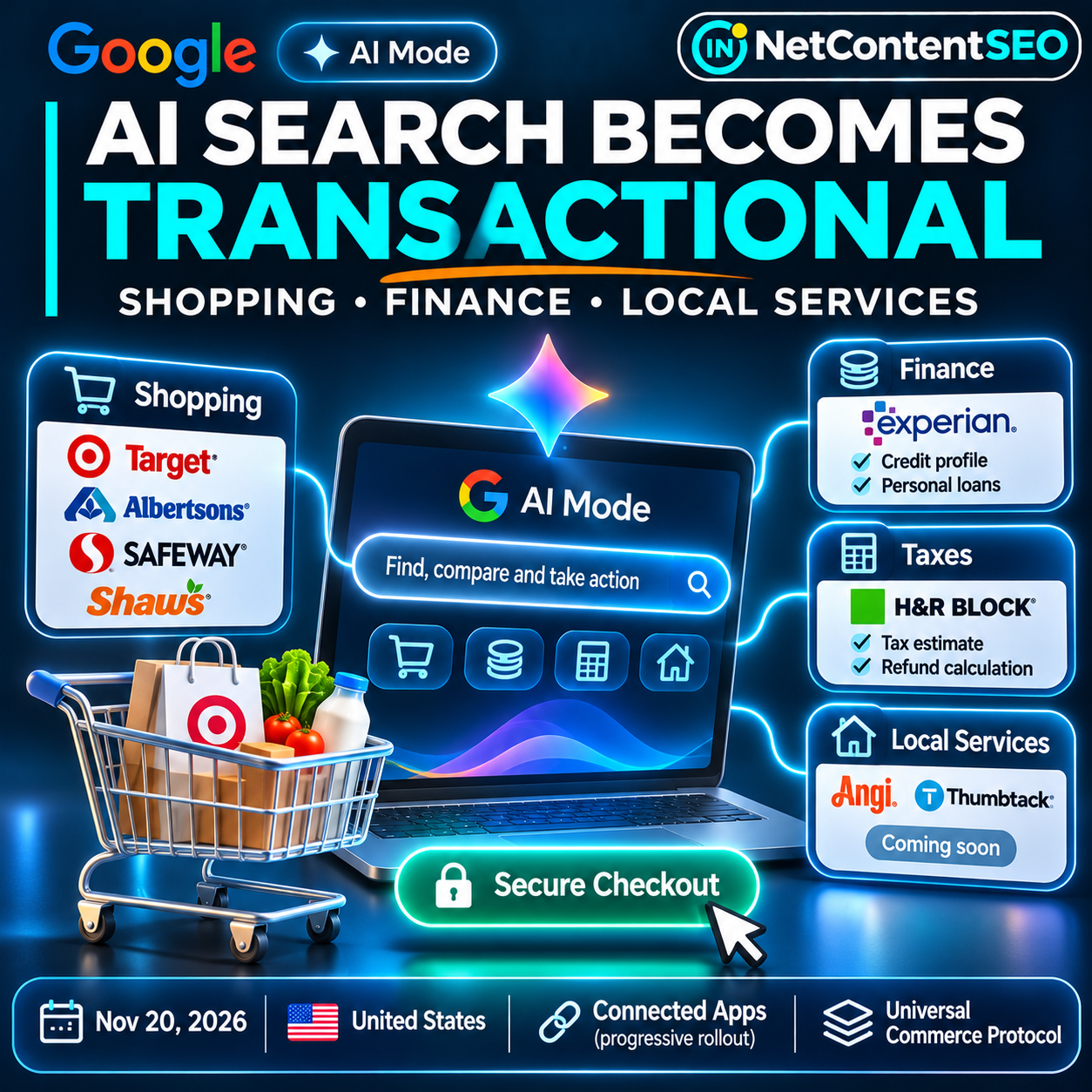

Google is expanding AI-powered Search from finding information to helping people complete commercial and service-related tasks. On November 20, 2026, the company announced new Connected Apps for groceries, personal finance, tax estimates and local home services. The rollout is focused on the United States and takes place in stages. For SEO and AI Search, this is a consequential development: businesses may increasingly compete not only to be found or cited, but also to be selected as a service through which an AI-assisted task can be completed.
What Google actually announced
Google's official November 20 announcement names four grocery retailers—Target, Albertsons, Safeway and Shaw's—whose Connected Apps are rolling out through Search and the Gemini app in the US. These integrations help users assemble grocery orders and proceed through checkout using the Universal Commerce Protocol (UCP). Google also announced that Experian, already available in Gemini, is rolling out in Search for credit information and personal-loan exploration. H&R Block can support tax calculations and refund estimates through Search. Angi and Thumbtack account connections for finding local professionals are expected in the coming weeks.
These announcements do not mean that every integration is already available to every American user, or that every task completes entirely inside one Google screen. Features, permissions, account connections and checkout handoffs vary by partner and rollout stage.
Shopping: from product discovery to checkout
For groceries, Google is using UCP to connect conversational discovery with order-building and checkout workflows. A user planning a holiday meal may ask for ingredients, assemble a shopping list and move toward purchasing them from a participating retailer. The integration shortens the path between deciding what to buy and beginning the transaction.
This is not Google's first agentic-commerce initiative. Earlier in 2026, the company introduced UCP-powered commerce experiences and expanded its merchant integration tools. The November release adds prominent grocery partners and positions the capability as part of everyday tasks rather than only product comparison.
For retailers, the operational questions are practical: can product availability, price, variants, delivery options and checkout requirements be represented accurately in connected systems? A merchant's website content still matters, but an agent may also rely on structured feeds, commerce protocols and authenticated partner integrations. The precise selection mechanisms for these new grocery flows have not been fully disclosed.
Finance: Experian moves from Gemini into Search
Experian was already accessible as a Connected App in Gemini. Google now says it is rolling out in Search, allowing eligible US users to check their credit rating and explore personal-loan options. This is a particularly sensitive category because results may depend on personal financial information and linked accounts.
The announcement should not be interpreted as Google itself becoming a lender, guaranteeing loan approval or providing a universally available credit report. The service operates through the named partner and applicable user permissions. Consumers should review the underlying provider's terms, eligibility requirements and disclosures before acting on financial recommendations.
Taxes: H&R Block supports calculations and refund estimates
Google also highlights H&R Block as a Connected App for calculating taxes and estimating refunds directly through Search. The example shows how a conversational interface can lead into a specialized service that performs a domain-specific task rather than simply returning general advice.
A tax estimate is not a finalized return, and the November announcement does not establish that the integration files taxes automatically for every user. Accuracy depends on the information supplied, the applicable tax rules and the provider's supported workflow. This is another example of why agentic products need clear consent, reliable data and explicit boundaries between estimates and completed transactions.
Local services: Angi and Thumbtack are next
Google says US users will be able to connect Angi and Thumbtack accounts to Search in the coming weeks. The intended use cases include finding professionals for household jobs such as repairs and seasonal installations. These are announced future integrations, not features that should be described as universally live on November 20.
For local businesses, this may be one of the most important areas to watch. A consumer might ask an AI assistant to find an available professional who matches a specific task, location, budget and schedule. A provider's chance of being considered could depend on data held by the connected marketplace, not just a traditional organic search listing. Google has not disclosed a universal ranking formula for these partner selections, so claims that any particular optimization guarantees inclusion would be speculative.
How the Connected Apps architecture works
The November announcement builds on Google's Connected Apps Platform preview announced October 28, 2026. Google says developers can integrate through a cloud-hosted Model Context Protocol (MCP) server or Android MCP using AppFunctions APIs, then register, test and submit the integration in the Google Connected Console. Developers can choose Search, Gemini or both as intended surfaces, subject to review and rollout availability.
Google says the platform supports management of verified branding and authenticated accounts, alongside operational metrics such as traffic, latency and error rates. Access is opening in phases; this is not yet a self-service guarantee that any business can publish a Connected App immediately. The platform creates a route for services to expose capabilities to AI interfaces, but approval and actual distribution remain distinct steps.
What changes for SEO and AI Visibility?
There is no announced change to Google's organic ranking algorithm in this release. The development concerns connected services and task completion. Its strategic importance is that discovery, recommendation and action can occur within a single AI-assisted journey.
Traditional SEO asks whether a page appears for a relevant query and whether the user clicks. GEO and AI Visibility also examine whether a brand is mentioned, cited or recommended in generated answers. Agentic commerce introduces a further question: can the service actually fulfill the user's request through an authorized integration?
These are separate outcomes. A company may rank organically without being a Connected App partner. A partner may be available for transactions without being cited in every AI answer. A mention or recommendation may not produce a measurable website session. Publishers and businesses should avoid treating all of these signals as interchangeable.
From search visibility to agent selection
The emerging user journey can be described in four stages: discovery, evaluation, service selection and execution. An AI assistant may interpret a request, gather relevant options, choose a supported service and guide the user toward completing the task. At each stage, different information may matter.
For product merchants, accurate catalog feeds, availability, fulfillment rules and structured offer data can support reliable transactions. For local service providers, current service areas, categories, qualifications, pricing context and scheduling information may be important. For financial and tax services, verified identity, consent and regulatory compliance become central. These are practical readiness factors, not a published Google Connected Apps ranking checklist.
Implications for independent websites and publishers
Independent websites should not conclude that conventional SEO is obsolete. Useful pages, original information, trustworthy sources and clear site architecture still help people discover and evaluate services. But a business whose main value is completing a task may also need an integration strategy: a usable API, an approved marketplace relationship, a reliable booking or checkout flow, or another means for authorized agents to interact with its services.
For a destination website, an agent might research a place, compare transport options and eventually connect to a booking partner. For a local directory, the important distinction may be between displaying a provider's profile and actually confirming availability or requesting a quote. These are illustrative future workflows, not functionality Google has promised for every website.
Content publishers should also monitor whether AI-assisted completion reduces the number of intermediate website visits. That is a plausible risk, not an effect measured in Google's November 20 announcement. The real impact will depend on partner coverage, user adoption, handoff design and attribution.
A practical preparation checklist
- Map the customer journey: identify which user questions lead to information gathering, comparison, booking, purchasing or other actions.
- Improve source accuracy: keep prices, service descriptions, eligibility, opening hours, availability and policies current.
- Review structured systems: check product feeds, booking integrations, APIs and relevant structured data without assuming one markup format guarantees selection.
- Assess integration options: follow Google's Connected Apps developer preview and relevant partner ecosystems, recognizing that access is phased.
- Preserve trust and security: require appropriate authentication, consent and confirmation for sensitive or consequential actions.
- Measure distinct outcomes: separate organic traffic, AI citations, Connected App usage, referrals and completed transactions wherever reporting permits.
- Test realistic tasks: examine whether a user can progress from a question to an accurate, authorized result without losing essential information.
What remains unknown
Google has not published a universal formula for how its AI systems select Connected Apps or choose among competing providers. It has not shown how these integrations affect organic click-through rates, publisher traffic or customer-acquisition costs. Availability remains limited by market, account eligibility, partner and rollout stage. Nor has Google announced that businesses can obtain Connected App placement simply by adding a schema property or allowing a particular crawler.
The larger shift: Search becomes a place to get things done
Google's November 20 expansion illustrates a fundamental evolution in AI Search. The search interface is becoming a starting point for tasks that previously required visiting multiple websites and apps. Grocery shopping, credit research, tax estimates and local-service discovery are different activities, but they share a common architectural direction: connect an AI interface to specialized services capable of taking action.
For SEO professionals, the next challenge is not to abandon rankings or citations, but to understand how brands and services remain discoverable, trustworthy and usable when an AI assistant becomes an intermediary between the customer and the business. The companies best prepared for this transition will combine high-quality public information with accurate operational data and safe, permission-based ways to complete real tasks.
Primary sources: Google, “Get your year-end tasks done with new Connected Apps,” November 20, 2026; Google, “Build and manage Connected Apps in one place,” October 28, 2026; Google, “Connect more of your apps to Search,” July 16, 2026; Google, agentic commerce and Merchant Center updates, September 16, 2026.