

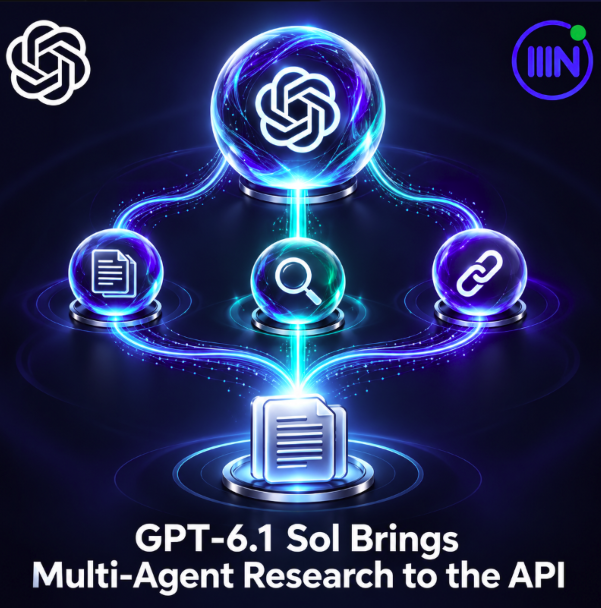

OpenAI’s October 2 guide documents a developer workflow with practical relevance for SEO research: GPT-6.1 Sol can delegate independent work to subagents in the Responses API and combine their findings. The multi-agent capability remains in beta. The announcement is documentation of a supported approach, rather than evidence that a particular monitoring application has already improved its results.
The GPT-6 model guide places delegation alongside asynchronous tool calling and mid-turn steering as ways to manage longer tasks. Together, they create options for separating independent investigation from work that must wait for evidence. The useful distinction is between doing more work concurrently and reaching a more reliable conclusion.
Three capabilities solve different problems
The multi-agent documentation includes GPT-6.1 Sol examples with delegation enabled and a configurable concurrent-subagent limit. Developers need the documented beta interface. This is not a claim that every model request automatically creates a research team or that adding agents guarantees a faster end-to-end result.
Asynchronous tool calling lets independent work continue while the application runs a slower tool and returns its result later. A downstream conclusion still needs the actual result. For a research system, that means a pending crawl or data query can coexist with another task without being treated as completed evidence.
Mid-turn steering allows updates through a Responses API WebSocket connection while a response is running. OpenAI states that steering does not rewrite output already sent, undo earlier actions or cancel tools that have started. A correction therefore changes the direction of ongoing work without erasing its execution history.
A practical pattern for SEO monitoring
Consider a monitoring application investigating a reported change to an AI-search product. One branch could check official documentation, another inspect available examples and another compare the observation with historical records. These are proposed uses of the architecture, not performance results published by OpenAI for SEO applications.
The coordinator would need to bring those branches together with explicit evidence labels. An official announcement, a screenshot and an analyst’s interpretation have different authority. If several agents repeat the same underlying news report, the final system should recognise a shared source rather than count those repetitions as independent confirmation.
Citation analysis could follow a similar structure. Separate workers might examine source identity, claim support and changes across a recorded prompt sample. The final review would still need to preserve the prompts, dates and observation conditions. Parallel execution helps organise the investigation; it does not remove the need to inspect whether a cited page supports the claim.
Evaluate completed research, not agent activity
For teams building these workflows, the meaningful comparison is a representative task completed with and without delegation. Measure the time taken, cost, missing evidence and quality of the final synthesis. A large number of tool calls or subagent summaries is activity, while a defensible answer is the outcome.
The application should also retain pending-tool state when instructions change. If a user narrows an investigation to one country while a broader data request is already running, the returned result may still arrive. The system needs to interpret it against the updated task rather than assume the update cancelled it.
This complements the broader shift toward managed research infrastructure. The new guide offers a concrete route for developers using GPT-6.1 Sol in the Responses API. For SEO and AI-visibility teams, the opportunity is to divide research sensibly and preserve its evidence through synthesis, while treating beta behaviour and application quality as matters to test.