

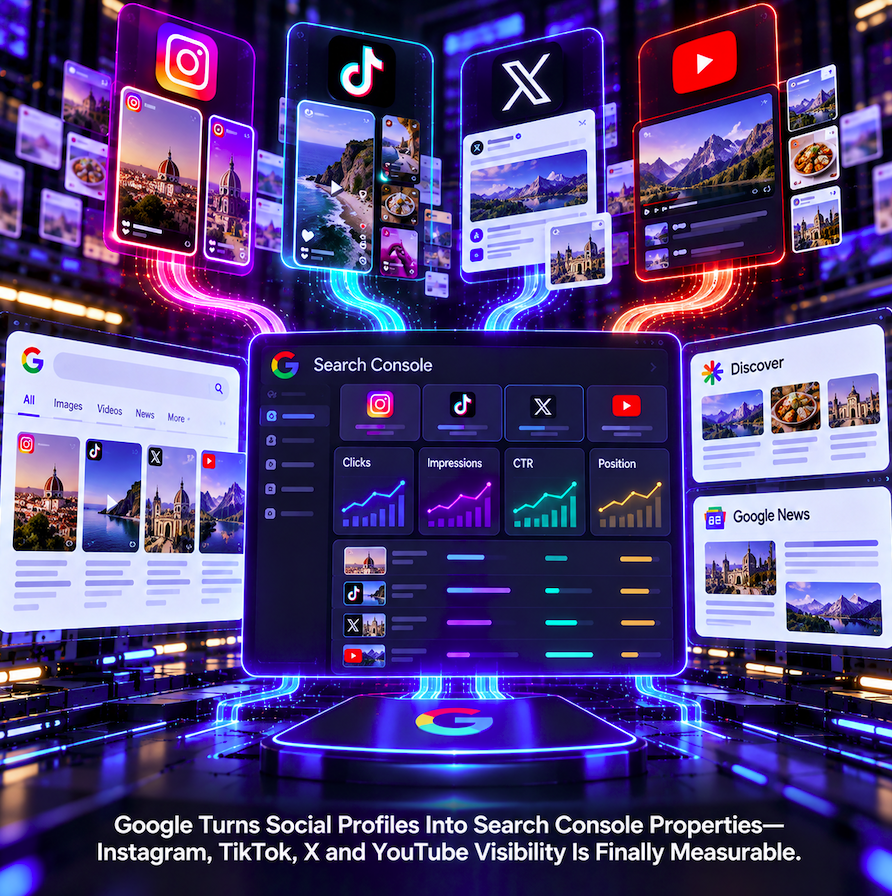

Google Search Console is no longer only an analytics product for websites. Creators and publishers can now add supported Instagram, TikTok, X and YouTube accounts as separate Search Console properties and measure how content published on those third-party platforms performs when Google surfaces it.
Google documents the feature in its official Search Console platform properties help page, dated July 29, 2026. The rollout remains gradual, so the option may not yet appear in every account. Where it is available, each social account or channel becomes its own property rather than being folded into the analytics for a publisher’s website.
The conceptual change is larger than the interface suggests. Search Console’s measurement boundary is expanding from URLs a publisher owns to content identities the publisher controls elsewhere. A creator can now ask a question that was previously difficult to answer with Google’s own first-party data: how visible are my Instagram posts, TikTok videos, X posts or YouTube content inside Google?
Each social account becomes a separate Search Console property
Google calls the new objects platform properties. Search Console currently supports four platforms: Instagram, TikTok, X and YouTube. A creator with accounts on several services must add each account separately; the same applies to organizations managing multiple profiles on one platform.
Ownership has to be verified. Google’s property setup documentation says verification can occur through an automated connection from an existing website property or through direct platform login. Search Console also periodically checks the connection for security. If the external authorization expires or breaks, access to the platform property pauses until the owner verifies it again.
After setup, Google says it can take several days for performance data to begin appearing. Newly created properties therefore do not instantly expose a complete historical social-search dataset; reporting starts as the platform property begins collecting and processing its metrics.
Clicks, impressions, CTR and position now apply to social content
The Performance report brings familiar Search Console metrics into the new property type: total clicks, impressions, average click-through rate and average position in Search. Publishers can drill into the content to identify which individual posts are driving discovery through Google.
This is not analytics for activity inside the social networks themselves. Search Console does not report how many times a TikTok video was shown in TikTok, for example. The property measures what happens when content belonging to that account is surfaced by Google.
That distinction makes platform properties particularly interesting for SEO teams. Social platforms have long supplied content to Google’s results, but measurement usually depended on referral analytics after a user left Google and reached an external destination. Search Console can now record the Google-side impression even when the content being ranked belongs to a third-party social platform rather than the publisher’s domain.
Instagram Stories can generate Search Console impressions and clicks
Google’s documentation gives an unusually concrete example with Instagram Stories. When a creator’s Story appears in Google Search, Search Console records an impression. If the user clicks the Story from the search result, the interaction becomes a click for the platform property.
This turns ephemeral social formats into measurable search assets when Google chooses to surface them. The Story may have been created for Instagram’s native audience, but its distribution can extend into Google Search and now leave a first-party measurement trail in Search Console.
For publishers, that creates a new analytical question: which formats designed for social feeds are also earning visibility from search? The answer can now be based on Search Console data rather than occasional manual SERP observations.
A video can count as a click even when the user stays in Google’s viewer
Video measurement exposes an even more important boundary. Google says videos shown in Search or Discover can generate impressions, and a user interaction can count as a Search Console click even when clicking the result opens the video in Google’s own viewer.
In other words, a click in a platform property should not automatically be interpreted as a referral session to YouTube, TikTok or another external platform. Search Console is measuring the interaction with the content result inside Google’s discovery environment, not necessarily an outbound browser navigation.
That nuance matters for analysts comparing Search Console with web analytics or platform-native traffic reports. A discrepancy does not necessarily mean one system is wrong. The products can be measuring different events and different destinations.
Discover and Google News can appear alongside Search
Platform properties are not limited to conventional Google Search reporting. Google says creators can also see performance in Discover and Google News when their content actually receives traffic from those surfaces. The relevant reports only appear when there is eligible activity to report.
This extends the feature from search analytics toward broader Google discovery analytics. A social post can potentially be measured as it moves through query-driven Search, recommendation-driven Discover or news-oriented distribution, depending on where Google surfaces it.
That broader distribution model connects directly with another recent Google change covered by NetContentSEO. Search Profiles can aggregate a publisher’s website and social identities, and following a Search Profile can make connected content more likely to appear for that user in Discover. Platform properties now provide a measurement layer for some of the same off-domain content ecosystem.
Search Console Insights adds a creator-level discovery view
The new properties also receive an Insights report. Google says it summarizes recent traffic trends, top-performing content and how users discover the platform’s content through Google Search. Goals can track milestones such as reaching a new total-click threshold.
There is an important reporting caveat inside Insights. Google says the primary summary card counts clicks across Google, including web, image, video and news search, while detailed lists beneath it focus specifically on traffic from web search results. As a result, the numbers in the detailed cards can be lower than the headline total without indicating missing data.
This is another reminder that Search Console increasingly aggregates heterogeneous discovery experiences. A single headline number may combine interactions originating from different search types even when the diagnostic detail available beneath it covers a narrower surface.
This is different from Search Console’s experimental social channel insights
Google has also been testing social channel insights inside Search Console’s broader Insights experience, where it can identify channels related to a website and show metrics such as clicks, impressions, content and queries. That experimental feature should not be confused with platform properties.
A platform property is a first-class property selected and verified for a supported Instagram, TikTok, X or YouTube identity. It can be managed independently in the property selector. The experimental social-channel module, by contrast, is an insight associated with a site and Google says users currently cannot freely choose arbitrary channels for that experiment.
The distinction matters because platform properties change Search Console’s underlying asset model. Google is not simply adding a social widget to a website dashboard; it is allowing a third-party platform identity to become the primary object being measured.
Search Console is expanding beyond the domain as the unit of SEO
Historically, Search Console’s organizing principle was ownership of a web property. SEO teams verified a domain or URL prefix, then analyzed how pages under that property performed in Google. Platform properties loosen that connection between search visibility and domain ownership.
The publisher still has to prove control, but the asset can now be instagram.com/username or an equivalent supported account rather than a site hosted by the publisher. The content remains on the platform, while Search Console provides Google-side performance data to the creator who owns the account.
That reflects the reality of modern search results. Users encounter videos, social posts, profiles, images and short-form content alongside conventional webpages. If Search Console measured only publisher-owned domains, an increasing portion of a brand’s actual Google visibility would remain outside its primary search analytics system.
Multimodal search makes social measurement even more relevant
The timing also intersects with Google’s expansion of visual discovery reporting. NetContentSEO recently covered Search Console’s new multimodal reporting for Lens and other image-led search experiences. Google says those insights can extend to supported platform properties, including social accounts, where applicable.
Together, the two developments broaden Search Console along two axes at once. The input to search is expanding beyond typed text toward images and multimodal queries, while the content being measured is expanding beyond publisher websites toward third-party creator platforms.
That combination makes traditional website-only visibility reporting increasingly incomplete for brands whose discovery footprint spans social video, visual content and conventional pages.
Social SEO can finally be measured from Google’s side of the result
The feature gives marketers a cleaner way to separate native social success from Google discovery. A TikTok post can perform poorly inside TikTok yet receive meaningful Google impressions; another can go viral on the platform while remaining effectively invisible in Search. Until now, those two distribution systems were difficult to compare using first-party Google performance data.
Platform properties create a measurement surface specifically for the Google side. Teams can identify posts earning impressions, compare CTR, inspect query-driven discovery and observe whether visibility is concentrated in Search, Discover or News where those reports are available.
That does not mean Search Console becomes a universal social analytics suite. It does not replace Instagram Insights, TikTok Analytics, X Analytics or YouTube Studio, because it does not measure native feed distribution and engagement. Its role is narrower and strategically distinct: it measures how social content participates in Google’s ecosystem.
The reporting boundary now follows the creator, not only the website
For years, SEO reporting implicitly treated the publisher’s domain as the container for organic visibility. Google’s platform properties challenge that assumption. A creator’s searchable footprint can now be divided into multiple independently measurable assets: the website, Instagram account, TikTok account, X account and YouTube channel.
That makes cross-platform search visibility easier to audit, but it also makes attribution more nuanced. A click can open a Google-hosted video viewer rather than leave Google. An Instagram Story can register an impression. Discover can distribute a social asset outside a conventional query. And each account maintains its own property rather than being automatically merged with the publisher’s domain.
The practical implication is that “Google organic visibility” is becoming a property portfolio rather than a website metric. For creators and brands that publish substantially on social platforms, Search Console can now reveal a portion of search demand that previously sat outside the domain dashboard.
Google is still rolling the feature out, so access is not universal. But the measurement model is already documented: Instagram, TikTok, X and YouTube identities can become Search Console properties in their own right. Social content has been part of Google Search for years; now its owners can finally measure that visibility from inside Google’s own search analytics product.