

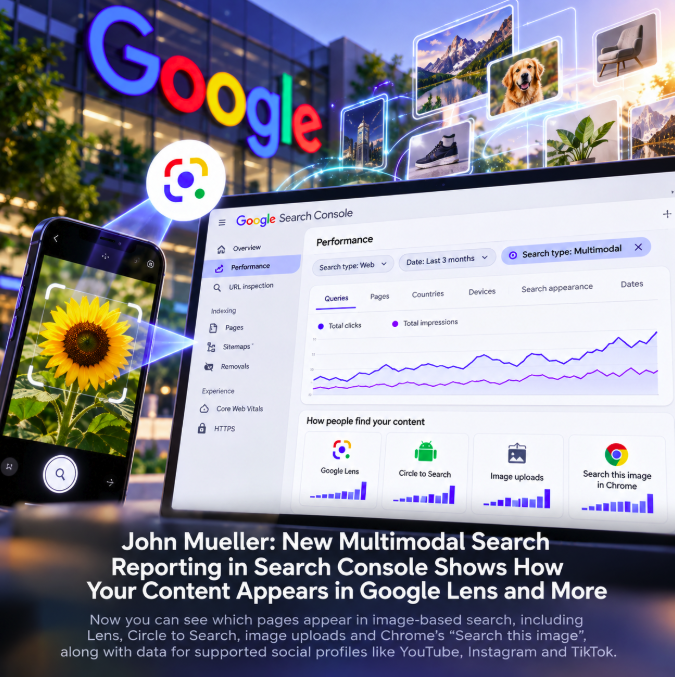

Google is giving publishers and SEO teams a clearer view of a part of search that has traditionally been difficult to measure: discovery that begins with an image rather than a typed query. The company has introduced web multimodal search reporting in Google Search Console, allowing site owners to analyze how their content appears when people use visual search experiences such as Google Lens, Circle to Search on Android, image uploads to Google Search and Chrome’s “Search this image” feature.
The update, announced on September 24, 2026, is rolling out globally and adds a new multimodal search type filter to Search Console’s performance reporting. According to Google Search Central’s official announcement, the filter is available in the Performance report for Search results as well as the report covering generative AI features. Publishers can also export the data for analysis in other tools, bringing visual discovery into workflows that have historically focused on text queries, clicks and conventional search appearances.
Visual search becomes measurable
The practical importance of the change is straightforward: a user no longer needs to describe an object in words before Google can connect that intent with web content. Someone can point a smartphone camera at a product, use Circle to Search on something visible on their screen, upload an image or search directly from an image in Chrome. Until now, publishers had limited first-party visibility into how these behaviors translated into exposure for their own pages. The new reporting gives them a dedicated way to examine that traffic inside Search Console.
That makes the update particularly relevant for ecommerce sites, retailers, travel publishers, food and recipe websites, fashion businesses, design platforms and any other property where images carry substantial informational or commercial value. Product photography, image quality and image accessibility have long mattered to users, but multimodal reporting gives teams another dataset they can use when deciding where visual optimization deserves investment.
John Mueller of Google’s Search Relations team highlighted precisely that point when discussing the launch: the metrics may give site owners additional evidence when making the case for improving product images and ensuring that visual assets can be properly discovered. The reporting does not turn image optimization into a new shortcut for rankings, but it does make the contribution of visual assets easier to investigate.
What publishers can learn from the new filter
Once multimodal data is available for a property, publishers can use it to understand which pages are being surfaced through image-led searches and compare that performance with other search activity. Over time, this can help identify pages whose visual content is generating discovery that might have been obscured inside broader performance totals. It can also expose a gap between pages with strong products or information and weak visual presentation.
The most useful interpretation will likely come from combining the new metrics with page-level analysis rather than treating multimodal search as an isolated channel. If a product page receives meaningful visual-search exposure but relatively few clicks, for example, the next questions should concern the quality and relevance of the imagery, the page experience, the surrounding product information and whether the page satisfies the intent suggested by the image. Conversely, pages that consistently perform well in multimodal discovery may offer clues about the kinds of imagery Google can successfully connect with users’ visual searches.
Google says the data will begin appearing when a site actually receives traffic from multimodal queries, so the absence of metrics should not automatically be interpreted as a technical problem. The rollout is global, but the amount of useful data will naturally depend on a property’s content and how often users encounter it through supported visual-search experiences.
Search Console is expanding beyond traditional websites
There is another notable dimension to the announcement: these insights are not limited to conventional website properties. Google says multimodal reporting can also be available for supported platform properties, including YouTube, Instagram and TikTok accounts. That fits a broader expansion of Search Console toward measuring content that creators publish on third-party platforms rather than exclusively on domains they operate themselves.
Google’s documentation for social and video content in Search Console explains that creators can add and verify supported accounts and analyze how posts and videos are discovered through Google. The available reporting can include traffic trends, top-performing content, search queries, geographic information and other performance dimensions. Bringing multimodal search into this environment makes Search Console more relevant to creators whose discoverability depends on both Google and social platforms.
Images are becoming part of the search interface
The larger shift behind the update is not simply a new Search Console filter. Search itself is becoming increasingly multimodal, with text, images, cameras and AI-driven interfaces converging around the same discovery process. For publishers, that means the assets surrounding an article or product can no longer be treated purely as decoration. Images can function as searchable information and as entry points into a website or platform profile.
This does not eliminate established SEO fundamentals. Pages still need to be accessible, useful and technically understandable, and Google continues to emphasize solid SEO foundations even as generative AI and newer search interfaces evolve. Its current guidance for generative AI features similarly recommends focusing on useful, reliable content and sound technical practices rather than looking for special-purpose optimization tricks.
What changes with multimodal reporting is measurement. Teams can now start separating visual-search activity from the rest of their Search Console data and test assumptions with first-party performance information. For organizations that have struggled to justify better photography, cleaner product imagery or more deliberate image optimization, that visibility could turn a subjective design discussion into a measurable search-performance conversation.
A new dataset for the visual web
Search Console has steadily evolved from a tool centered on blue-link search performance into a broader measurement layer for a changing Google ecosystem. Multimodal reporting is another step in that direction. It acknowledges that users increasingly search by showing Google what they mean rather than typing a description of it.
For site owners, the immediate task is simple: check the new multimodal search type filter, determine whether meaningful data is already available and identify which pages or visual assets are participating in this form of discovery. The deeper opportunity is to use those findings to understand where images are not merely supporting content, but actively helping users find it.