

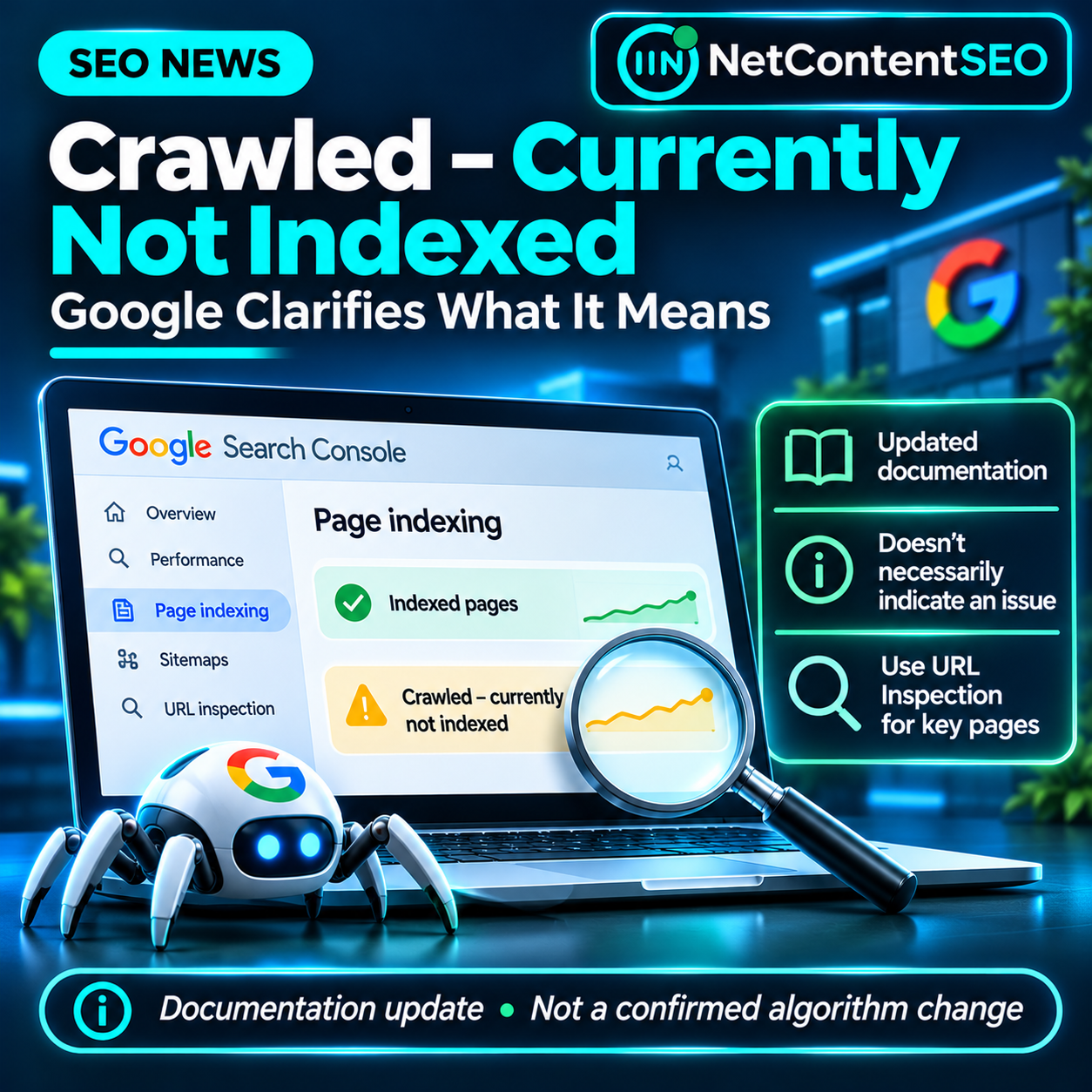

Google has revised its Search Console documentation for the “Crawled – currently not indexed” status, making a distinction that matters for websites with hundreds or thousands of URLs: a page can be successfully crawled without being selected for Google's index, and that outcome does not automatically mean something is broken.
Barry Schwartz reported the documentation update on November 3, 2026, in Search Engine Roundtable. The change expands Google's explanation and provides guidance for investigating important pages. It does not, on its own, establish that Google changed its indexing algorithm, reclassified existing URLs or modified Search Console reporting.
What changed in Google's explanation?
Previously, the help text explained that Google had crawled a page without indexing it, that indexing might happen later, and that resubmitting the URL for crawling was unnecessary. The revised description explicitly states that Google does not index every page it discovers and that this status is common across many sites. It also makes clear that the status alone does not necessarily call for action.
For pages that are important to a website, the updated guidance points owners toward the URL Inspection tool and other diagnostic methods to identify issues that might prevent appearance in Search. Google also directs site owners who have completed a thorough investigation and suspect a complete site-wide indexing bug toward its dedicated issue-reporting form.
This is a more actionable description of a familiar indexing state, not evidence of a newly introduced indexing rule.
Crawling is not indexing
Google's crawling systems retrieve pages and discover their content. Indexing is a separate process in which Google evaluates whether content should be stored and made eligible for search results. A successful fetch does not guarantee that a URL will be indexed, even when it returns HTTP 200, appears in an XML sitemap and contains a self-referencing canonical tag.
Google's crawling and indexing FAQ has long warned that crawling and indexing depend on multiple factors and that sitemap submission does not guarantee inclusion. The November documentation change reinforces that established principle.
When should SEOs investigate?
Context determines urgency. A handful of excluded tag pages, redundant parameter URLs or near-duplicate archive views may not warrant any intervention. Conversely, important product categories, unique editorial articles or primary service pages remaining excluded over time deserve investigation—especially if the pattern grows or affects most of a site.
For each priority URL, inspect its latest crawl information, HTTP response, indexability directives, canonical signals and rendered content. Use Google's URL Inspection tool to review the stored crawl information and, when appropriate, perform a live test. A live test can confirm certain accessibility conditions but does not guarantee future indexing or reproduce every part of Google's indexing decision.
Next, examine whether the page offers distinctive value compared with other pages on the same site and across the web. Review internal links, content overlap, template repetition and whether important pages are discoverable through meaningful navigation rather than XML sitemaps alone. Server logs can help establish whether Googlebot has fetched the pages and encountered access or rendering issues.
How to approach large-scale indexing exclusions
On large sites, the total number of “Crawled – currently not indexed” URLs is less informative than the distribution of affected page types. Segment excluded URLs by template, directory, publication date, internal-link depth, canonical pattern and business importance. A sudden concentration in one template may indicate a technical or content-system issue; a stable set of intentionally low-value URLs may not.
Build representative samples for diagnosis, then validate whether the findings generalize across the affected groups. Look for patterns in duplicate titles, near-identical descriptions, thin pages, empty rendered sections, inconsistent canonicals and internal links that lead to low-value variations. Avoid making mass changes based solely on one example URL.
Track the number and proportion of important, indexable URLs that actually enter the index over time. Compare changes with deployments, migrations and template modifications. Be careful with Search Console's reporting delays and sampling limitations: a change in the report is not always a same-day change in Google's index.
What not to do
Repeatedly submitting unchanged URLs for indexing is not a substitute for fixing discoverability, duplication, rendering or content problems. Nor should every excluded URL be rewritten simply because Search Console lists it. Adding more XML sitemaps, changing lastmod dates without real updates or forcing more crawl requests does not guarantee indexing.
Similarly, do not treat the new documentation as proof of a broad Google indexing incident. Google's Search Status Dashboard is the appropriate place to check acknowledged incidents, while a site's own diagnostics remain essential for understanding its specific indexing patterns.
Does this affect SEO rankings or AI visibility?
The documentation change itself is not a ranking update. However, the underlying distinction between crawling and indexing remains central to organic visibility: a URL that Google has not indexed cannot rely on that URL's ordinary indexed listing to attract traffic from Google Search.
AI visibility requires separate measurement. A page's absence from the traditional index does not, by itself, prove anything definitive about every AI product's retrieval or citation behavior. Teams should avoid converting a Search Console indexing status into an unsupported claim about all LLM visibility.
The practical takeaway
Google's updated wording is a reminder to prioritize diagnosis over alarm. “Crawled – currently not indexed” is a status, not a complete root-cause analysis. For low-priority or redundant pages, it may be normal. For commercially or editorially important URLs, it is a reason to investigate the specific page and the wider template or site context.
The important change is in Google's explanation, not a confirmed change to how indexing works. SEO teams should use the clearer guidance to distinguish harmless exclusions from genuine problems rather than treating every non-indexed URL as a technical failure.