

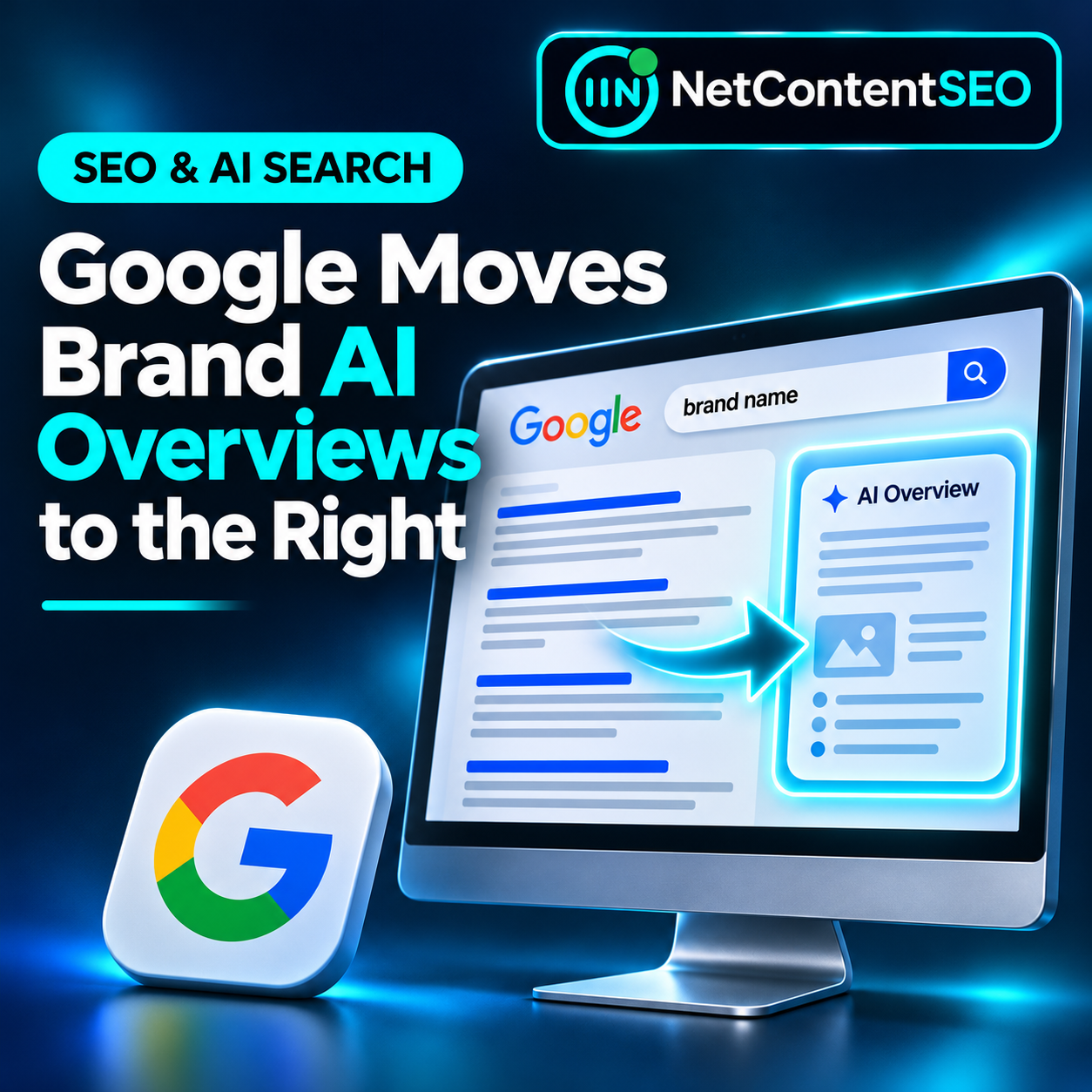

Google is displaying AI Overviews for some brand-name searches in the right-hand column of desktop search results, in a position long associated with Knowledge Panels. The layout was documented by SEO professionals in late October and reported by Barry Schwartz at Search Engine Roundtable on November 2, 2026, with further coverage from PPC Land on November 3. Google has not announced a worldwide launch, and the observations do not establish whether this is an experiment or a lasting design change.
What observers found
Chris Long shared examples of branded desktop searches showing AI-generated summaries on the right rather than above the main organic results. David McSweeney had noted similar variations on October 31. Reported examples include Apple, Zillow, Coca-Cola and Google. Previously, AI Overviews for these queries could occupy the top or middle of the central results column. The right-side placement can give organic results more vertical room in the primary column, while shifting the AI-generated description toward the space users associate with brand identity and factual summaries.
Importantly, a screenshot of one layout is not proof that every user, location or brand sees it. Search interfaces are personalized and subject to ongoing testing. The observed examples are desktop results, predominantly from the United States.
Why replacing Knowledge Panel territory matters
A traditional Knowledge Panel presents structured information about an organization, person or other entity. An AI Overview instead synthesizes a narrative from information available to Google's systems. The visual distinction may be subtle, but the editorial consequences are significant: the company itself does not directly author the AI summary, and its framing or source selection may differ from the organization's preferred description.
PPC Land highlighted a Zillow example where the generated narrative and nearby factual fields appeared to disagree about the company's founding year. Such inconsistencies underline the importance of verifying what an AI system says about a brand, rather than treating prominent placement as a guarantee of accuracy.
Does the new position change organic clicks?
It could, but there is not yet sufficient evidence to say how. An AI Overview moved out of the main column may leave more room for a brand's official website and other organic results. Conversely, a prominent right-hand summary may satisfy navigational or informational intent without a click, or draw attention away from the primary results. Screen dimensions, device type, query intent, advertisements and user behavior all matter.
Neither the practitioner screenshots nor the initial industry reports provide controlled click-through-rate measurements attributable to this specific layout. Claims of a traffic gain or loss would therefore be premature. Google Search Console also does not provide a straightforward layout-specific report that isolates right-column AI Overviews from other appearances.
Implications for SEO and AI Search visibility
The development makes brand-entity consistency more operationally important. Organizations should compare the AI-generated description with their official website, verified business information, structured organization data and reputable third-party references. Check names, product categories, founding dates, leadership, location, ownership and other high-salience attributes. Correct demonstrable errors at their sources where possible, rather than attempting to manipulate a generated answer through keyword repetition.
For technical SEO, maintain a clear, crawlable About page, consistent Organization structured data where applicable, accurate canonical URLs and discoverable pages explaining the company's products and services. For AI Search, prioritize attributable facts, unambiguous entities and corroboration across trustworthy sources. These are sound information-quality practices, not guaranteed mechanisms for controlling an AI Overview.
How to monitor the change responsibly
Track a stable set of branded queries across desktop and mobile, recording geography, language, date, viewport and whether an AI Overview appears in the main column, right column or not at all. Keep screenshots or SERP captures and separately record the sources cited by the summary. Compare branded impressions, organic clicks and landing-page engagement over time, while accounting for advertising changes, seasonality and ranking movement.
Where feasible, segment navigational brand searches from informational searches such as a brand plus reviews, pricing or support. A right-hand AI Overview may play a different role in each journey. Even then, observational correlations should not be described as causal proof.
A design change, not a confirmed ranking update
Google has not confirmed a global rollout or announced that organic ranking systems changed alongside this layout. The evidence supports a narrower conclusion: on some desktop brand searches, AI Overviews have been observed occupying right-column space associated with Knowledge Panels. That alone is noteworthy because it changes how a brand's identity is represented on the results page.
Bottom line: the immediate priority is to audit what Google's AI says about a brand and where that summary appears, then measure actual user behavior rather than assume a visibility impact. The right-hand column may become another important surface for AI-mediated brand discovery, but its long-term role remains uncertain.