

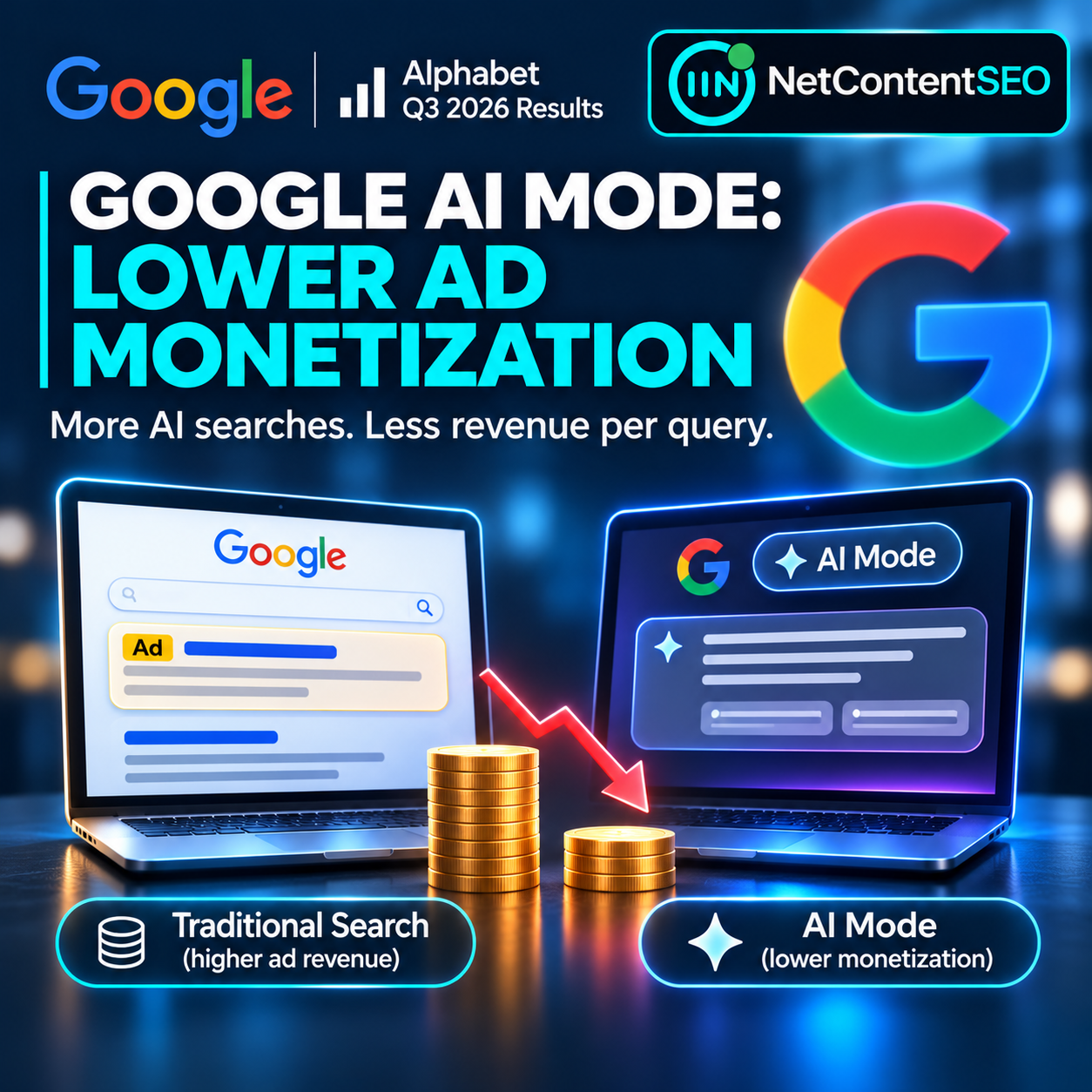

Google is facing an important commercial challenge in its transition from conventional search results to AI-powered answers. During Alphabet's third-quarter 2026 earnings call, Chief Business Officer Philipp Schindler acknowledged that rapidly growing usage of AI Mode was weighing on Search advertising growth because monetization in AI Mode remained lower.
That admission is significant precisely because it came alongside strong overall results. Alphabet reported consolidated third-quarter revenue of $127.6 billion, up 25% year over year. Google Search & other advertising revenue rose 12% year over year to approximately $63.35 billion. Search query growth, according to CEO Sundar Pichai, reached its fastest year-over-year rate in five years. Yet the new AI experience is not generating advertising revenue as efficiently as the mature search product.
What Google Actually Said
Responding to an analyst's question about why search revenue growth had slowed even as queries accelerated, Schindler cited several contributing factors. Foreign-exchange movements were the largest factor behind the sequential deceleration in Search growth, followed by industry-specific conditions in retail and media. He also pointed to the strong growth of AI Mode queries and the lower monetization Google was seeing in that experience.
This is a qualitative disclosure, not a published comparison of revenue per query. Alphabet did not disclose how much less an AI Mode query earns, nor the precise share of Search revenue affected. Claims that AI Mode earns a specific percentage less than classic search are not supported by the reported figures.
More Searches Do Not Automatically Produce More Advertising Revenue
The traditional search advertising model is built around a well-understood interaction: users enter queries, Google displays ranked results and advertisements, and advertisers bid for opportunities to reach people with identifiable intent. AI Mode changes the format. Queries can be longer, conversational, exploratory and multi-step, with answers synthesized across multiple sources.
That creates additional engagement, but it does not necessarily create the same number of commercially valuable ad placements per interaction. Many conversational queries occur earlier in a customer's research process, before a specific product or service is selected. Google's challenge is to convert that engagement into advertising opportunities without undermining the usefulness of the AI experience.
Google executives have argued that many AI Mode searches are incremental rather than replacements for conventional searches. That distinction is important: even if each AI Mode query currently earns less, additional queries can still represent future revenue opportunities. But it remains a company claim rather than a published independent measurement of incrementality.
AI Mode Is Not the Same as AI Overviews
One critical distinction is often lost in discussions of Google's AI Search business. AI Overviews are AI-generated summaries integrated into conventional search results. AI Mode is a more conversational, AI-first search experience. Google previously said AI Overviews monetize at approximately the same rate as comparable searches without them. That statement should not be applied automatically to AI Mode.
Schindler's October 2026 remarks concerned lower monetization in AI Mode. They do not establish that every AI-powered search feature generates less revenue, or that advertising in AI Overviews has suffered the same shortfall.
How Google Plans to Close the Gap
Google is expanding advertisements within AI Mode internationally and testing additional opportunities to show ads during follow-up questions in the United States. These multi-turn placements matter because a user may begin with broad research and only later express purchase intent. An ad introduced at the right point in that journey may be more useful and commercially relevant than an ad placed during the initial exploratory question.
Google also says its early ad experiments have produced encouraging results. It has described click-through rates for sponsored product listings in AI Mode as similar to those for organic product listings within that same environment. However, this is a limited comparison: it does not establish equivalent conversion rates, return on advertising spend or revenue per query relative to traditional search.
What This Means for Advertisers
Advertisers should not assume that more AI Search activity guarantees proportionate increases in paid traffic or sales. AI Mode changes both the context in which ads appear and the way users move from discovery to action. Campaign teams need to monitor commercial outcomes—qualified visits, leads, conversions, customer acquisition costs and revenue—rather than treating impressions or query growth as sufficient proof of performance.
There is also a transparency challenge. Google currently aggregates AI-powered search advertising with broader campaign reporting, limiting the ability to isolate every AI Mode placement. That makes careful testing, attribution and landing-page analysis particularly important as these experiences expand.
What This Means for SEO and Publishers
The implications extend beyond paid advertising. If AI Mode increases search engagement while changing how often users click through to websites, publishers face a different version of the same economic question: how does AI visibility translate into measurable value?
Google's disclosure does not prove that AI Mode is reducing all publisher traffic, nor does it quantify the effect on organic referrals. It does, however, show that Google itself is still refining the business model of conversational search. Publishers should track the gap between visibility, actual referrals and business outcomes, and invest in distinctive content and direct audience relationships that retain value beyond a generated summary.
The Bigger Shift: Search Is Becoming an Economic Experiment
For two decades, search advertising relied on a relatively stable relationship among user intent, ranked results, ad inventory and website visits. AI Mode introduces a more dynamic interface in which users can ask follow-up questions, compare options and potentially complete tasks without navigating through the same sequence of results pages.
That does not mean the existing search business is collapsing: Search advertising revenue is still growing, and Alphabet remains highly profitable. The more defensible conclusion is that Google's next search model is expanding faster in usage than in monetization efficiency. How quickly that gap closes will shape advertiser strategy, publisher distribution and the economics of AI Search itself.
Sources: Alphabet Q3 2026 earnings release, October 28, 2026; Alphabet Q3 2026 earnings call transcript; Search Engine Roundtable analysis, October 29, 2026.