

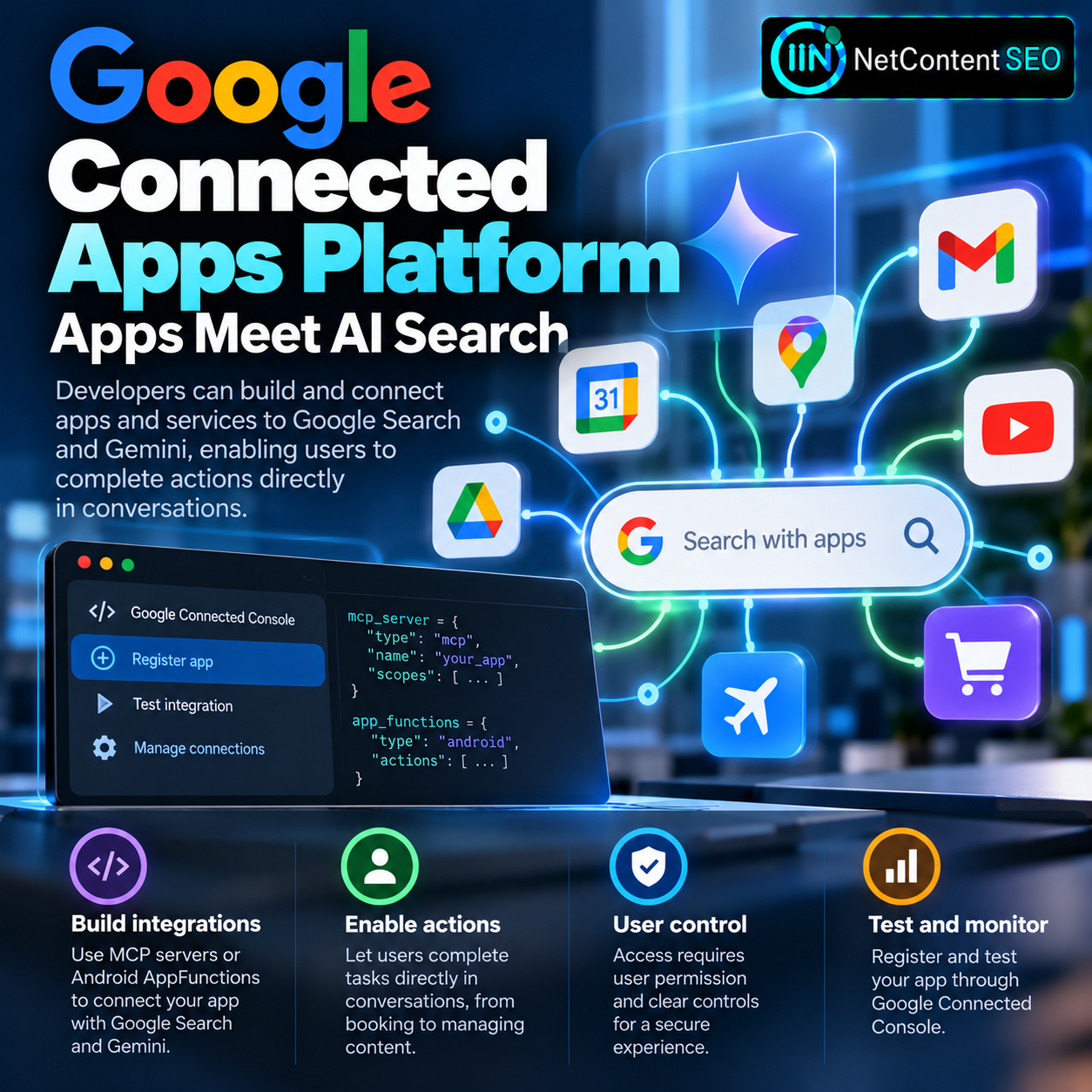

Google is opening a new route for third-party services to work directly inside its AI-powered search and assistant experiences. On October 28, 2026, the company announced the developer preview of Connected Apps Platform, a unified system for building, registering, testing and managing integrations that can be made available in Google Search, the Gemini app or both.
The development is significant for the evolution of AI Search because it shifts the focus beyond retrieving information. With authorized connections, users may be able to access personal account context and complete tasks through a conversational interface. However, this announcement does not describe an update to traditional organic search ranking algorithms or a new requirement for websites to rank in Google.
What Google announced on October 28
Google describes Connected Apps Platform as a way for developers to build an integration once and potentially reach users across multiple Google products. The company is opening access in phases, with more developers, markets and product surfaces to follow.
Developers can choose whether to submit an integration for Search, Gemini or both. Google also says it has launched more than 50 Connected Apps across its Search and Gemini experiences, spanning categories such as productivity, ticketing, fitness and other services. That figure is a combined ecosystem count, not proof that all 50 apps are currently available in Google Search.
Google's announcement names Adobe, Experian, Localiza and Peloton as partners whose integrations are live in Gemini, with Search availability expected in the coming weeks. Calm is another forthcoming integration for both Search and Gemini. Those planned releases should not be confused with integrations already live on every surface.
How Connected Apps Platform works
According to the official developer documentation, Google supports two main integration paths: a remote Model Context Protocol (MCP) server and an Android MCP path using AppFunctions APIs.
A cloud-hosted MCP server can expose a service's authorized data and tools to supported Google products. This means the assistant can request information or invoke actions provided by a third-party application, subject to the applicable authorization and integration controls. Android MCP uses the Jetpack AppFunctions approach to make supported Android app functionality available to intelligent assistants, including use cases where actions execute on a user's device.
These paths are different from traditional website crawling. A search engine discovering a public page does not automatically gain permission to operate a private account, place an order or change a calendar entry. Connected Apps rely on explicit service integrations and authorization.
Google Connected Console: register, test and publish
The Google Connected Console documentation explains the developer workflow. After preparing an integration, developers use the console to register their service, configure its public identity, connect endpoints, manage testers and submit a version for review.
The documentation covers requirements such as endpoint configuration, domain verification, metadata, testing and troubleshooting. Developers choose the intended Google product destinations before submitting their app for review. After an integration is live, Google says developers can monitor traffic, latency and error rates and maintain verified branding and authenticated account connections.
The presence of a submission process matters: building an MCP server does not guarantee that Google will approve an app or show it to every user. Availability depends on review, rollout stage, product surface and the user's ability to connect the service.
User authorization is central, not optional
Connected Apps are designed to let users link a service and then access its permitted data and actions through supported Google experiences. Google's documentation includes OAuth 2.1 guidance for secure authorization of remote services.
This is a major distinction from ordinary web search. An informational query can return public content without a user logging into the source website. An action such as changing a booking, reading private account information or updating a personal record requires appropriate authorization and safeguards.
Developers therefore need to consider least-privilege access, clear consent, data minimization, action confirmation and reliable error handling. These are implementation and governance considerations, not new Google SEO ranking signals.
What kinds of apps make sense?
Google's Connected Apps design guidelines favor capabilities that help users complete meaningful tasks, including bookings, scheduling, analyzing information and coordinating projects. The goal is not merely to reproduce static website content in another interface, but to provide functionality that adds value to a conversational workflow.
Consider a user researching a trip. A conventional search may show articles, hotel listings and booking websites. An authorized Connected App could potentially allow the user to interact with a travel service or complete an eligible action without switching through multiple pages. This is an illustrative application of the platform's capabilities, not a claim that a specific new travel integration has launched.
Similarly, productivity tools can support document workflows, scheduling or analysis when the relevant app is available and the user grants permission.
Connected Apps are not the same as organic SERP results
Barry Schwartz highlighted an important caveat in Search Engine Roundtable's October 28 coverage: an app being built does not mean it will automatically appear for searchers. Users must have access to the integration and connect it through the relevant personalized Google settings.
That difference is essential for SEO reporting. Traditional search optimization concerns discoverability, crawling, indexing, ranking and how public pages appear in search results. Connected Apps concern a different distribution mechanism: an approved, permissioned integration that can expose specific capabilities within an AI experience.
Google's October announcement does not say that Connected Apps replace normal web results, nor does it establish that connecting an app improves a website's organic ranking.
Why this matters for AI Search and agentic discovery
AI Search is increasingly associated with systems that do more than answer questions. An assistant may identify a need, gather information, call an authorized tool and help complete a transaction or workflow. Connected Apps Platform gives developers a standardized route to participate in some of those experiences.
For businesses, that introduces a second strategic question alongside content visibility: Can a service provide a useful, secure action when an AI assistant needs one? An app that reliably checks availability, retrieves authorized information or executes a well-defined task may have value in an action-oriented journey, even though its distribution is not governed by traditional keyword rankings.
However, the platform's announcement does not explain a universal algorithm for selecting among competing apps. It would be premature to promise that adding an MCP integration will produce traffic, citations, referrals or conversions. Measurement and user adoption will need to be observed over time.
What SEO teams should do now
For publishers whose main product is editorial content, this launch does not create an immediate requirement to build an app. Existing fundamentals—accessible pages, useful content, accurate structured information where appropriate and dependable site performance—remain relevant to conventional search.
For companies offering interactive services, the opportunity is more concrete. Teams can evaluate whether their products include repeatable actions that users might reasonably request in natural language, whether those actions can be safely exposed through MCP or Android AppFunctions, and whether their developers can meet the platform's registration and authorization requirements.
Businesses should also separate measurement of organic search performance from any future connected-app usage. Google Connected Console's traffic and reliability monitoring serves a different purpose from the impressions, clicks and positions commonly analyzed in search-performance reports.
Privacy, security and operational risks
Giving an AI assistant access to a third-party service creates potential benefits but also new responsibilities. Developers must ensure that the system acts only within granted permissions, avoids exposing private data and handles sensitive actions carefully. They should account for unexpected tool calls, stale account context, incomplete transactions and ambiguous user instructions.
Google's phased rollout and review process may help manage integration quality, but no approval system removes the need for security testing, clear consent and human oversight of consequential actions.
What remains unknown
Google has not announced general availability for all developers and markets. Nor does the October 28 announcement provide a comprehensive public explanation of how a user's request is routed among competing Connected Apps, whether a given integration will be recommended or invoked, or what commercial outcomes developers should expect.
Those unanswered questions matter for anyone attempting to forecast an app's visibility or return on investment. The current evidence supports a new developer platform preview and expanding partner ecosystem—not guaranteed distribution or a measurable shift in organic traffic.
NetContentSEO assessment
Google Connected Apps Platform is a meaningful step toward search experiences that combine answers with actions. By supporting MCP integrations, Android AppFunctions and a unified developer console, Google is making it easier for service providers to connect capabilities with Search and Gemini.
For SEO professionals, the key is to distinguish traditional organic search visibility from permissioned, app-based participation in AI workflows. They may increasingly intersect in the user's journey, but they are not the same channel, and Google's announcement does not establish a new organic ranking rule.
Organizations with transactional or account-based services should monitor the preview and evaluate secure integrations. Publishers and site owners should avoid treating the news as an urgent technical SEO change.
Primary sources: Google official announcement, October 28, 2026; Connected Apps Platform developer documentation; Google Connected Console guide; Connected Apps design guidelines. Additional reporting: Search Engine Roundtable, October 28, 2026.