


Google has refreshed its documentation on how website owners control the content they share with Search and AI-generated experiences. The official Google Search Central documentation changelog dates this update to October 21, 2026, not October 26. The October 26 entry concerns user-generated spam prevention and is a separate documentation change.
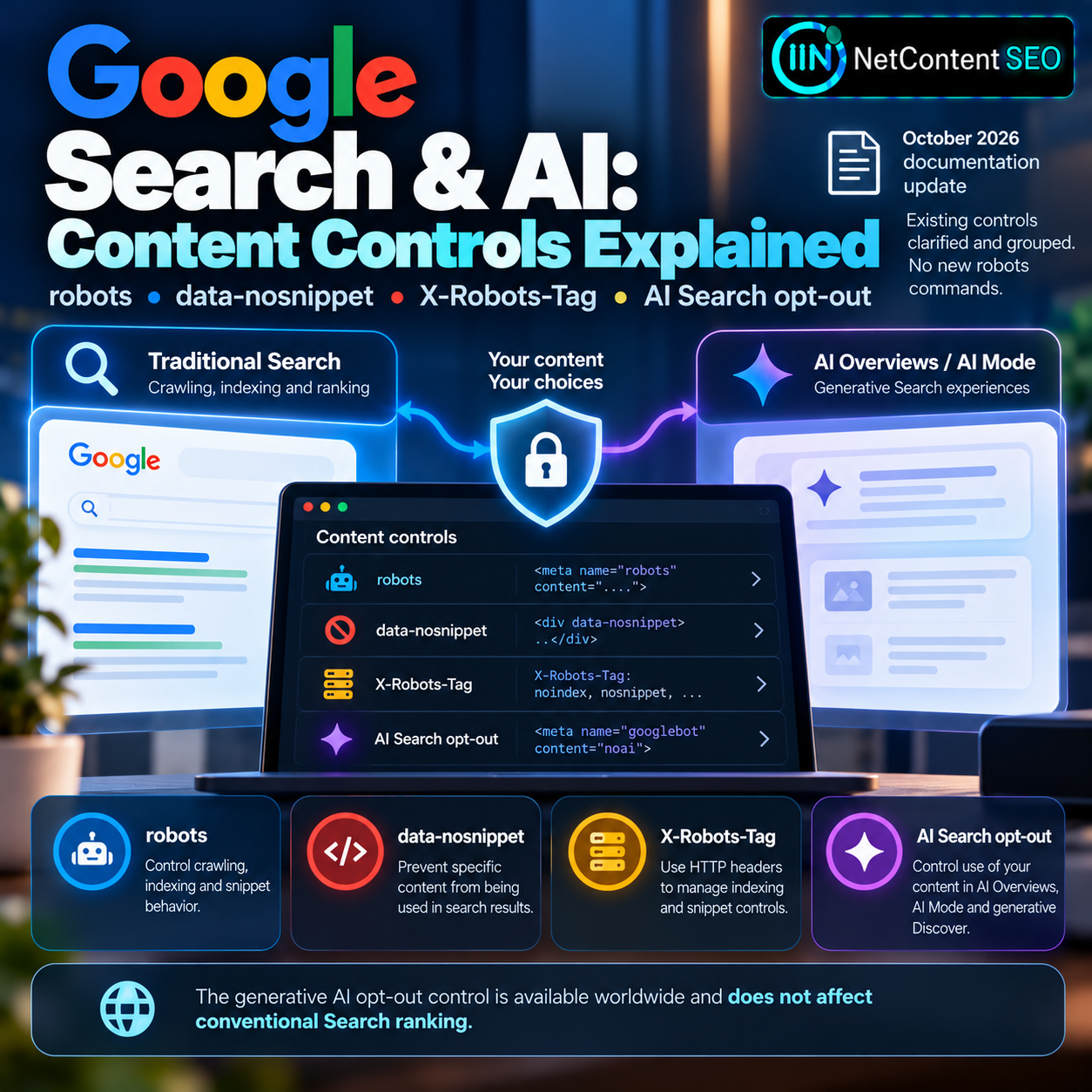
The October 21 revision brings together established options including the robots meta tag, data-nosnippet, X-Robots-Tag and Google's Search generative AI control. It is a clarification and consolidation of existing mechanisms, not the introduction of a new robots command or an organic ranking algorithm update.
There is, however, an important practical development behind the documentation: Google says its dedicated Search generative AI control became available to all websites worldwide on August 31, 2026. That gives verified site owners a property-level choice about participation in certain AI-powered Search experiences.
What exactly changed in Google's documentation?
Google's changelog describes the October 21 update as an expansion of its Control what you share with Google Search guide to cover options that already existed. The update explicitly names robots meta tags, data-nosnippet, X-Robots-Tag and the Search generative AI control, together with minor clarifications about the scope of Google Search.
Search Engine Roundtable and Search Engine Land covered the documentation revision on October 21. Their reports reinforce the distinction between a guide update and a feature launch.
The practical message is that publishers should understand which control affects indexing, which affects snippets and which governs inclusion in Google's generative AI features. These tools serve different purposes and should not be treated as interchangeable.
Robots meta tags: control indexing and previews
The HTML robots meta tag allows site owners to give search crawlers instructions about indexing and search-result presentation. For example, <meta name="robots" content="noindex"> tells compliant search engines not to index a page.
Other established directives, such as nosnippet or max-snippet, can affect the amount of text displayed in Search previews. These are not new October 2026 commands.
It is important to distinguish a robots meta tag from robots.txt. A robots.txt rule controls crawler access to paths; a robots meta tag can tell a crawler what to do with a page after it has accessed it. Blocking a page in robots.txt can prevent Google from seeing its noindex instruction, so combining the two without a plan can lead to unexpected results.
Data-nosnippet: exclude selected passages from snippets
The data-nosnippet HTML attribute lets publishers identify portions of visible page text that Google should not use in supported search snippets. It can be applied to supported HTML elements such as span, div and section.
For example, a page could wrap a sensitive but publicly displayed excerpt in <span data-nosnippet>...</span>. This is a preview control, not a guarantee that the content is confidential or inaccessible. Anyone who can load the page may still be able to read the underlying text.
Publishers should therefore not use data-nosnippet as a substitute for authentication, access controls or removal of truly private data.
X-Robots-Tag: HTTP-header control for pages and files
X-Robots-Tag communicates robots directives in an HTTP response header rather than an HTML element. It is especially useful for non-HTML resources, including PDF documents, where an HTML robots meta tag cannot be inserted directly.
For instance, a server may return X-Robots-Tag: noindex for a PDF that should remain accessible to authorized visitors but should not appear in Google's index. As with HTML robots rules, the crawler must be able to fetch the resource to discover the header.
This is an established technical SEO tool and does not constitute a newly introduced AI-specific directive.
The Search generative AI control is a separate choice
Google's official Search generative AI control help page says the setting is available under Settings > Search generative AI in Search Console. Google reports worldwide availability for all websites as of August 31, 2026.
The setting currently covers AI Overviews, AI Mode and generative AI features in Google Discover. Site owners can choose to include their links and content in those experiences or exclude them. Google also documents inheritance of settings from parent properties, with an option to override the inherited value for a child property.
When inclusion is selected, a site's content can be eligible to appear as links or help ground responses in covered AI features. Inclusion does not guarantee that the site will be cited, displayed or receive traffic.
When exclusion is selected, Google says the site's links and content will not appear in the covered generative AI features, and its crawled content will not be eligible to ground their generated answers. Google states that this setting is not used as a ranking or inclusion signal in other parts of Search.
That means the choice is distinct from a sitewide noindex directive, which removes a page from conventional Google Search results.
What happens to traffic and reporting?
Google says excluded sites will not receive impressions or traffic from the covered generative AI features. For publishers, this creates a strategic trade-off: excluding content may address concerns about AI-generated presentation, but it also removes opportunities for links and discovery in those experiences.
Google points site owners to the Generative AI performance report for evaluating performance in covered features. Before changing the setting, publishers should establish a baseline, document the current property configuration and evaluate the effect over time.
Google says a change typically takes a few days to take effect, with some content potentially taking longer because of caching and propagation. Immediate conclusions from a single day's data would therefore be unreliable.
Google-Extended is not the same as Search AI exclusion
Another important distinction concerns Google-Extended. Google's Search generative AI control documentation explains that its Search Console setting does not govern AI model training. For limiting training of models used to generate responses in Search generative AI features, Google points publishers to Google-Extended.
Conversely, using Google-Extended should not be presented as a substitute for the Search Console control when the objective is to exclude links and content from AI Overviews, AI Mode or generative AI Discover.
There is no need to invent a noai robots meta directive. The October 2026 documentation does not announce such a new command. Publishers should use the officially documented settings and directives for the intended purpose.
Which control should publishers use?
To remove a page from ordinary Google Search: use a properly implemented noindex rule, making sure Google can access it.
To limit how much text appears in a search preview: review supported snippet directives and data-nosnippet, understanding that they do not secure the underlying content.
To control indexing of a PDF or another non-HTML file: consider an X-Robots-Tag response header.
To exclude a verified site from covered generative AI Search features while retaining conventional Search eligibility: review the Search generative AI control in Search Console.
To address AI model-training use: review Google's separate Google-Extended documentation and its scope, rather than assuming a Search snippet directive handles training.
Technical mistakes to avoid
One frequent mistake is assuming robots.txt and noindex are equivalent. They are not: blocking crawling can stop Google from seeing a page-level indexing directive.
A second mistake is using preview controls to protect private information. If a document must remain confidential, it should not be publicly accessible in the first place.
A third is treating the Search generative AI setting as a page-level HTML command. Google's documented mechanism is a Search Console property setting with inheritance behavior; it is not a newly defined robots token.
A fourth is confusing AI Search participation with AI training. The controls target different processes, and their consequences should be assessed separately.
What does this mean for SEO and AI visibility?
The October 21 update is not a new organic ranking factor. But it gives publishers a useful framework for decisions that can affect discoverability and visibility across Google products.
For most publishers, the key question is whether they want their content eligible for citation and discovery in AI-powered Search features. Opting out may serve a particular editorial or licensing strategy, but it should be a deliberate decision informed by business goals and performance data.
SEO teams should document their existing robots directives, snippet controls and Search Console AI setting, then ensure that different stakeholders understand the consequences. Changing a property-level AI setting is a strategic publishing decision, not a routine fix for a technical warning.
NetContentSEO assessment
Google's October 2026 revision is a documentation clarification, not a new SEO command or algorithm update. The bigger operational story is that Google now documents a globally available Search generative AI opt-out alongside familiar indexing and snippet controls.
That separation matters. A publisher can choose whether to participate in certain AI Search experiences without necessarily removing its content from conventional Search, while other directives remain available for controlling indexing and previews.
For technical SEO professionals, the best next step is an audit of existing settings—not an urgent sitewide code change.
Sources: Google Search Central, documentation changelog (October 21 and October 26, 2026); Google Search Central, Control what you share with Google Search; Google Search Console Help, Search generative AI control; Search Engine Roundtable, October 21, 2026.