

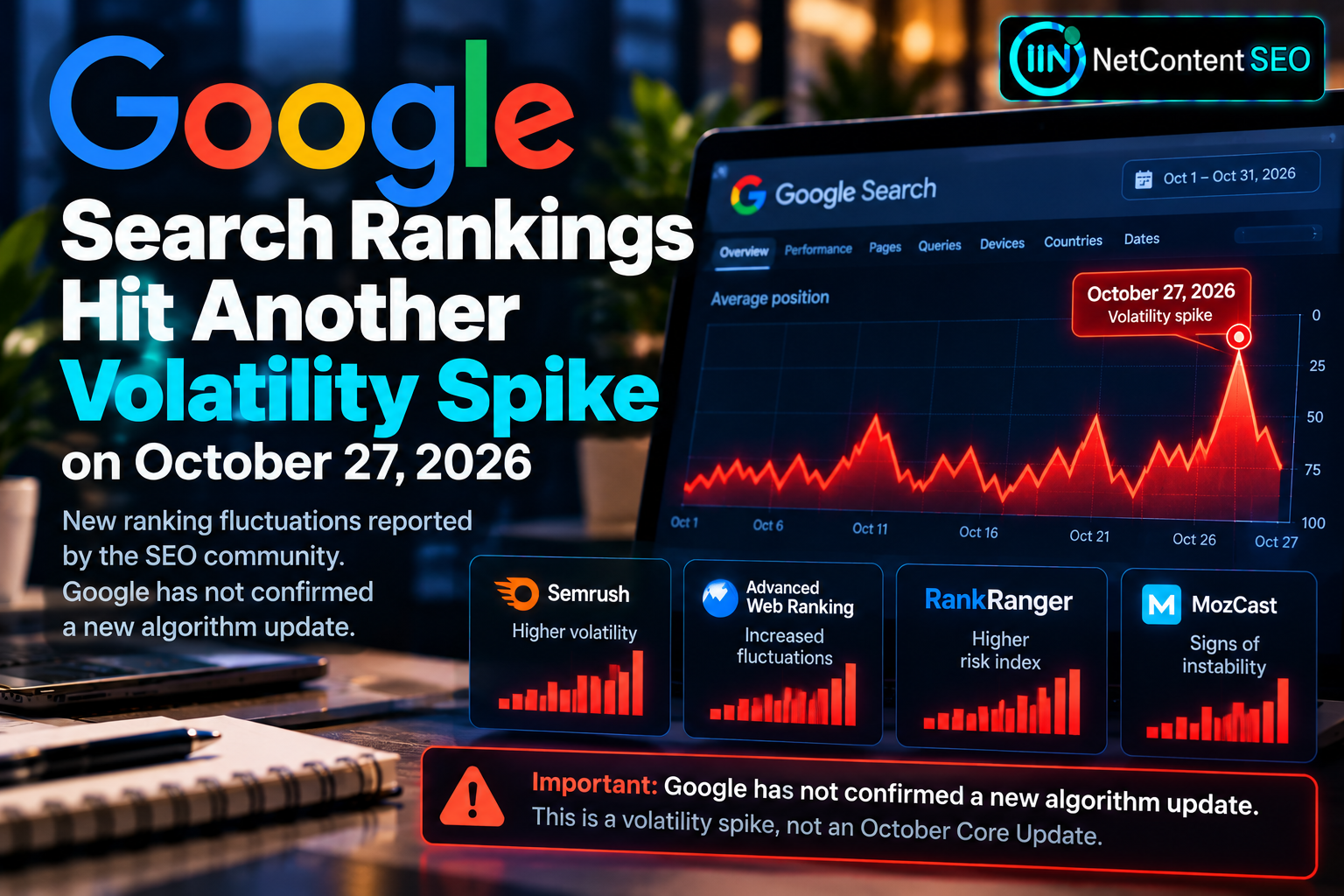

Google Search rankings experienced another reported wave of volatility on October 27, 2026, according to Barry Schwartz at Search Engine Roundtable. The latest observations follow several periods of unusual movement earlier in the month, prompting renewed discussion among website owners, publishers and SEO professionals.
There is a crucial distinction: Google has not confirmed a new algorithm update associated with the October 27 fluctuations. The available evidence describes ranking movement reported by monitoring tools and the SEO community. It does not justify labeling the event an “October Core Update.”
What happened on October 27?
In his October 27 report for Search Engine Roundtable, Barry Schwartz described another noticeable rise in Google Search ranking volatility. His coverage brought together readings from third-party tracking platforms and discussion among search marketers who were seeing changes in their results.
Ranking-volatility tools monitor how search results change across sets of queries. When their readings rise, it can indicate that more results are moving—or moving more substantially—than usual. That is a useful early warning, but it is not direct proof that Google launched a particular algorithm update.
Schwartz’s report places the October 27 activity within a broader sequence of reported October fluctuations, including periods around October 16, October 20–21 and October 24. The October 27 movement was described as especially noticeable in that context.
Why third-party volatility trackers matter—and what they cannot tell us
SEO monitoring services such as Semrush Sensor and other SERP tracking platforms can reveal unusual aggregate movement. They may be among the first public signals that rankings are shifting across industries or markets.
However, each service uses its own keyword samples, geographic coverage, device configurations and volatility methodology. A sharp reading in one tool is not a universal measurement of every Google search result, and tools may disagree about the scale or timing of a fluctuation.
For this reason, volatility dashboards should be interpreted alongside actual site performance. They cannot identify the precise algorithmic cause of a ranking change, and a high-volatility day does not establish that every website has been affected.
SEO community reports add context, not confirmation
Schwartz also highlighted discussion from members of the SEO community describing ranking changes and traffic movement. These reports can be valuable because they reflect what site owners are observing in real properties, rather than only a fixed sample of tracked keywords.
But anecdotal reports are inherently uneven. A publisher losing traffic, an ecommerce site gaining visibility and a tool showing broad SERP movement may all be describing different parts of the search ecosystem. Changes in demand, seasonality, competitors, SERP features and analytics reporting can further complicate the picture.
The most reliable interpretation comes from comparing independent signals while keeping the limitations of each in mind.
Has Google confirmed an October 2026 core update?
No official Google confirmation of an October 27 core update has been identified in the reporting discussed here. It would therefore be misleading to call this an “October Core Update” or attribute the movement to a named ranking-system change.
Google sometimes confirms broad core updates and spam updates through its official communications and the Google Search Status Dashboard. Other ranking changes and fluctuations may occur without a public announcement. An absence of confirmation does not mean rankings cannot change; it means the cause has not been officially established.
SEO reporting should preserve this distinction between an observed outcome and a verified explanation.
How to investigate your own site's performance
If you noticed a traffic change around October 27, start with Google Search Console rather than making immediate sitewide changes. Compare daily clicks, impressions, average position and click-through rate against a relevant prior period, and segment the analysis by country, device, page and query.
Remember that recent Search Console data may be incomplete or revised. Allow enough time for reporting to settle before treating a single day's movement as a lasting trend.
Next, examine whether changes are concentrated in a few important URLs, an entire section, a particular search intent or one geographic market. Check whether demand changed, whether search features appeared or disappeared, and whether your rankings moved consistently across several independent checks.
Finally, look at business outcomes. A fall in impressions without a comparable change in clicks or conversions is a different problem from a sustained drop in qualified organic sessions. The correct response depends on what actually changed.
What not to do during a volatility spike
A sudden ranking decline can tempt teams to rewrite large numbers of pages, remove content, overhaul internal links or make broad technical changes. Without a diagnosis, these actions can make it harder to understand the original issue and may introduce new problems.
Do not assume that every losing page was penalized, that one new competitor caused all changes or that a specific update is responsible. Instead, document the timing, affected queries, URLs, devices and markets, then investigate whether the trend persists.
Technical problems such as accidental noindex tags, broken canonical signals, crawl failures or deployment errors should still be checked promptly when evidence points to them. The advice to avoid hasty changes is not an instruction to ignore genuine site faults.
How long should SEOs wait before drawing conclusions?
There is no universal waiting period that fits every site. For a short-lived movement, several days of additional data may help distinguish noise from a developing pattern. For larger websites or high-impact commercial pages, teams should monitor key metrics daily while keeping change logs and checking for technical incidents.
If declines remain visible over time, analyze which page types and search intents are affected, compare competitors and evaluate whether content relevance, quality or user needs may have shifted. Any changes should be tied to evidence, not speculation about an unnamed Google update.
What this means for SEO professionals
The October 27 reports reinforce a familiar but important lesson: SERP volatility is a signal to investigate, not a diagnosis. Third-party tools can alert us to unusual movement, while Search Console and analytics help determine whether a specific business has actually been affected.
Clear terminology matters too. A ranking spike reported by Barry Schwartz is newsworthy on its own. It does not need to be presented as an officially confirmed algorithm release to deserve attention.
NetContentSEO assessment
The latest reported Google ranking fluctuations warrant close monitoring, particularly for sites that saw changes during other volatile periods in October. But the evidence available here supports only the observation of increased volatility and community discussion, not the existence of a newly confirmed Google core update.
SEO teams should track trends, validate data and avoid reactive changes based on one day of rankings. If Google issues a formal announcement or additional evidence clarifies the cause, that should be reported separately.
Source: Barry Schwartz, Search Engine Roundtable: Google Search Ranking Volatility, October 27, 2026. For official updates, consult the Google Search Status Dashboard.