

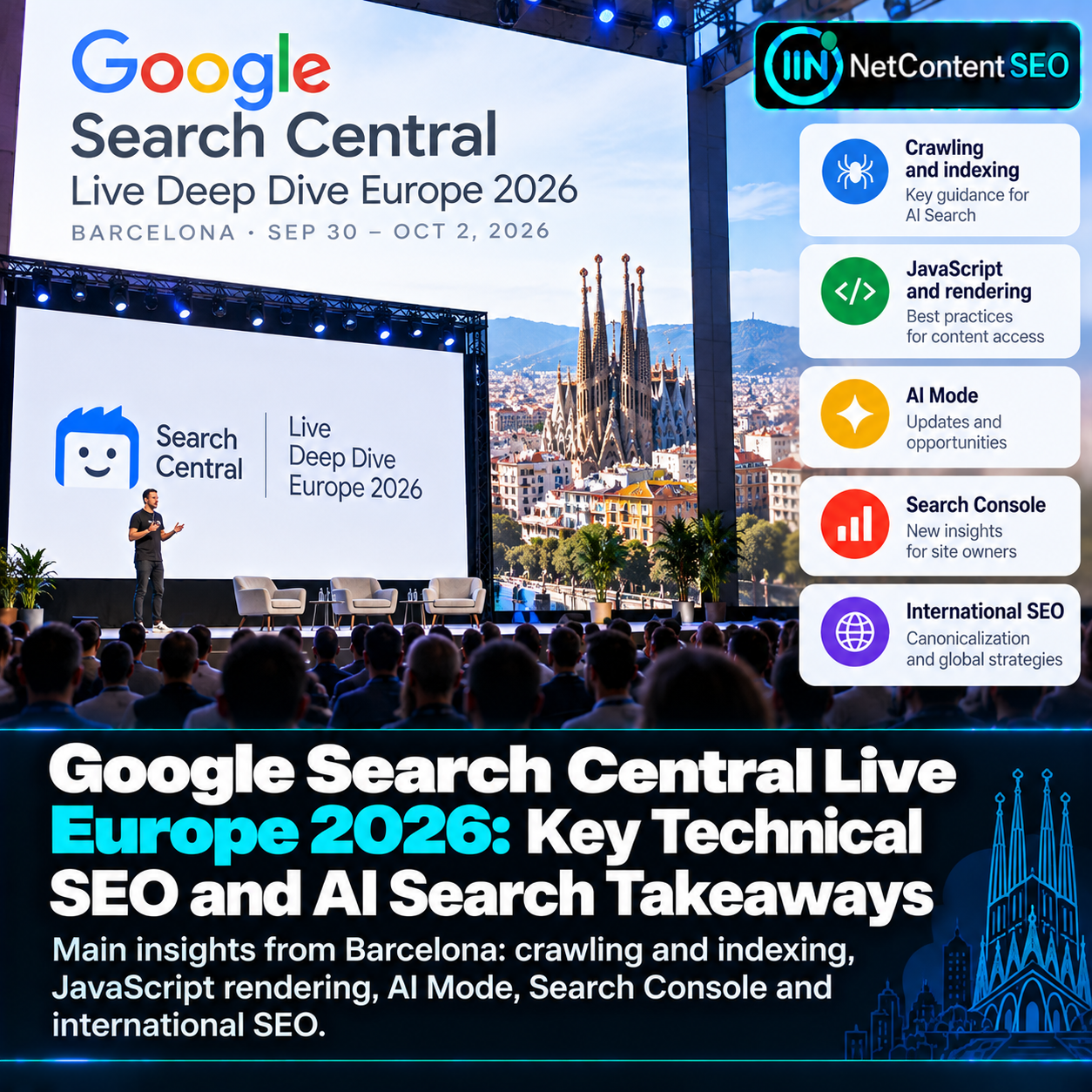

Google Search Central Live Deep Dive Europe 2026 took place in Barcelona from September 30 to October 2, bringing together Google Search Relations staff and SEO practitioners for three days devoted to how Google discovers, processes and serves web content. Rather than revisit the pre-event speaker announcement, this article examines the technical themes that emerged from the event and what they mean for SEO and AI Search.
Google's official September 16 announcement said the agenda combined established search fundamentals with new, mostly AI-focused topics. The observations below also draw on attendee reports by Digitaloft and ROAST. These are participant summaries, not official transcripts or new Google Search documentation.
Day one: crawling remains the starting point
The first day focused on discovery and crawling. The central lesson was familiar but essential: a page cannot participate reliably in search if Google cannot find or fetch its important content. Attendee accounts described sessions on how Google discovers URLs, decides what to crawl and uses Search Console to diagnose problems.
For publishers, the practical takeaway is to maintain clear internal links, accessible URLs and accurate technical signals. These fundamentals matter whether the eventual search experience presents traditional blue links or an AI-generated answer. The event did not establish a separate shortcut that guarantees AI citations.
Day two: indexing, JavaScript and canonicalization
The second day turned to what happens after a page is crawled. According to ROAST's day-two recap, sessions covered how HTML is interpreted, indexing controls, text and multimedia, and the structure of Google's index.
JavaScript rendering remains a practical risk. Content that depends on a user click or scroll may not be available to automated rendering in the same way as content included in the initial page output. Likewise, blocking essential JavaScript resources can interfere with how a search engine understands the page. The exact behavior of individual sites should be tested rather than inferred from a general conference summary.
Canonicalization and duplication were also part of the technical discussion. A declared canonical is a signal, not a guarantee that Google will choose the preferred URL. SEO teams should verify that internal links, redirects, sitemaps and page content support a consistent preferred version.
Indexing controls and AI Search
Attendee reports describe discussion of robots meta directives, including noindex, snippet limits and preview controls. These settings have implications for how content can appear in search features. However, controlling a snippet is not the same as choosing whether a page will be cited by an AI system, and teams should consult current Google documentation before changing directives at scale.
The operational lesson is to audit templates for accidental restrictions and understand the trade-offs of reducing previews. A blanket restriction introduced to influence AI exposure could also affect ordinary search presentation.
Day three: query understanding, ranking and serving
The final day focused on what happens after content is in the index: interpreting queries, retrieving potential results, ranking them and displaying search features. The ROAST day-three recap describes sessions on query understanding and how language, entities, synonyms and context affect retrieval.
These themes matter to AI Search because users increasingly submit complex, conversational requests. Digitaloft's recap attributes to event presentations the observation that AI Mode queries tend to be longer and can involve multimodal input. Such reported figures are event-context observations, not a new ranking specification or a promise about traffic.
What the event means for GEO
One useful way to read the three-day program is as a chain of dependencies: discovery, crawling, rendering, indexing, retrieval and serving. AI-powered experiences change how answers are assembled and presented, but they do not eliminate the need for accessible, understandable source material.
That does not mean technical compliance alone creates citations. A page can be crawled without being indexed, indexed without ranking prominently, and retrieved without being cited in an AI answer. Each outcome should be measured separately where reliable data exists.
Practical priorities after Barcelona
- Review internal linking and crawl paths to important pages.
- Test whether essential content is present and accessible without user interactions.
- Audit robots directives, canonical signals and duplicate URL patterns.
- Use Search Console to distinguish discovery, crawling and indexing issues.
- Evaluate AI citations and referral traffic separately from conventional organic metrics.
- Validate conference claims against Google's current documentation before making site-wide changes.
NetContentSEO assessment
The most valuable takeaway from Search Central Live Deep Dive Europe 2026 is not a new AI optimization trick. It is the continued relevance of technical SEO foundations to both conventional and AI-powered search. The event offered a useful framework for examining how content moves from discovery to final presentation, while attendee recaps add operational details that should be treated as secondary reporting rather than definitive policy statements.
Sources: Google Search Central official announcement; Digitaloft event summary; ROAST day one, day two and day three.