

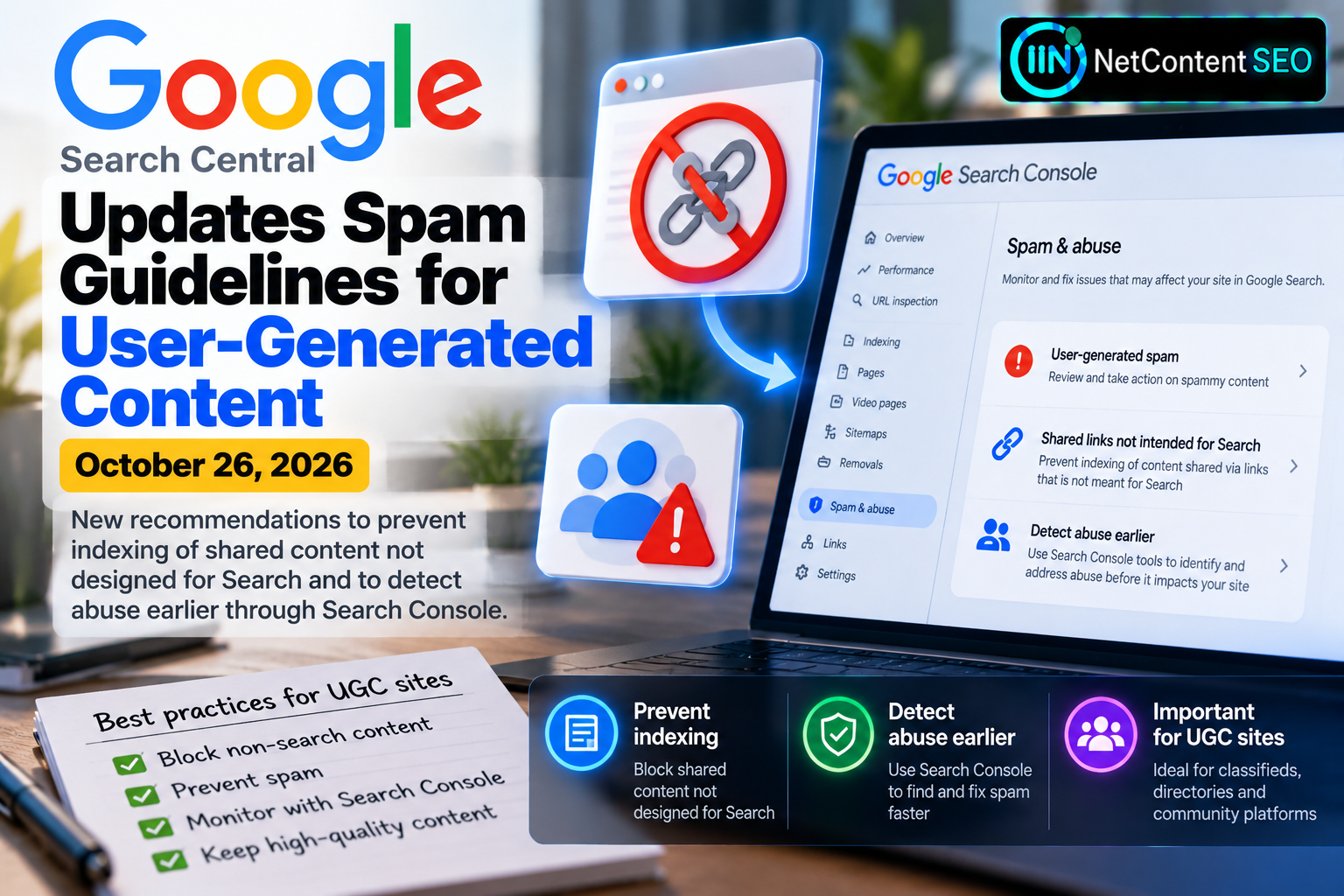

Google Search Central has expanded its guidance on preventing user-generated spam, with practical recommendations for platforms that host public submissions, shareable pages, generated content and web apps. The advice is especially relevant to classified-ad websites, directories, forums, community platforms and services that allow users to create large numbers of URLs.
Two points deserve particular attention: not every page shared through a link should be indexed by search engines, and site operators should monitor indexing and content-creation patterns before abuse becomes a large-scale problem. The guidance appears in Google's official document, Prevent user-generated spam on your site and platform.
This is a documentation and operational best-practices story. It should not be confused with Google's earlier UGC Fresh Data Program, nor does it announce a new ranking algorithm or automatic penalty for legitimate user-generated content.
Why Google is addressing UGC platforms
Services that let users publish comments, listings, profiles, generated pages or small web applications can attract legitimate communities—and spammers. A bad actor may exploit registration forms or publishing tools to create thousands of low-value pages, insert manipulative links, distribute misleading material or host phishing content.
Google's guidance emphasizes that even basic preventive measures can reduce the incentive for abuse. Rather than waiting for a manual action or a collapse in search quality, platforms should combine account-level controls, publication rules, indexing decisions and monitoring.
Only index pages that are actually meant for Search
One of the most useful clarifications concerns pages created primarily to be shared directly with other people. Some products generate shareable outputs, documents, temporary results or interactive pages that are useful to the person holding the link but not intended as search results.
Google advises platform owners to consider whether these pages should be discoverable in search engines at all. A shareable URL does not automatically need to become an indexable landing page.
For pages that should remain accessible through their URLs but should not appear in Google Search, a properly implemented noindex robots directive is an appropriate technical option. This should be applied selectively, according to the page's purpose and the product's privacy expectations.
Site operators must also remember that a crawler needs to access the page to discover its noindex directive. Blocking the same URL in robots.txt can prevent Google from seeing the instruction. For genuinely private or sensitive content, authentication and appropriate access controls are required; noindex is not a security mechanism.
Consider noindex for posts from new or untrusted users
Google also recommends evaluating a temporary noindex policy for posts from new accounts that have not yet earned a reputation on the platform. Once a user demonstrates trustworthy behavior, the service can allow their content to be indexed.
This creates a practical disincentive for spammers who register solely to place links into search results. It also provides moderation teams time to detect suspicious behavior before newly submitted pages gain search visibility.
Importantly, this is a recommendation, not a universal requirement to noindex every new user's content. Legitimate classified platforms may have business reasons to index new ads quickly. Their implementation should balance discovery, moderation capacity and abuse risk.
Use appropriate attributes on links in untrusted content
Because many spammers seek links to external websites, Google advises using rel="nofollow" or rel="ugc" on links appearing in untrusted user-generated content. These attributes help communicate the nature of those links to search engines.
The presence of these attributes does not remove the need to moderate malicious links, scams or harmful content. They are one component of a broader anti-abuse strategy.
Detect suspicious account and publishing patterns
Google suggests monitoring signups and user interactions for unusual patterns, including the speed of form completion, repeated requests from the same IP ranges, user agents, usernames and other submitted values.
These signals can support an account-reputation system and help identify coordinated automated abuse. None of them should be treated as definitive proof of malicious intent on its own: shared networks, accessibility tools and legitimate automation can also produce unusual activity.
Platforms should combine signals, establish thresholds appropriate to their audience and provide a route for legitimate users to resolve false positives.
Search Console can reveal abuse before it spreads
The guidance recommends verifying relevant sites or subdomains in Google Search Console to receive alerts about manual actions and security issues. Operators should also review the Page Indexing and Search performance reports for unexpected increases in indexed pages, impressions or search queries unrelated to the platform's purpose.
For example, a directory that normally publishes a modest number of approved entries might suddenly see thousands of indexed URLs for unrelated commercial terms. That does not automatically establish spam, but it is a strong reason to investigate which accounts created the pages and whether publication controls failed.
Google additionally recommends platform-level alerts for anomalies such as a spike in newly published pages or a small number of users generating a disproportionate share of indexable URLs. Server logs, suspicious redirects and Google Alerts may offer complementary signals.
These checks rely on existing Search Console reports and monitoring practices; the documentation does not announce a new dedicated Search Console 'Spam & abuse' dashboard.
Other protective measures for UGC websites
Google encourages platforms to publish a clear anti-abuse policy, make that policy visible during signup and give trusted users ways to report spam. Verification challenges such as reCAPTCHA can help discourage automated account creation, while monitoring for phishing or malware can protect both visitors and the domain's reputation.
Google also suggests watching for unusual combinations of geography and language, suspicious keywords, redirects and large blocks of encoded JavaScript. These indicators require contextual review rather than automatic assumptions about particular countries or languages.
What classified sites and directories should do
For a classified-ad portal, the practical approach begins with the publishing lifecycle. New submissions can enter a review or lower-trust state; spam signals can be checked before publication; and the platform can decide when a listing becomes eligible for indexing.
Expired, withdrawn, duplicated or deliberately private listings need an intentional URL policy. Depending on the situation, that may involve a meaningful replacement page, an appropriate HTTP status, a redirect where justified or a noindex directive. The right choice depends on the content's purpose and whether the URL should continue to exist.
Directory operators should similarly distinguish genuinely useful category and listing pages from automatically generated, thin or spam-heavy combinations of filters and user inputs. A large number of URLs is not inherently a policy violation, but publishing pages with little value primarily to manipulate rankings can conflict with Google's spam policies.
Does this mean Google is penalizing all UGC?
No. Legitimate forums, comments, listings and other user-contributed material remain a normal part of the web. Google's concern is abusive behavior and low-value content intended to manipulate search visibility.
The guidance should not be interpreted as a newly announced core update, a blanket rule against indexed user content or a requirement to hide all shared URLs. It offers ways to reduce abuse and make indexing choices that fit the intended use of a page.
How this differs from the UGC Fresh Data Program
This guidance concerns prevention and detection of spam on platforms hosting user-created content. It focuses on moderation, indexing, link attributes, account signals and Search Console monitoring.
It is not an announcement of the UGC Fresh Data Program and should not be presented as a new feature of that earlier initiative. Mixing the two would obscure the operational advice that site owners can implement now.
NetContentSEO assessment
The most important message for UGC platforms is straightforward: decide which user-generated pages deserve search visibility, and monitor the publishing system for abuse before suspicious content is indexed at scale.
For classifieds, directories and community websites, this requires coordination between SEO, engineering, moderation and security teams. Account reputation, selective indexing and anomaly detection are more effective when designed into the product than when added only after a spam incident.
Google's official documentation provides a useful checklist, not a promise of better rankings or a newly announced algorithmic change.
Primary source: Google Search Central — Prevent user-generated spam on your site and platform. Related policy context: Google Search spam policies.