

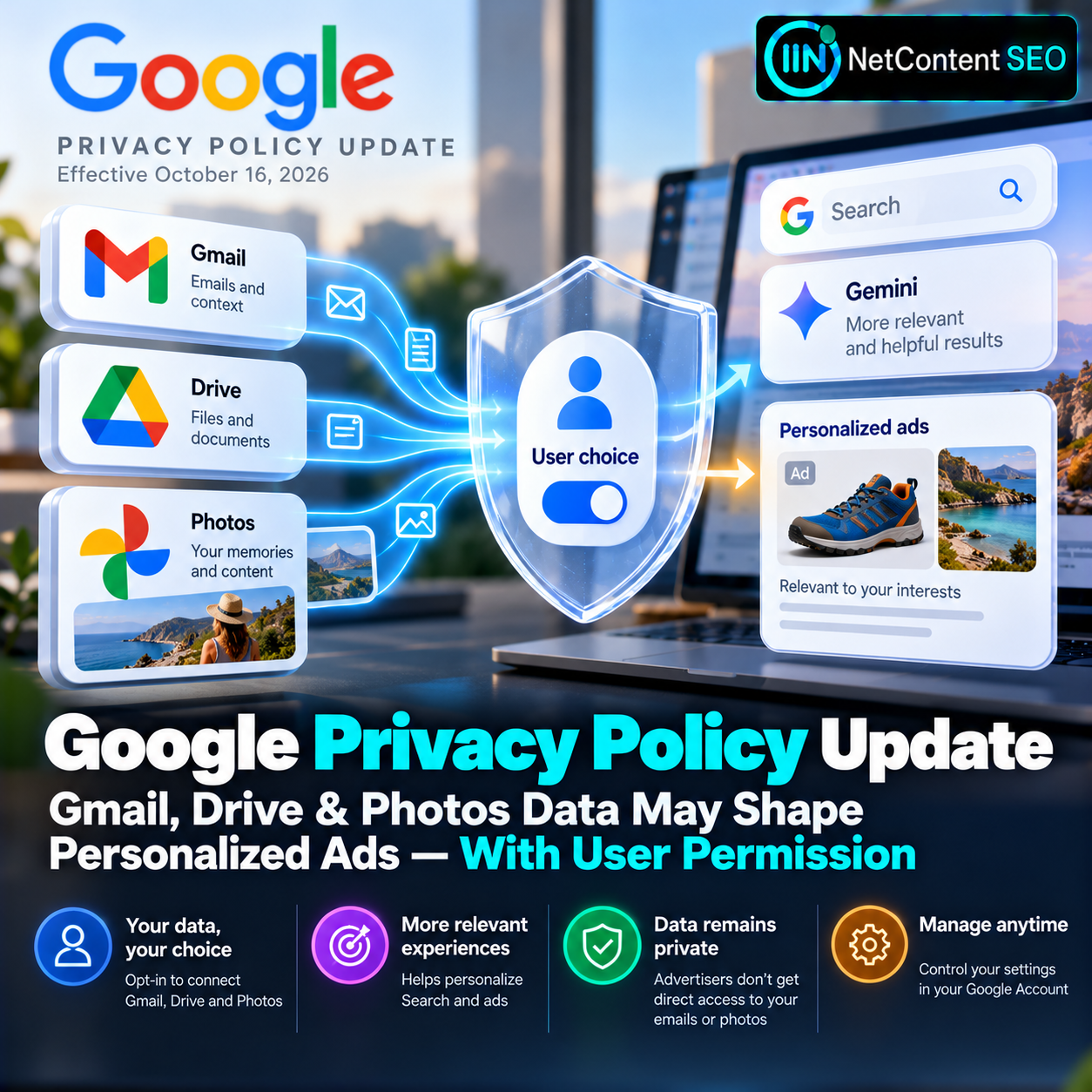

Google’s updated Privacy Policy, effective October 16, 2026, clarifies how information from Gmail, Google Drive and Google Photos may contribute to personalized experiences—including advertising—when users choose to make that data available to compatible Google services. The wording is significant for the evolving relationship between Google Search, AI-powered personalization and its advertising business. But it does not mean Google automatically turns everyone’s private emails, files or photos into ad-targeting data.
The key distinction is user choice. Under the official Google Privacy Policy, content from Drive, Gmail and Photos remains excluded from personalized ads unless a person chooses to make data from those services available to another Google service that supports personalized advertising.
What Google’s October 2026 Privacy Policy says
In the section covering personalized services, content and ads, Google explains that users may allow products such as Search or Gemini Apps to access information held in other Google services, including Google Photos and Workspace apps such as Gmail and Drive. That access is subject to the policies and settings of the service receiving the information.
The policy provides a concrete example: Search may process some of the data a user has allowed it to access to personalize content, including ads. This connects optional cross-service data access with the possibility of ad personalization, rather than treating the two activities as necessarily separate.
Google also explicitly states that it does not show personalized ads based on Gmail, Drive or Google Photos content unless the user chooses to make data from those services available to other Google services that support personalized ads.
These two statements should be read together. The default restriction remains important; the newly emphasized exception matters when users enable supported integrations.
Does Google now read Gmail emails to target ads?
Not automatically, according to the published policy. The text does not say that all Gmail messages are scanned for advertising across every account. It describes a conditional use of information that users choose to make available to compatible Google products.
That distinction is essential because a headline suggesting Google has universally resumed using private Gmail messages for ad targeting would overstate what the policy establishes.
Google also says it does not share personally identifying information, such as a person’s name or email address, with advertisers unless the user requests that sharing. This is not the same as saying that Google never processes data to select or personalize ads: Google can personalize the ads displayed through its own systems without handing advertisers a copy of an email or photo.
How Google Search and Gemini fit into the change
The policy names Search and Gemini Apps as examples of services that may, depending on available settings, access data from other Google products to create a more personalized experience. The example involving Search and ads makes the advertising implications explicit.
For AI-powered products, the broader strategic direction is notable. Systems that help users by incorporating permitted personal context could also support more tailored commercial experiences, subject to product rules and controls.
However, the policy is not proof that every AI Mode session uses Gmail or Photos content for advertising, nor does it establish a universal rollout of any particular personalized ad feature. The availability and effect of connections depend on product support, account settings and jurisdiction.
What information is involved?
The policy describes several kinds of content that people store in Google products. Gmail contains messages that users write and receive; Drive contains documents and files; Google Photos contains images and videos. When a person chooses to grant supported cross-service access, some of that information may become available to the receiving Google service for the purposes described in its applicable policies and settings.
Google’s text does not say that the entirety of every mailbox or photo library becomes ad-targeting material once a connection is enabled. It refers to the data users allow a service to access and the permitted uses of that data.
Nor should the new wording be confused with an announcement that advertisers can inspect private files or photos. The Privacy Policy maintains separate statements about sharing personal information with outside parties.
Privacy controls: what users can review
Google directs users to account settings and My Ad Center to control aspects of ad personalization. Users concerned about cross-service personalization should review which Google services they have connected, what permissions they have granted and whether personalized ads are enabled for their account.
Google’s Account settings and Privacy Checkup provide additional starting points for reviewing available controls. The exact settings can differ by service, region and account type.
Users in the European Union should also be aware that Google’s policy notes that decisions about linking services can affect how data is used across Google products. The policy wording alone does not determine whether a particular EU account has any optional integration enabled.
Why this matters for advertisers
For the advertising industry, the update highlights the potential value of consented first-party context inside a large ecosystem of search, productivity and AI services. Information that a user voluntarily shares to improve a product experience may, under supported conditions, help shape advertising relevance as well.
That is a meaningful strategic direction, but the policy itself does not publish new targeting controls for advertisers, audience sizes, performance metrics or a launch date for a specific Google Ads product. Claims about higher conversion rates or access to Gmail-derived audience segments would require separate evidence.
SEO and AI Search implications
This is a privacy and personalization policy update, not a confirmed organic search ranking update. Google has not announced a new crawling rule, structured-data requirement, indexing mechanism or AI citation policy through this document.
Nevertheless, the change is relevant to AI Search because personalized context can influence what a user sees and how a service responds. As search experiences become more conversational and connected to users’ permitted personal information, the relationship between organic discovery, personalized answers and advertising deserves close scrutiny.
For SEO professionals, the practical question is how to evaluate increasingly personalized search experiences without assuming that every observed difference is a ranking change. Testing should document whether accounts are signed in, which personalization settings are active, the region, the query and the interface used.
For AI visibility research, it is similarly important to distinguish source retrieval, answer personalization and advertising selection. These processes can overlap in the user experience without being the same technical mechanism.
What Google has not announced
The October 2026 policy does not establish that Gmail and Photos content is automatically used to target ads for every user. It does not authorize advertisers to browse private emails, and it does not describe a new organic SEO ranking signal.
It also does not prove that AI-generated search answers are now ranked according to information found in private Gmail messages. Any such assertion would require a separate technical announcement or independently reproducible evidence.
NetContentSEO assessment
The most important development is the explicit connection between optional cross-service access and personalized advertising in Google’s privacy documentation. That wording shows how Google is framing the commercial possibilities of personalized Search and Gemini experiences while maintaining a stated role for user settings and consent.
The correct reading is neither that nothing has changed nor that Google is automatically selling access to private mailboxes. It is that the policy now describes circumstances in which data from Gmail, Drive and Photos can inform personalized ads after users choose to make that information available to supported services.
For the search industry, the story is less about an immediate ranking effect and more about the continuing convergence of personal context, AI-assisted discovery and advertising.
Primary source: Google Privacy Policy, effective October 16, 2026.