

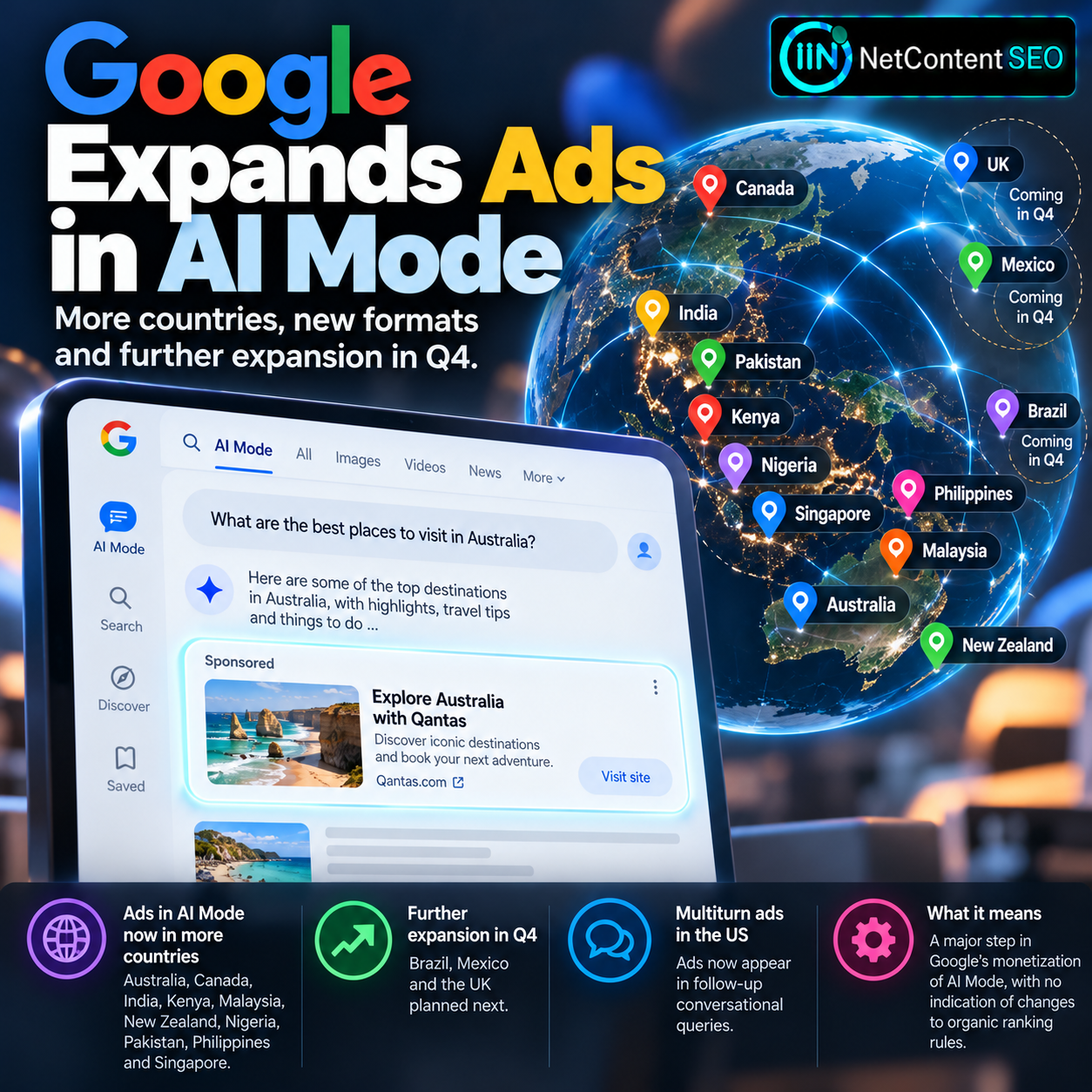

Google is accelerating the commercialization of conversational search. On October 28, 2026, the company announced that ads in Google Search's AI Mode are expanding to ten additional countries. It also introduced multiturn ads in the United States, enabling sponsored placements in responses to follow-up questions during an AI Mode conversation.
The development matters for advertisers, publishers and SEO teams because it broadens the commercial footprint of an experience built around AI-generated answers rather than traditional lists of search results. But the distinction is crucial: this is an advertising product expansion, not an announced update to Google's organic ranking algorithm.
Which countries are getting ads in AI Mode?
Google's official announcement names Australia, Canada, India, Kenya, Malaysia, New Zealand, Nigeria, Pakistan, the Philippines and Singapore as the ten markets where it is scaling ads in AI Mode.
Google says further expansion is planned during the fourth quarter of 2026, including Brazil, Mexico and the United Kingdom. Those three are planned markets in the announcement, not part of the list of ten where the expansion is currently being rolled out. The company has not provided exact country-by-country launch dates in this announcement.
This distinction matters when reporting on availability. A planned rollout should not be described as already fully launched in every location or for every advertiser.
Multiturn ads: sponsored placements in follow-up questions
Alongside the geographic expansion, Google says it is launching multiturn ads in the US. In conventional search, an advertiser often targets the user's current query. In AI Mode, a person may ask an initial question and then refine the request through a sequence of follow-ups.
Multiturn advertising allows a sponsored result to appear in response to a later question in that conversation. Search Engine Roundtable's Barry Schwartz reported Google's clarification that these ads can show on responses to follow-up user queries as people engage in back-and-forth interactions with AI Mode.
For example, a traveler could begin with broad destination research, then ask about specific hotels, prices or booking options. Commercial relevance may emerge later in the dialogue. That is an illustrative scenario, not a description of a particular confirmed ad impression.
Google says ads will be clearly labeled “Sponsored” and that it will continue testing formats.
Google's CTR claim needs careful interpretation
One of the most consequential lines in Google's announcement concerns engagement. The company says that click-through rates are already similar between sponsored and organic product-list items within AI Mode.
That statement is based on Google internal US data collected from August 20 to September 3, 2026. It is not a published independent industry benchmark. More importantly, the comparison concerns product-list items, not every organic web link, publisher citation or AI-generated answer source.
It would therefore be misleading to claim that AI Mode ads now perform as well as all organic search results, or that ordinary SEO traffic will necessarily be replaced by paid traffic. The announcement does not establish either conclusion.
Google also says AI Mode queries are, on average, three times longer than traditional searches, citing its US AI Mode research from May 2026. Longer conversational queries may provide more context about intent, but that does not mean every longer query is commercial or equally valuable to advertisers.
Why this is an important monetization milestone
Traditional search advertising has long been organized around keyword-triggered queries and recognizable results pages. AI Mode changes the user interface: search becomes a conversation, and the system may synthesize information, ask for clarification or help compare options across several turns.
By placing ads within that experience, Google is attempting to connect commercial offers with moments when users are evaluating products or services. Expansion into additional countries increases the geographic scope of that experiment, while multiturn placements increase the number of potential commercial moments within a single research journey.
Whether these formats improve advertiser returns or user satisfaction at scale will require independent measurement. The announcement offers Google's early claims, not a comprehensive cross-market performance study.
What changes for Google Ads and PPC teams?
Advertisers operating in the newly listed countries should monitor Google's official campaign documentation and account-level availability rather than assume every format and targeting option is immediately accessible.
As AI Mode expands, campaign teams will need to think beyond short keyword strings and consider how commercial intent develops through multi-step research. Product feeds, accurate landing-page information, useful offer details and clear conversion measurement remain important foundations for campaigns aimed at high-intent users.
Performance analysis should separate conventional search placements from AI-driven experiences wherever Google provides reliable reporting. Teams should avoid attributing every movement in cost, click-through rate or conversion volume to AI Mode without evidence from campaign data.
Google has been testing multiple AI advertising formats throughout 2026. Its May 2026 advertising announcement described additional conversational and product-focused ad experiences. The October expansion should be understood as part of that broader commercial development, not as the first appearance of advertising in AI-powered Search.
Does this change organic SEO rankings?
No organic ranking-rule change is announced in Google's October 28 post. The update addresses ad availability, formats and the commercial experience within AI Mode. It does not describe a new ranking factor, a change to crawling or indexing, or a requirement to purchase ads to appear organically.
However, the user interface can still matter to organic visibility. Sponsored placements may compete for attention with unpaid results and cited sources, particularly when users are researching purchases. That is a plausible area for monitoring, not a quantified effect established by the announcement.
SEO teams should continue to assess their visibility through available search-performance reports, referral traffic, conversions and direct observation of relevant queries. Changes in ad density should be documented separately from changes in organic ranking position.
AI Search visibility and paid visibility are different measurements
The expansion also reinforces the need to distinguish three concepts: organic visibility in AI-generated answers, paid placements within AI Mode and traffic generated by traditional search results. They can coexist in a search journey but are not interchangeable metrics.
A business might be cited organically in an AI response without advertising, appear in a sponsored product placement without earning an organic citation, or receive visits from a conventional web result. Reporting that collapses these into one undifferentiated “AI visibility” score can obscure what is actually happening.
Publishers should be especially cautious about drawing conclusions from Google's product-list CTR claim. It does not establish click behavior for informational publisher links, nor does it demonstrate the share of AI Mode answers that send visitors to independent websites.
What about Brazil, Mexico and the UK?
Google explicitly identifies Brazil, Mexico and the United Kingdom as planned additional locales during Q4 2026. For agencies with clients in these markets, that is a useful planning signal, but the precise timing and availability of particular ad formats should be confirmed through future Google announcements and advertiser-account access.
Because AI Mode advertising can involve different markets, products and campaign configurations, a global announcement should not be treated as a guarantee that every advertiser is eligible for every placement.
What to monitor next
The most useful follow-up questions are practical: how broadly multiturn ads become available; what reporting Google provides for AI Mode placements; whether advertiser performance differs by market and query type; how prominently sponsored results appear alongside organic citations; and whether users respond differently to ads placed at the start of a conversation versus later follow-ups.
These are open measurement questions, not outcomes already demonstrated by the October launch.
NetContentSEO assessment
Google's October 2026 expansion is a meaningful commercial step for AI Mode. It extends sponsored placements into ten more countries, identifies three additional markets for Q4 and introduces US multiturn ads that can reach users as a conversation evolves.
For PPC teams, the opportunity is to understand how conversational intent translates into advertising performance. For SEO teams, the priority is to track the relationship between paid placements, organic citations and actual site visits without confusing interface monetization with an algorithm change.
The central conclusion is straightforward: AI-powered search is becoming a larger advertising surface, but Google has not announced that the rules of organic ranking have changed as part of this rollout.
Sources: Google, “Ads in AI Mode expand to new markets,” October 28, 2026; Search Engine Roundtable, “Google Expands Ads In AI Mode To More Countries & Multiturn Ads In U.S.,” October 28, 2026; Google, “A new generation of ads for the AI era of Search,” May 20, 2026.