

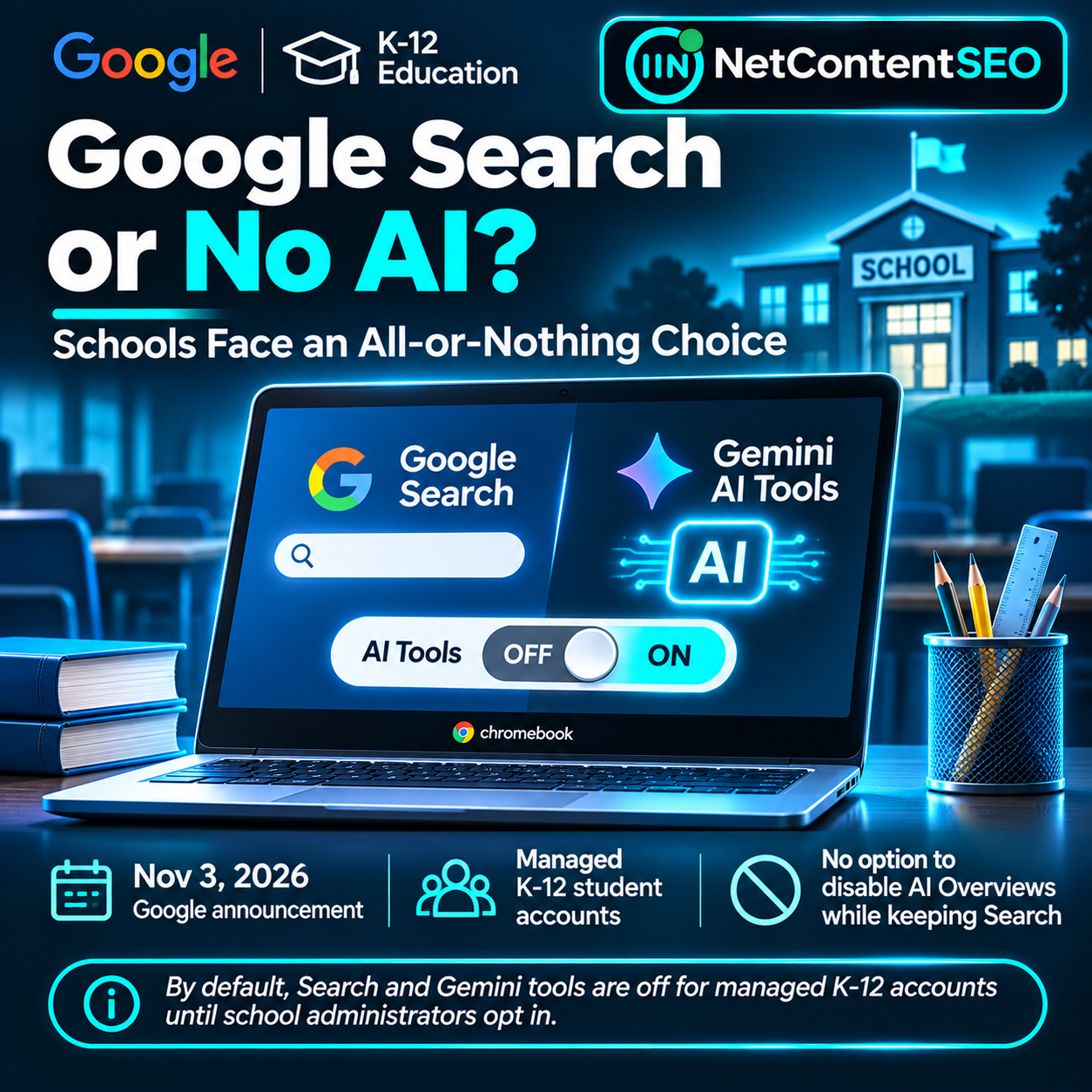

Google says it will give K–12 schools more explicit control over student access to Gemini and related AI products. But there is a significant trade-off: administrators who want to prevent AI-generated answers from appearing in Google Search cannot simply switch off AI Overviews while keeping the conventional search experience available through managed student accounts. Under the announced approach, schools that decline access to Search's integrated AI features must also forgo Google Search for those accounts.
The policy was announced on November 3, 2026, in Google's official education blog. It was reported by TechCrunch and by Barry Schwartz at Search Engine Roundtable.
What Google is changing for K–12 student accounts
Google announced an opt-in approach for access to Google Search, Gemini, Gemini Notebook and Gemini in Classroom. These products will be turned off for managed K–12 student accounts until school administrators explicitly enable them. Google said it will share additional implementation details with schools before the changes roll out, giving districts time to prepare.
The distinction between managed accounts and all students is essential. This is not a worldwide shutdown of Google Search in schools, nor does it mean that children will be unable to search from personal accounts or other devices. It concerns administrator-controlled services used with school-managed student identities.
Why schools cannot simply remove AI Overviews
Educators have raised concerns that AI-generated summaries may answer students' questions before they have evaluated sources themselves. A school might reasonably want pupils to use conventional web search while excluding AI-generated explanations. However, Google says Search and AI are now deeply integrated, and its announced administrative controls do not offer a standalone option to remove AI Overviews while preserving Google Search.
In reporting from Chalkbeat, Google's education leader Chris Phillips said schools that are not comfortable with AI in Search can choose not to enable Search at all. That leaves institutions with a broader decision than a simple AI-feature toggle. The product's design makes the ability to access ordinary search results dependent on accepting an AI-integrated search environment.
Google's alternative: Guided Learning
Google is introducing Guided Learning capabilities intended to encourage students to work through problems instead of receiving finished answers immediately. In Google Classroom, Guided Learning became globally available on November 3 for participating schools. Teachers can assign activities grounded in class materials, while receiving information intended to help identify where students need additional support.
Google is also piloting Guided Learning in Search for selected US schools later in November 2026. When systems detect certain types of homework-related queries, Search may respond with prompts, explanations and step-by-step guidance instead of immediately presenting the answer. The pilot is limited in scope, and its future expansion depends on feedback and further development. It should not be described as an already universal replacement for AI Overviews.
The educational trade-off: answers versus research skills
AI-generated explanations can support learning when they encourage exploration, clarify difficult concepts or adapt to individual needs. But they may also reduce the need to locate original documents, compare competing sources and assess credibility. Those research behaviors are fundamental to digital literacy, particularly when students are still learning how to distinguish evidence from confident-sounding claims.
The concern is not simply that AI exists in the classroom. It is whether schools can choose the appropriate level of assistance for different ages, assignments and learning objectives. An integrated Search product may be convenient for some teachers while being too prescriptive for others who want students to practice source evaluation independently.
What Google says about learning outcomes
Google argues that Guided Learning can improve outcomes, pointing to research into AI-supported instruction. However, claims about better test performance in particular studies should not be generalized into proof that all students learn more effectively with AI or retain knowledge over the long term. Study design, subject matter, student age, access conditions and follow-up periods all affect interpretation.
Schools evaluating the technology should consider whether students can independently demonstrate what they learned after the AI assistance is removed. Privacy, data governance, teacher oversight and accessibility are also relevant to the decision.
What the change means for Google Search and SEO
For SEO professionals, the announcement illustrates how tightly AI-generated answers are becoming embedded in Google's search interface. Rather than offering administrators a separate, conventional search mode without AI Overviews, Google is treating the AI-enabled experience as part of the product schools choose to activate.
There is no evidence that this policy changes Google's ranking algorithms or the eligibility of websites for indexing. It also does not establish how much search traffic publishers will gain or lose from educational users. Its relevance to publishers is strategic: when AI is inseparable from the discovery interface, the ways people encounter, interpret and click original sources can change.
Educational publishers, reference sites and institutions should continue to make information accurate, attributable and accessible. They should not assume that inclusion in an AI-generated response guarantees a click, or that this announcement creates a new SEO ranking signal. The larger question is whether users retain enough visibility into primary sources to evaluate the answers they receive.
Control is becoming a product-design issue
The debate also highlights the difference between allowing an institution to disable an entire service and allowing it to choose specific features within that service. Google is providing an administrator-level opt-in for managed student accounts, which is meaningful control over access. But it is not the same as giving educators a granular switch for AI-generated search answers.
Schools may ultimately decide that Guided Learning provides sufficient safeguards. Others may prefer search tools that let students browse and compare sources without a generated answer appearing first. Both choices should be evaluated against actual learning needs rather than assuming that either AI assistance or AI exclusion is always the best approach.
What happens next
Google says it will communicate more implementation details before the account-control changes roll out. Its Search Guided Learning pilot begins in selected US schools later in November, with wider availability to be determined. Until the settings and their behavior are documented in full, administrators should avoid assuming that existing school configurations will remain unchanged or that they can selectively disable AI Overviews without affecting Search.
Bottom line: Google's new policy offers schools the ability to opt in to AI-integrated products, but not the specific choice many educators want: traditional Google Search without AI-generated answers. That distinction makes this an important development for educational technology, digital literacy and the future design of AI Search.