

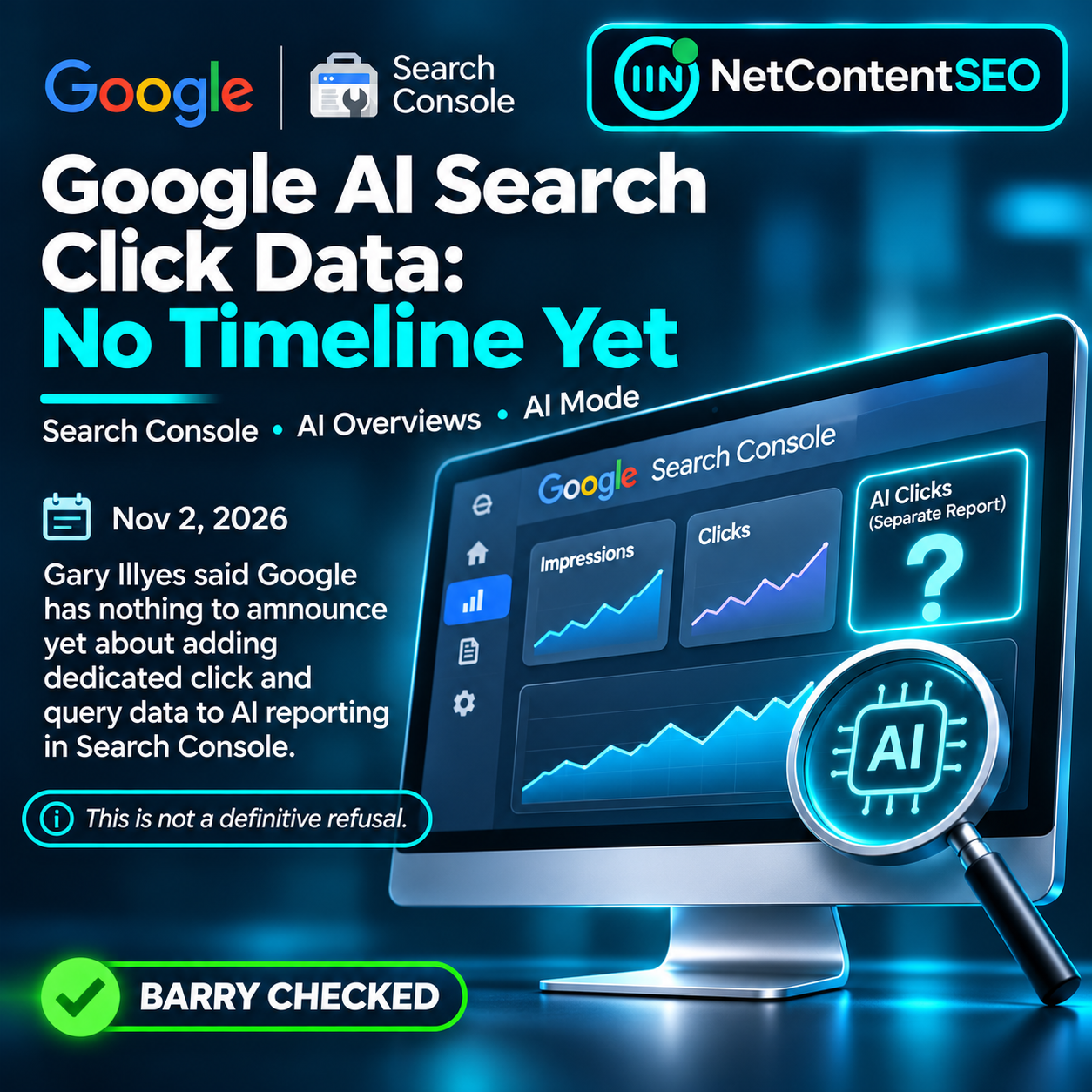

Google has not announced when—or whether—it will provide a dedicated breakdown of clicks and queries from AI Overviews and AI Mode in Search Console. The uncertainty resurfaced on November 2, 2026, after Google Search analyst Gary Illyes responded to a LinkedIn discussion about reporting plans. His response emphasized the team's interest in providing useful data, but did not promise any particular metrics or a delivery date. Barry Schwartz reported the exchange in Search Engine Roundtable.
What Gary Illyes actually said
The discussion began with a LinkedIn post citing an unattributed comment reportedly made at a Google Search Central Live event. The claim suggested that click and query metrics were expected to become available in the AI performance report, though the timing was unknown. Illyes challenged that characterization, saying he did not think Google had phrased its position that way. He added that the Search Console team wanted to provide more data that made sense, but had nothing to announce.
That statement is neither a product announcement nor a definitive refusal. It does not confirm that separate click reporting is on the roadmap, and it does not establish that Google has ruled it out. John Mueller subsequently pushed back on interpretations that treated Illyes's comment as a rejection of click metrics. The responsible conclusion is narrower: there is no confirmed timetable or committed set of new AI click and query metrics.
What Search Console currently measures
Search Console's Generative AI performance reporting provides visibility into impressions associated with AI Overviews and AI Mode, with dimensions including pages, countries, devices and dates. It does not provide a corresponding dedicated breakdown of AI clicks, click-through rate or search queries. Clicks from links inside AI features can still count in the ordinary Search performance totals, but those totals do not isolate AI-originated visits.
This distinction matters. It is inaccurate to say Google never counts AI clicks; the problem is that publishers cannot readily separate them from conventional search clicks in the available reports. An impression-based AI report answers a different question from a click-based acquisition report.
Why the missing breakdown matters for SEO
AI Search changes the relationship between visibility and website traffic. A publisher can appear in an AI-generated answer without necessarily receiving a visit. Without dedicated click and query information, it is difficult to calculate a reliable AI-specific click-through rate, identify which AI appearances drive visits, or compare the acquisition efficiency of AI Overviews with ordinary organic listings.
For publishers, this complicates editorial investment decisions. For brands, it makes the difference between being mentioned and being chosen harder to quantify. For agencies, it creates attribution challenges when reporting SEO and AI visibility performance to clients. These are measurement limitations, not evidence that every AI appearance produces zero traffic.
A regulatory deadline adds pressure
Reporting from Search Engine Journal highlights a UK Competition and Markets Authority requirement for Google to provide publishers with clearer AI Search engagement metrics, including impressions, clicks and click-through rate. The reported compliance date is December 3, 2026, and the requirements relate to AI features shown to UK users. Google may satisfy the rules through a mechanism other than a new globally available Search Console report.
The UK development is therefore relevant context, but it should not be presented as a confirmed worldwide Search Console launch date. Whether and how Google changes its reporting remains to be seen.
How to measure AI visibility in the meantime
SEO teams should distinguish observed AI exposure, organic traffic and business outcomes rather than collapsing them into one metric. Use Search Console's available AI impression data to understand which pages and markets appear in AI experiences. Review standard organic clicks and landing-page engagement separately, and monitor branded versus non-branded trends where the data permits.
Supplementary SERP observations and third-party AI visibility tools can help document whether a brand or page is cited, but those observations are not equivalent to first-party click attribution. Avoid treating changes in overall organic traffic as proof of AI-driven gains or losses without controlling for rankings, seasonality, search demand, site changes and other factors.
What a useful AI Search report should provide
A meaningful reporting system would distinguish AI Overviews from AI Mode, identify impressions and clicks by landing page and query where privacy rules allow, and make the calculation of click-through rates transparent. Consistent definitions and historical continuity would matter as much as the metrics themselves. These are editorial recommendations, not announced Google features.
As Google increasingly integrates AI responses into Search, the demand for comparable measurement will grow. Yet the November 2 exchange should not be exaggerated into a claim that Google refuses to provide click data. Illyes said there was nothing to announce, leaving the issue unresolved.
Bottom line: AI visibility and AI-generated traffic are not the same thing. Until Google supplies a reliable separate breakdown, publishers should report what they can measure, clearly label what remains unknown, and avoid promising AI-specific traffic attribution that Search Console does not currently support.