

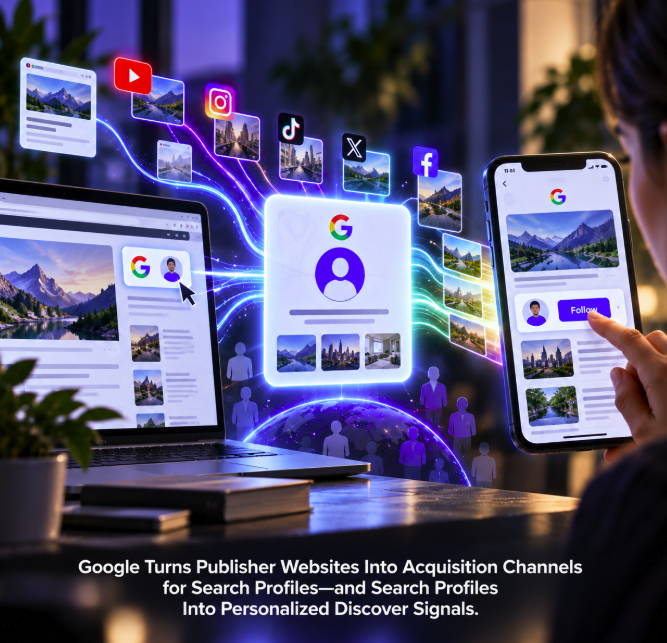

Google has documented a new loop between publisher websites, Search Profiles and personalized content distribution in Discover. Publishers and creators with a claimed Search Profile can now place an official Google badge—or a simple text link—on their own sites to send readers to a Google-hosted profile. Once a reader follows that profile, Google says the content connected to it becomes more likely to appear for that reader in Discover.
The new Search Central documentation, last updated September 16, turns the badge into more than an identity link. Google explicitly says a Search Profile brings together content from across the web and social platforms, and that following the profile makes linked content—such as the publisher’s website plus Instagram, TikTok, YouTube, X and Facebook content—more likely to appear for that audience on Google Discover.
That creates a two-way distribution system. A publisher can use traffic it already owns to acquire followers on a Google property, while Google can use that follow relationship to personalize what those users see later in Discover. The website becomes an acquisition channel for the Search Profile, and the Search Profile becomes a declared-interest signal that can influence future content exposure.
The badge links directly to a Google-hosted Search Profile
Google’s implementation is straightforward. After claiming a Search Profile, a publisher or creator can identify the profile URL using the pattern https://profile.google.com/@handle, download Google’s official Search Profile badge assets and add a standard HTML link around the badge.
Google also provides a simpler alternative for contexts where a graphical badge is unnecessary. Publishers can use a text link such as “Find us on Google Search” in article bylines, newsletters or bio links. That makes the profile promotable across several high-intent audience touchpoints rather than restricting it to a site footer or dedicated social-links page.
The documentation includes brand and accessibility requirements. Google recommends sufficiently large touch targets, preserving the integrity and colors of its official icon assets, and maintaining visual consistency when monochrome versions are used. It also distinguishes the Search Profile badge from Google’s Preferred Sources badge and advises publishers on how to display the two together without confusing their functions.
The important part happens after the reader clicks Follow
A profile badge by itself is simply a navigation element. The strategic value appears when a reader reaches the Search Profile and chooses to follow it.
Google says that following makes content linked on the Search Profile more likely to appear for that user in Discover. The wording is deliberately probabilistic: “more likely” is not a guarantee that every article, video or social post will enter the feed, and Google does not provide a numerical weighting for the follow relationship.
Even with that limitation, the documentation establishes a direct connection between an explicit audience action and personalized Discover eligibility. A reader can tell Google that a publisher or creator matters to them, and Google can use that relationship when deciding what to surface later.
This should not be confused with a general organic Search ranking signal. Google’s documentation describes a personalization effect in Discover for the audience that follows the profile. It does not say that adding a badge improves rankings for ordinary search queries or that follower counts boost a site globally.
One follow can connect a website and multiple social platforms
Search Profiles are designed as aggregation surfaces rather than website-only profiles. Google says they bring together content from across the web and social platforms into a single destination.
The September 16 Search Central page specifically names Instagram, TikTok, YouTube, X, Facebook and the publisher or creator’s website as examples of content linked to a profile. When a reader follows that Search Profile, the connected content can become more likely to appear in the reader’s Discover experience.
That broadens the value of the follow action. A publisher is not necessarily asking users to subscribe only to articles from its domain. It can be asking them to follow an entity whose content exists across formats and platforms, allowing Google to assemble a personalized stream from those connected sources.
For creators who publish video, social posts and articles under the same identity, that can make the Search Profile a cross-platform distribution hub. For publishers, it creates a reason to think about social-account connections as part of Google audience development rather than only as outbound links.
The publisher website becomes a funnel into Google’s identity layer
Historically, publishers have used Google to acquire audiences for properties they control. Search and Discover send traffic to websites, where publishers try to convert visitors into newsletter subscribers, registered users, paying members or app users.
The Search Profile badge reverses part of that flow. Google is now encouraging publishers to use their websites, bylines and newsletters to send readers into a Google-hosted profile and convert them into followers there.
That is not necessarily a bad trade. A Search Profile follower may create future distribution opportunities inside Discover that would not exist otherwise. But the relationship is structurally different from an email subscription. Google controls the interface, recommendation system and conditions under which the followed publisher’s content reappears.
The strategic question is therefore not whether publishers should abandon first-party subscriptions for Search Profile followers. They serve different purposes. The more interesting possibility is that audience teams may begin treating a Search Profile follow as another conversion event alongside newsletter signup, app install and social follow.
Search Profiles are becoming more than profile pages
Google introduced Search Profiles as dedicated destinations where publishers and creators can organize their identity and content inside Search. Recent updates suggest the product is evolving into a broader entity and distribution layer.
NetContentSEO recently reported that Google is expanding Search Profiles and confirms that profile information can feed Knowledge Panels. Google’s help documentation says details such as a profile’s name, bio and social links may be reflected in the corresponding Knowledge Panel, while Search Profiles themselves can provide a persistent Google-hosted destination for recent content and connected accounts.
The badge adds another component to that system: acquisition. Instead of waiting for users to discover a Search Profile through Google, publishers can actively promote it on properties where they already have attention.
The Discover connection then completes the loop. Website traffic can produce a Search Profile follower, and that follower relationship can make future website and social content more likely to reappear in the user’s personalized Google feed.
This is an explicit preference signal, not ordinary SEO authority
The distinction between a follow and a traditional ranking signal is important. Conventional SEO tries to make a page relevant and authoritative for users who may have no prior relationship with the publisher. Search Profile follows operate at the individual-user level.
A reader has explicitly indicated interest in a source. Google can then use that preference to personalize future recommendations for that person. The resulting visibility is therefore closer to audience retention than generic search acquisition.
That may change how publishers evaluate Discover performance. Instead of treating every impression as the product of a content-ranking system operating from scratch, some future impressions may reflect an existing declared relationship between the user and the source.
Google does not disclose how heavily a Search Profile follow is weighted against other Discover signals, and its documentation does not say that followed sources will dominate a user’s feed. The safe conclusion is narrower: following increases the likelihood of exposure for linked content.
Discover becomes a retention channel as well as an acquisition channel
Discover has traditionally been important because it can expose publishers to users without requiring a conventional search query. A strong recommendation can produce large bursts of traffic from audiences who may not have deliberately sought out the publication.
Search Profile follows add a retention dimension. If an existing reader follows the publisher, Discover can potentially help bring that person back to future content. The publisher is no longer relying only on Google predicting that the article will interest an unknown user; it has an explicit interest relationship available to the recommendation system.
This makes the feature conceptually closer to following a creator on a social network, although the resulting content is mixed into Discover rather than delivered through a dedicated following feed described in the Search Central documentation.
The development is especially notable because Google’s Discover footprint remains fluid. NetContentSEO recently documented that the previously announced desktop Discover rollout appears to have receded, even as Google continues investing in personalization and publisher-following features on supported Discover surfaces.
Cross-platform content makes entity consistency more valuable
If a Search Profile connects a website with YouTube, TikTok, Instagram, X and Facebook, publishers have a stronger incentive to keep identity signals consistent across those properties. Names, imagery, bios, ownership and account relationships all contribute to whether users understand that the content comes from the same source.
That does not mean Google has announced a new entity-ranking formula. It means the product itself is built around aggregating content under a claimed profile, so incorrect or incomplete connections can weaken the usefulness of the destination even before ranking is considered.
For larger media organizations, the challenge becomes more complex because one company may operate many publications, verticals, presenters and social accounts. Google has already introduced multi-account management capabilities for Search Profiles, suggesting that the system is intended to accommodate publishers with more complicated brand architectures.
Publishers can now test the badge as an audience-conversion element
The new documentation creates a practical experimentation opportunity. Publishers can place the Search Profile badge in locations where users already make subscription decisions—article bylines, author pages, newsletter templates, site headers or post-article modules—and measure whether readers engage with it.
Google does not currently provide a public SEO formula for valuing a Search Profile follower, so publishers should avoid treating follower acquisition as a guaranteed traffic investment. The sensible approach is to measure downstream effects where possible: growth in followers, Discover visibility, returning audiences and referral behavior.
Placement also matters. A badge competing with newsletter signup, membership prompts and social links may have an opportunity cost. Publishers should decide whether the Google follow is complementary to their first-party audience strategy or whether it is taking attention from a conversion they value more highly.
Google is building a publisher relationship that extends beyond the click
The broader significance is that Google is creating a persistent relationship between users and publishers inside Search. A traditional organic result is transactional: the user searches, clicks and leaves Google. A Search Profile follow can persist after the original visit and inform future personalized discovery.
That fits a wider evolution in Google’s content surfaces. Search is increasingly blending entity profiles, personalized feeds, social content and AI-generated discovery experiences rather than treating the open-web result page as the only destination.
For publishers, the opportunity is additional distribution. The tradeoff is that the relationship exists on Google’s platform and remains governed by Google’s recommendation systems. A follower is useful, but it is not equivalent to an email address or a direct subscription.
The badge turns Search Profiles into an audience-development product
The September 16 Search Central update looks small at first glance: Google published badge assets, a URL pattern and an HTML snippet. The consequential sentence is the one explaining what happens when the user follows.
Google now explicitly connects that action to a greater likelihood that the profile’s linked website and social content will appear in the follower’s Discover experience. That gives publishers a reason to promote Search Profiles proactively rather than treating them as passive identity pages that users encounter only through Search.
The resulting loop is unusually clear. Publishers can use their websites to acquire Google Search Profile followers. Search Profiles can aggregate the publisher’s website and social identities. Those follows can then become personalized Discover signals that increase the chance of future exposure to the same audience.
For SEO teams, that is not a new universal ranking factor. For audience-development teams, it may be something more interesting: a Google-native retention channel built on an explicit follow relationship.